


Table of Contents
- What Is Remote Staffing for Home Services?
- Benefits of Virtual Assistants for Trades
- Virtual Assistants for Home Service Businesses
- How to Implement Remote Staffing for Home Services
- Best Remote Staffing Agencies for Home Services
- Legal, Tax, and Compliance Considerations
- Common Mistakes to Avoid When Staffing Remotely
- Getting Started With Remote Staffing for Home Services
Last Updated: July 16, 2026
What Is Remote Staffing for Home Services?
Remote staffing for home services means replacing traditional in-house administrative roles with trained, managed virtual professionals who specialize in home service industry workflows. Rather than hiring full-time staff, home service businesses use pre-qualified remote professionals to handle dispatching, estimating, customer service, and office management from remote locations.
The critical difference from generic virtual assistant services is industry expertise. A remote dispatcher who understands emergency calls, service estimates, and contractor terminology will deliver far better results than a generic VA without that background. This specialized knowledge is non-negotiable.
According to research from Bureau of Labor Statistics workforce trends, remote work arrangements have fundamentally changed hiring patterns across service industries. Remote staffing works because the administrative backbone, scheduling, customer communication, billing, and lead qualification, doesn’t require on-site presence. Technicians still visit customer locations; office staff work from anywhere.
Remote staffing for home services means replacing traditional in-house administrative roles with trained, managed virtual professionals who specialize in home service industry workflows.
Benefits of Virtual Assistants for Trades
Cost Savings and Overhead Reduction
Hard Hat Helpers clients report cutting administrative overhead by over 50% compared to hiring local, in-house staff. A typical scenario: a mid-size plumbing company spending $50,000 annually on a full-time office manager can move that role to a remote professional for $24,000-$30,000 annually, with the staffing company handling payroll, benefits, and performance management.
Beyond salary, you eliminate office space, equipment, benefits administration, payroll taxes, and management overhead. You don’t need larger offices, backup staff for vacation coverage, or workers’ compensation claims for office roles.
Calculate your true cost of an in-house employee: salary + benefits (25-30%) + payroll taxes (7.65%) + office overhead allocation. Most home service businesses discover remote staffing costs 40-55% less than the all-in number.
24/7 Availability and Scalability
Home service emergencies don’t follow 9-to-5 schedules. With remote staffing, you can staff dispatch and customer service across time zones, extending coverage without paying night shift premiums. During peak seasons you scale up; during slow periods you scale down.
Hard Hat Helpers clients see 15-20% improvement in first-call answer rates simply because dispatch support is available during extended hours. The quality improves too, because your remote team knows your service offerings, pricing, and scheduling system inside out.
Focus on Core Business Operations
When your office manager is a reliable remote professional, you stop managing administrative problems. You stop worrying about coverage, scheduling conflicts, and vacation requests for back-office staff. This mental bandwidth matters, contractors spend less time on operations and more time on business development, customer relationships, and strategic planning.
Virtual Assistants for Home Service Businesses
Dispatchers and Call Center Support
The dispatcher role is the operational heartbeat of any home service business. A skilled dispatcher manages customer calls, schedules technician routes, handles emergency requests, and serves as the first voice customers hear. This role translates exceptionally well to remote staffing because it requires no on-site presence, doesn’t require in-person customer interaction, and performance is measurable.
A remote dispatcher with home services experience will outperform a local hire without that background. Hard Hat Helpers trains remote dispatchers on your service offerings, pricing, technician availability, and scheduling system. Within two weeks, customers won’t notice they’re talking to someone remote, they’ll just notice faster call answers and more accurate scheduling.
Call center support extends beyond dispatching to lead qualification, appointment confirmation, follow-up calls, and customer service callbacks. These roles work perfectly remotely but require training, consistency, and accountability.
Avoid hiring generic call center staff without home services training. They’ll cost less but generate more customer friction, missed scheduling details, and service errors that cost far more than salary savings.
Estimators and Sales Coordinators
Estimators present a nuanced opportunity. While in-person estimate visits still require technicians on-site, pre-estimate and post-estimate coordination works perfectly remotely. A remote estimator coordinator qualifies leads, gathers initial information, schedules visits, and follows up with quotes and paperwork.
Some companies successfully move the entire estimating role remote using video consultations for smaller jobs or preliminary assessments. HVAC companies assessing furnace replacements, plumbing companies evaluating water heater issues, and electrical companies diagnosing panel problems can often provide accurate estimates through detailed video calls and photos.
The sales coordinator role is almost entirely suited to remote work: following up on estimates, sending proposals, answering specification questions, scheduling callbacks, and managing the sales pipeline. A dedicated remote sales coordinator typically increases close rates by 10-15% through consistent, timely follow-up.
Office Managers and Administrative Staff
The office manager role is perhaps the most obvious candidate for remote staffing. Managing invoicing, accounts receivable, scheduling, customer communication, vendor coordination, and administrative tasks requires no on-site presence and benefits from someone who understands home service workflows.
A remote office manager handles accounts payable and receivable, processes customer payments, manages scheduling conflicts, coordinates with technicians, handles customer complaints, and keeps the business running smoothly. This role creates the most noticeable improvement in business operations when done well.
How to Implement Remote Staffing for Home Services
Define Your Staffing Needs and Roles
Start by documenting your current administrative workflow. Where does your office manager spend time? What tasks consume your own time or your technicians’ time that could be handled by administrative staff? Where do you have gaps in coverage?
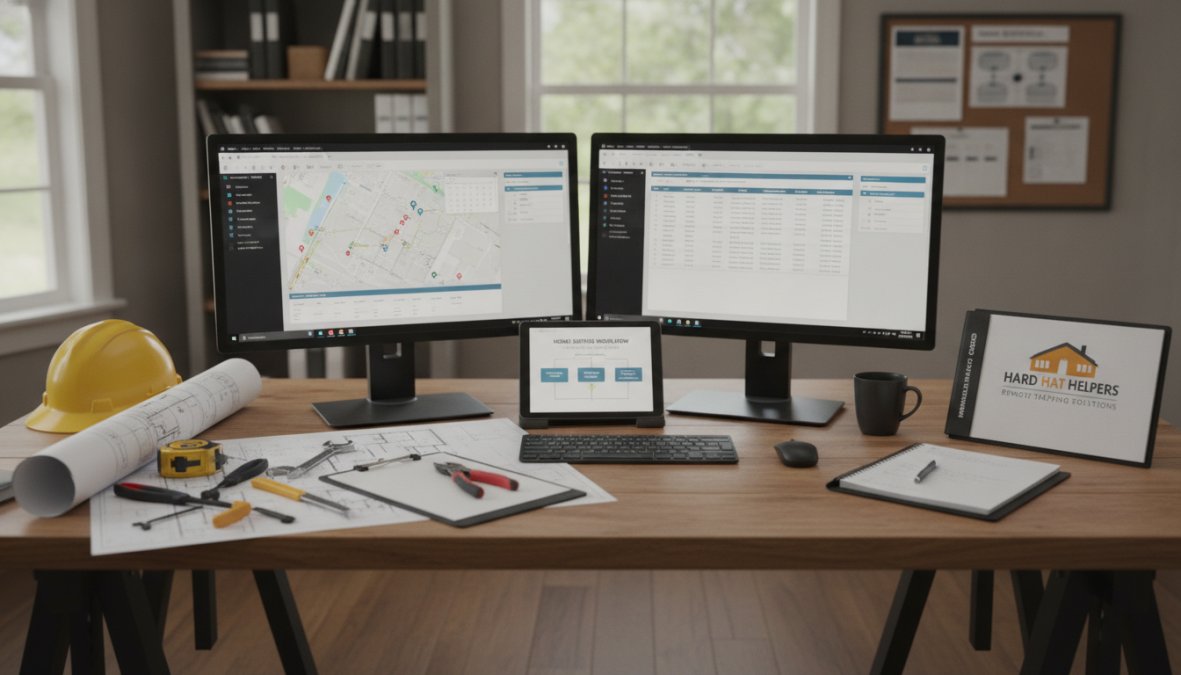
Create detailed job descriptions for each role you want to fill remotely, including specific responsibilities, required knowledge (software systems, service offerings, pricing), and performance metrics. Be realistic about volume: a small company with 3-4 technicians might need a half-time dispatcher and quarter-time office manager; a mid-size company with 15+ technicians might need a full-time dispatcher, full-time office manager, and part-time estimator coordinator.
Set Up Remote Infrastructure and Tools
Your remote team needs access to the same systems your in-house staff would use: phone system, scheduling software, CRM, accounting platform, and other business tools. Most modern business software is cloud-based and accessible from anywhere, but you’ll need proper access controls and security protocols.
Hard Hat Helpers handles technical integration, connecting your remote team to your phone system, scheduling software, CRM, and payment processing systems while managing authentication, security protocols, and ongoing technical support.
Develop Onboarding and Training Workflows
This is where specialized remote staffing differs from generic VA services. Your remote team needs training on your specific business, service offerings, pricing, typical customer scenarios, technician capabilities, and scheduling constraints.
A well-designed onboarding process takes 2-4 weeks. Week one covers business fundamentals: services, pricing, target customers, and brand promise. Week two covers systems and processes: phone system, scheduling software, customer communication. Week three covers scenario training: handling common customer questions, scheduling complex jobs, managing emergencies. Week four involves shadowing and live support with real-time feedback.
Assign an internal point person for onboarding who can answer questions about your specific business, review work, and provide feedback. This accelerates integration and ensures your remote team understands your company culture and standards.
Establish Performance Management Systems
Define what success looks like for each role: for a dispatcher, that might be call answer time under 2 minutes, 98% scheduling accuracy, and customer satisfaction above 4.5/5. For an office manager, that might be all invoices processed within 48 hours, zero missed payment deadlines, and 95% billing accuracy.
Hard Hat Helpers provides continuous performance monitoring with dashboards and regular check-ins. Weekly 15-minute calls maintain alignment and catch problems early. Monthly reviews ensure satisfaction and clear expectations.
Best Remote Staffing Agencies for Home Services
Industry-Specialized Providers vs. General Staffing Agencies
General staffing agencies and VA platforms offer lower costs but lack home services expertise. You’ll spend weeks training a generic virtual assistant on industry basics. They won’t understand emergency call urgency, estimate complexity, or seasonal business fluctuations.
Industry-specialized providers like Hard Hat Helpers focus exclusively on home services. Your remote team arrives already trained on the industry, understanding workflows, and ready to integrate quickly. The trade-off is slightly higher cost, but the value comes in faster onboarding, better performance, and lower management overhead.

Comparison of Service Models and Pricing
Remote staffing companies operate under different models:
Placement Model: You pay a one-time fee ($500-$2,000) to be matched with a candidate, then hire them directly. You manage payroll, benefits, and performance. Lower upfront cost, but you assume all employment responsibilities.
Managed Services Model: You pay a monthly fee for a dedicated remote professional. The staffing company employs them, handles payroll and benefits, manages performance, and replaces them if needed. Higher cost, but significantly less administrative burden.
Hybrid Model: Flexible arrangements where you scale hours up or down with transparent hourly rates and minimal commitment.
For home services businesses, the managed services model typically delivers better results. You avoid employment complexity, get dedicated professionals trained on your business, and have a partner managing performance and accountability.
| Service Model | Upfront Cost | Monthly Cost | Your Responsibility | Best For |
|---|---|---|---|---|
| Placement | $500-$2,000 | Direct salary | Payroll, benefits, management | Companies comfortable managing remote staff |
| Managed Services | $0-$500 | $2,500-$5,000+ | Performance expectations | Companies wanting minimal HR overhead |
| Hybrid/Flexible | $0 | Hourly + fee | Task assignment | Companies with variable workload |
Hard Hat Helpers pricing depends on role, experience level, and your specific needs. Contact Hard Hat Helpers for a customized quote.
Legal, Tax, and Compliance Considerations
Remote staffing introduces legal and tax considerations that vary by location and staffing model.
Employment Classification: If you hire remote staff directly, they’re employees, and you’re responsible for payroll taxes, workers’ compensation insurance, and labor law compliance. If you use a managed staffing service, the staffing company employs the remote staff, and you’re purchasing services.
State and Local Regulations: Some states have specific rules about remote workers, particularly around tax withholding and unemployment insurance. If you hire a remote employee in a different state, you may have tax obligations in that state.
Data Security and Confidentiality: Your remote team will access customer information, pricing data, and business systems. You need clear agreements about data security, confidentiality, and data handling if the remote worker leaves.
Contract Terms: Clear contracts protect both parties. Define responsibilities, performance expectations, termination conditions, and customer data handling.
Hard Hat Helpers handles these compliance issues. We employ remote staff, manage payroll taxes, carry appropriate insurance, and maintain data security protocols. For companies hiring remote staff directly, consult with an accountant or employment attorney about your specific situation.
Don’t assume remote staff are contractors rather than employees to avoid payroll taxes. The IRS and state labor boards have specific contractor classification criteria, and misclassifying employees creates significant liability.
Common Mistakes to Avoid When Staffing Remotely
Hiring Without Clear Role Definition: Vague job descriptions lead to mismatched expectations. Define exactly what you need, what systems they’ll use, and what success looks like.
Skipping Onboarding and Training: Minimizing training backfires. Remote staff who don’t understand your business, systems, or standards will make costly mistakes. Budget 2-4 weeks of structured onboarding.
Inadequate System Integration: Remote staff who can’t access needed systems will create workarounds that compromise security or accuracy. Ensure proper access from day one.
Poor Communication and Feedback: Remote staff need regular feedback and clear communication. Weekly check-ins and monthly reviews prevent small issues from becoming big problems.
Treating Remote Staff as Disposable: Invest in their development and retention. Treat remote professionals as valued team members.
Insufficient Performance Monitoring: Define clear metrics for each role and track them consistently. Review performance monthly and address issues immediately.
Ignoring Industry-Specific Expertise: Hiring generic virtual assistants and expecting them to learn your industry on the job is inefficient. Invest in remote staff who already understand home services workflows.
Getting Started With Remote Staffing for Home Services
Step 1: Document Your Needs
Understand exactly what administrative tasks consume your time or your team’s time. Where are your bottlenecks? When are you scrambling for coverage?
Step 2: Define Your Roles
Create detailed job descriptions for positions you want to fill remotely, including specific responsibilities, required knowledge, and performance metrics.
Step 3: Choose Your Staffing Partner
Evaluate whether you want to hire directly (placement model) or use a managed service. For most home service businesses, managed services deliver better results.
Step 4: Plan Your Integration
Before your remote staff starts, ensure your systems are ready. Test access and troubleshoot technical issues before day one.
Step 5: Commit to Onboarding
Budget 2-4 weeks for structured onboarding. This investment pays dividends in performance and retention.
Step 6: Monitor and Adjust
Track performance metrics, conduct regular check-ins, and adjust as needed.
Remote staffing for home services solves a persistent problem: administrative overhead that drains profits and distracts from growth. Hard Hat Helpers specializes in providing remote professionals trained specifically for home services, integrated directly into your systems, and managed with continuous performance monitoring. You get dedicated administrative support that cuts overhead by over 50%, frees your time for business development, and scales with your business. Book a consultation with Hard Hat Helpers today to explore how remote staffing can transform your operations.
Frequently Asked Questions
What types of roles can be remotely staffed in home services?
Common remote roles include dispatchers who manage customer calls and technician routing, estimators who prepare quotes and proposals, office managers handling scheduling and payroll, and customer service representatives managing follow-ups. Remote staffing for home services works best for administrative, customer-facing, and back-office positions that don't require on-site presence. Specialized training on your products and service offerings ensures remote staff integrate seamlessly into your operations.
How much can I save with remote staffing for home services?
Many home service businesses report overhead cost reductions of 50% or more by using remote staffing instead of hiring in-house employees. Savings come from eliminating office space, equipment, benefits administration, payroll taxes, and management overhead. Pricing depends on staffing quantity, experience level, and service model, whether you use a managed agency, hire directly, or use a hybrid approach. Contact staffing providers for current pricing quotes tailored to your needs.
What software and tools are essential for managing a remote home services team?
Key tools include communication platforms (Slack, Teams), project management software (Asana, Monday.com), time tracking and attendance monitoring systems, CRM software for customer data, and industry-specific dispatch or scheduling tools. Security is critical, ensure tools comply with data protection standards. Many remote staffing agencies provide their own workspace apps and monitoring dashboards, reducing setup complexity and ensuring your remote staff can access necessary systems securely.
How do I ensure compliance and security with remote staffing for home services?
Work with staffing agencies that handle payroll, tax withholding, and benefits management to reduce your compliance burden. For cross-border remote staffing, understand tax implications and employment laws in relevant jurisdictions. Implement security protocols including background checks, data encryption, access controls, and confidentiality agreements. Dedicated staffing providers specializing in home services typically manage these requirements, including SOC 2 and HIPAA compliance where applicable, allowing you to focus on business growth.