


Table of Contents
- Why Hire a Virtual Home Service Estimator
- Virtual Home Service Estimating Software vs. Remote Staff
- Understanding the Virtual Estimator Job Description
- Best Practices for Virtual Site Visits and Remote Estimation
- Top Tools and Platforms for Virtual Home Service Estimating
- Outsourcing Home Service Quotes: Staffing Solutions and Training
- Legal, Liability, and Data Security Considerations
- How to Hire a Virtual Home Service Estimator: Step-by-Step
How to Hire a Virtual Home Service Estimator
Last Updated: July 15, 2026
Home service businesses that adopt virtual estimation reduce quote turnaround time from 5-7 days to 24-48 hours, directly improving conversion rates. This shift from field-dependent to remote-capable estimation has become essential for competitive advantage.
Why Hire a Virtual Home Service Estimator
Virtual estimation eliminates the bottleneck of field visits for every estimate: customers wait days for availability, estimators spend hours driving between jobs, and your conversion window closes while competitors present bids. Remote estimators work from anywhere, handle multiple estimates simultaneously, and use video walkthroughs, photos, and measurement tools to generate accurate quotes without site visits for initial scoping.
Overhead costs drop significantly, many businesses report 50% reductions in administrative expenses by outsourcing estimation. You gain flexibility to scale seasonally without managing full-time payroll and benefits. Faster quote delivery increases close rates, and virtual estimation creates a documented trail of photos, measurements, and scope documents that reduces disputes and liability.
Hire a virtual home service estimator before your busy season, not during it. Onboarding takes 2-4 weeks, so plan ahead to avoid scrambling when leads pile up.
Virtual Home Service Estimating Software vs. Remote Staff
Most successful home service businesses use a hybrid approach, software handles straightforward estimates, while remote estimators manage complex or high-value projects.
When to Use Estimating Software
Estimating software works when projects follow predictable patterns. A pressure washing company can quote based on square footage and surface type. Tools like QuoteIQ analyze property photos and local pricing data, generating market-accurate estimates in minutes without human intervention.
Advantages: zero labor cost per estimate, instant turnaround, and consistency. Disadvantages: inflexibility with complex projects, custom requests, or situations requiring professional judgment. Software candidates are businesses with high-volume, standardized work: HVAC maintenance, plumbing service calls, landscaping, or pressure washing. If 70% of your estimates follow a repeatable pattern, software can handle that automatically.
Specialized tools like Hover generate precise 3D measurements from smartphone photos for roofing and exterior work. Jobber and Housecall Pro offer mobile-friendly quoting workflows for field technicians.
When to Hire Remote Estimators
Hire a virtual home service estimator when projects are complex, high-value, or require judgment calls. A general contractor managing a $100K renovation needs a professional estimator who understands scope creep, change orders, and client communication. Remote estimators excel at relationship building through discovery conversations and expertise.
The trade-off is cost. A remote estimator costs $150-400 per estimate depending on complexity. This works when your average project value justifies that cost.
| Approach | Best For | Setup Time | Cost Per Estimate | Scalability |
|---|---|---|---|---|
| Estimating Software | High-volume, standardized work | 2-4 weeks | $0-5 | Instant |
| Remote Estimators | Complex, high-value projects | 3-6 weeks | $150-400 | Slower (hiring cycles) |
| Hybrid Model | Mixed project complexity | 4-8 weeks | $50-200 average | Flexible |
Understanding the Virtual Estimator Job Description
Define exactly what you need before hiring. A virtual estimator in roofing needs specific skills: pitch calculations, local building codes, material costs, and ability to interpret satellite imagery. A virtual estimator for general contracting needs different skills: strong communication, discovery questioning, scope documentation, and ability to handle objections.
Core responsibilities typically include:
Intake and Qualification. Review lead information, ask clarifying questions, and determine project fit.
Remote Site Assessment. Conduct video walkthroughs, measure spaces using photos or customer measurements, and document scope through notes, photos, or video.
Estimate Preparation. Use your pricing templates, cost databases, and labor rates to build detailed quotes.
Customer Communication. Follow up with quotes, answer questions, address concerns, and guide customers toward saying yes.
CRM Management. Log all interactions, update lead status, attach documents, and maintain data integrity.
Specify your tools, pricing authority, approval process, and expected turnaround time.
The most common hiring mistake is vague expectations. Define what “accurate estimate” means, which tools to use, and what turnaround time you expect upfront.
Best Practices for Virtual Site Visits and Remote Estimation
Virtual estimation only works if you capture the right information during remote assessment.
Video Walkthrough Techniques
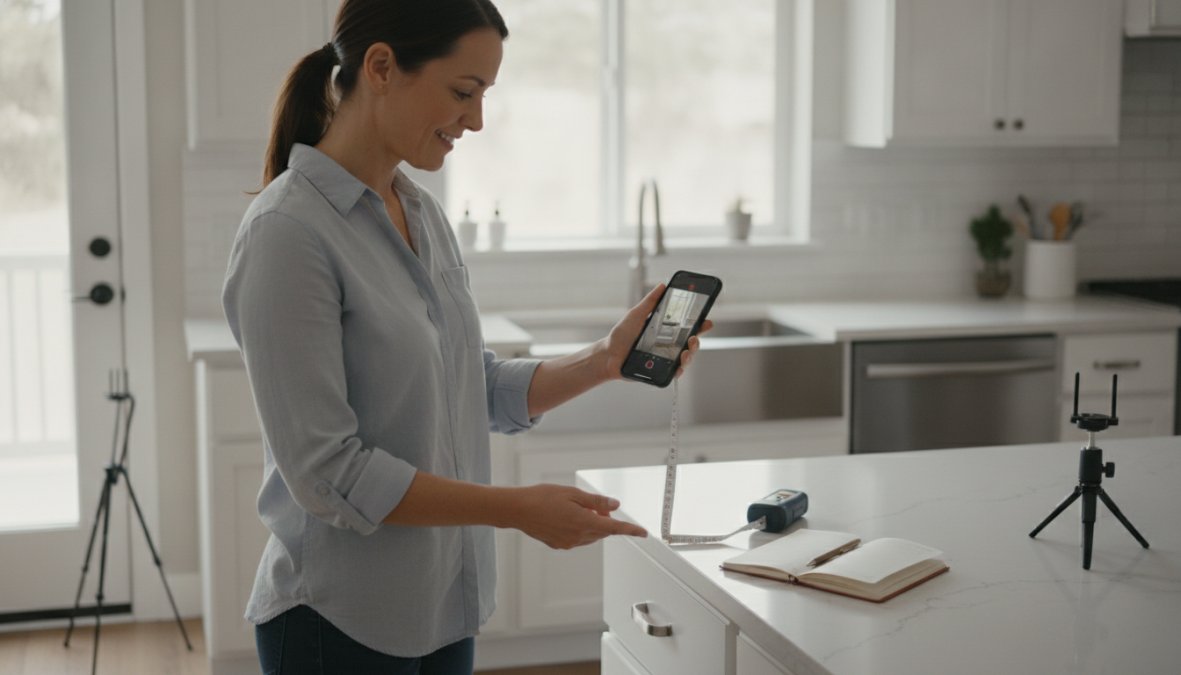
A video walkthrough provides spatial context, scale, and how elements relate. Start with good lighting, natural daylight is best. Have customers film a wide shot of the entire space, then zoom in on specific areas needing work. Encourage slow movement and narration: "This is the kitchen, and the cabinet under the sink has water damage from the leak last month."
Establish a measurement protocol. Have customers measure key elements: counter length, ceiling height, wall dimensions. Photo-based tools like Hover generate precise dimensions from smartphone photos, but work best for exterior projects.
Document scope clearly with a checklist specific to your trade: for flooring, that’s subfloor condition, existing material, dimensions, and obstacles. The checklist ensures your estimator gets everything needed without follow-up questions.
Customer Questionnaire and Scope Documentation
A well-designed questionnaire prevents scope creep and misunderstandings. Start with basics: project type, timeline, budget range, and decision-making process. Then get specific to your trade. For a kitchen remodel, ask about cabinet style, countertop material, appliance brands, and layout preferences.
Ask about constraints: pets, children, noise restrictions, whether customers need to remain in the space. Ask for visual references: "Show me examples of the kitchen style you like."
Document site-specific challenges: limited parking, HOA restrictions, historic district designation, accessibility requirements. The questionnaire creates a paper trail that protects your business and clarifies expectations.
Top Tools and Platforms for Virtual Home Service Estimating
AI-Powered Estimating Solutions
QuoteIQ analyzes property photos and local pricing data to generate market-accurate estimates automatically. For high-volume work like pressure washing, landscaping, and roofing inspections, this eliminates manual takeoff work. Speed is the advantage, upload a photo and get a quote within minutes.
Xactimate is the industry standard for restoration and insurance work. It’s the most comprehensive cost database available, making your estimates intelligible to adjusters and insurance companies. The learning curve is steep, but accuracy is unmatched for complex damage assessment.
Field Service Management Platforms
Jobber and Housecall Pro integrate estimating into complete workflows: lead management, scheduling, invoicing, and customer communication. Jobber’s strength is user-friendly interface for field technicians. Housecall Pro emphasizes customer communication through integrated messaging.
Specialized Measurement and Documentation Tools
Hover is the best tool for exterior projects requiring precision measurements. Upload smartphone photos of a roof and Hover generates a 3D model, precise measurements, and material quantity estimates. Accuracy typically matches on-site verification within 1-2%.
Clear Estimates serves remodeling contractors with pre-built project templates and current cost data, faster than Xactimate for simpler projects.
Outsourcing Home Service Quotes: Staffing Solutions and Training
You have three paths: hire directly, use a staffing agency, or work with a specialized virtual assistant service.
Onboarding and Training Virtual Estimators
Direct hire gives you the most control but requires the most effort. You’re responsible for recruitment, onboarding, benefits, payroll, and performance management. Onboarding takes 3-6 weeks: weeks one and two focus on tools and systems; weeks three and four focus on your business, service offerings, and quality standards; weeks five and six involve supervised estimates with your review.
Staffing agencies handle recruitment and initial training while managing payroll, benefits, and compliance. You get a pre-vetted estimator trained on remote estimation best practices. The trade-off is less customization.
Freelance estimators offer maximum flexibility with no ongoing commitment. The risk is consistency, different estimators may deliver different quality.
When onboarding any virtual estimator, pair them with your best salesperson for the first two weeks. Have them listen to how your top performer conducts discovery and handles objections.
Integration with Your CRM and Existing Workflows
A virtual estimator is only as effective as their access to your systems. They need your CRM, estimating software, pricing database, and document templates. Document your workflow explicitly: how leads come in, what information to collect, when estimates should be sent, and how follow-up works.
The best integration happens when your estimator has visibility into your entire pipeline. They should see which customers are already in your system and their history, helping them tailor their approach and identify upselling opportunities.
Legal, Liability, and Data Security Considerations
Hiring a virtual home service estimator introduces legal and operational risks you need to address upfront.
Licensing and Compliance. Some states require estimators to hold specific licenses or certifications. Check your state and local regulations.
Liability and Insurance. Your business insurance should cover estimator errors, but verify this with your insurance agent. Clarify whether your estimator needs to be bonded.
Independent Contractor vs. Employee. If you hire directly, the IRS has specific rules about classification. Consult a CPA or employment attorney if uncertain.
Data Security and Privacy. Your estimators access customer information: names, addresses, phone numbers, and photos of homes. Use a password manager, enable two-factor authentication, and establish policies about information access.
Video Recording and Privacy. Some states require consent before recording inside homes. Establish a clear policy that customers must consent to video recording and understand how it will be used.
Estimate Accuracy and Liability. Your estimate is a contract offer. If you quote a job at $5,000 and the customer accepts, you’re generally obligated to complete it at that price. Document your estimation process and assumptions.
How to Hire a Virtual Home Service Estimator: Step-by-Step
Define Your Estimation Needs
Audit your current estimation process. How many estimates do you create per month? How long does each take? What’s your close rate? What’s the average project value?
These metrics tell you whether you have a capacity problem or a quality problem. Document your volume by project type to understand what expertise your estimator needs.
Estimate the financial impact. If you’re losing 30% of leads because estimates take too long, how much revenue is that? Compare this against the cost of hiring a remote estimator.
Choose Your Approach: Software, Staffing, or Hybrid
If your work is high-volume and standardized, software-first is right. If your work is complex and high-value, hire a remote estimator. If you’re uncertain, start with software for 30 days to see how many estimates it handles accurately.
If you decide to hire, choose your staffing model: direct hire for deep customization, agency for minimal operational burden, or freelance for flexibility.
Evaluate Providers and Set Performance Metrics
If using an agency, request a consultation to understand their process, pricing, and guarantees. If hiring directly, post your job description where home service professionals congregate and look for candidates with experience in your trade.
Define success metrics before they start: estimate accuracy, customer satisfaction, turnaround time, error rate, and communication speed. Review performance monthly for the first three months.
Frequently Asked Questions
What does a virtual home service estimator do?
A virtual home service estimator reviews property photos, videos, customer questionnaires, and measurements to create accurate project quotes without visiting the site in person. They analyze scope of work, calculate material and labor costs, and prepare professional estimates that help close sales. Virtual estimators can work as remote staff, use specialized software, or combine both approaches to streamline your lead generation and sales pipeline.
How do I choose between hiring remote staff and using virtual home service estimating software?
Hiring remote estimators works best if you handle complex, high-value projects requiring judgment and client communication. Estimating software suits high-volume, standardized jobs where speed and consistency matter most. Many contractors use both: software for quick initial quotes and remote staff for detailed, custom estimates. Consider your project complexity, team size, and conversion rate goals when deciding.
What are the best practices for virtual site visits in home service estimation?
Effective virtual site visits rely on clear video walkthroughs, detailed customer questionnaires, and precise measurement tools. Ask clients to film multiple angles, capture dimensions, and document existing conditions. Provide a checklist so customers capture all necessary details. Use measurement apps or AI photo analysis to extract dimensions from images. Document the scope of work in writing to prevent misunderstandings and ensure accurate project quotes.
What should I look for in a virtual estimator when outsourcing home service quotes?
Look for estimators with experience in your specific trade (HVAC, roofing, plumbing, remodeling, etc.), familiarity with your pricing models, and strong attention to detail. Verify they understand local market conditions, can use your preferred estimating software, and communicate clearly with customers. Consider providers offering dedicated support, continuous performance monitoring, and training on your products and services to ensure seamless integration into your workflow.