




Table of Contents
- Average Hourly Rates and Monthly Salary Models for Virtual Assistants
- Full-Time vs. Part-Time VA Costs: What Affects Your Budget
- Virtual Assistant Hourly Rates by Country: Geographic Impact on Pricing
- Freelance vs. Agency: Comparing Pricing Models and Hidden Costs
- How to Hire a Virtual Assistant for Small Business: Cost-Effective Strategies
- Virtual Assistant Contract Template and Interview Questions: Protecting Your Investment
- Hidden Costs and Total Cost of Ownership When Hiring a Virtual Assistant
- Industry-Specific Rate Benchmarks and ROI Calculation Framework
Last Updated: July 5, 2026
Understanding the cost of hiring virtual assistants is critical for business owners planning operational budgets. Virtual assistant pricing varies dramatically based on location, experience level, employment model, and service type. This guide breaks down every component of VA hiring costs and shows you how to calculate your actual return on investment.
Average Hourly Rates and Monthly Salary Models for Virtual Assistants
Virtual assistant costs split into two primary compensation structures: hourly rates and fixed monthly salaries.
US-Based Virtual Assistant Rates
US-based virtual assistants typically charge $25 to $75 per hour depending on experience and specialization. Entry-level VAs start around $20-30/hour, mid-level professionals command $40-60/hour, and senior VAs with specialized skills often charge $60-75/hour or more. For full-time dedicated positions, US-based virtual assistants typically earn $3,000 to $6,500 per month, translating to roughly $18-32/hour for a 40-hour week. The advantage is language fluency, cultural familiarity, and alignment with your business hours, critical for client-facing roles.
Many home services companies hire a US-based VA for dispatching and customer communication paired with an offshore VA for data entry and scheduling, cutting costs by 30-40% while maintaining service quality.
Offshore Virtual Assistant Pricing
Offshore virtual assistants from the Philippines, India, and Eastern Europe charge significantly less: typically $5-20 per hour. Philippines-based VAs average $8-15/hour, Indian VAs range $6-18/hour, and Eastern European VAs typically cost $12-25/hour. Monthly salary models for offshore talent range from $800 to $2,500 per month for full-time positions. However, offshore VAs require 20-30% more management time than US-based staff, which partially offsets hourly savings.
Full-Time vs. Part-Time VA Costs: What Affects Your Budget
Your employment model determines not just hourly rates, but total cost structure including benefits, taxes, and management expenses.
Full-Time Dedicated Virtual Assistants
A full-time VA working 40 hours per week costs between $36,000 and $78,000 annually before payroll taxes, benefits, and management overhead. If using an agency, expect 20-40% higher costs due to onboarding, training, and performance monitoring.
Most businesses underestimate true cost by forgetting payroll taxes (7.65% FICA plus state unemployment insurance), equipment and software licenses, training and onboarding (typically 40-80 hours), management time (typically 5-10 hours per week), and turnover costs if the relationship doesn’t work out.
Part-Time and Project-Based Arrangements
Part-time VAs working 10-20 hours per week are ideal for variable workload or testing whether outsourcing makes sense. Part-time rates are typically 15-25% higher per hour than full-time rates due to administrative overhead. Project-based arrangements offer maximum flexibility, with rates typically running 20-40% higher than hourly rates to account for scoping and project setup.
For most small home services businesses, starting with 15-20 hours per week of part-time VA support (approximately $2,000-3,500/month) is the sweet spot.
Virtual Assistant Hourly Rates by Country: Geographic Impact on Pricing
Geographic location is the single largest driver of VA pricing. A $50/hour US-based VA doing the same work as a $12/hour Philippines-based VA represents a 4x cost difference, but the US-based VA works in your time zone, requires minimal supervision, and handles complex client communication without errors.
Philippines-based VAs dominate the offshore market with rates from $8-15/hour and strong English proficiency. India offers the widest range ($6-18/hour) depending on whether you hire through a platform or specialized agency. Eastern Europe (Poland, Romania, Ukraine) charges $12-25/hour but offers cultural and language advantages for European-based businesses.
The practical reality: location matters less than the specific person you hire. An excellent Philippines-based VA at $12/hour outperforms a mediocre US-based VA at $40/hour.
Hiring offshore talent through freelance platforms without agency support creates significant risk: no recourse if the person disappears, no backup coverage, no performance guarantees, and hidden costs in management and turnover.
Freelance vs. Agency: Comparing Pricing Models and Hidden Costs
Your choice between hiring a freelancer directly and using an agency dramatically affects both cost and risk profile.
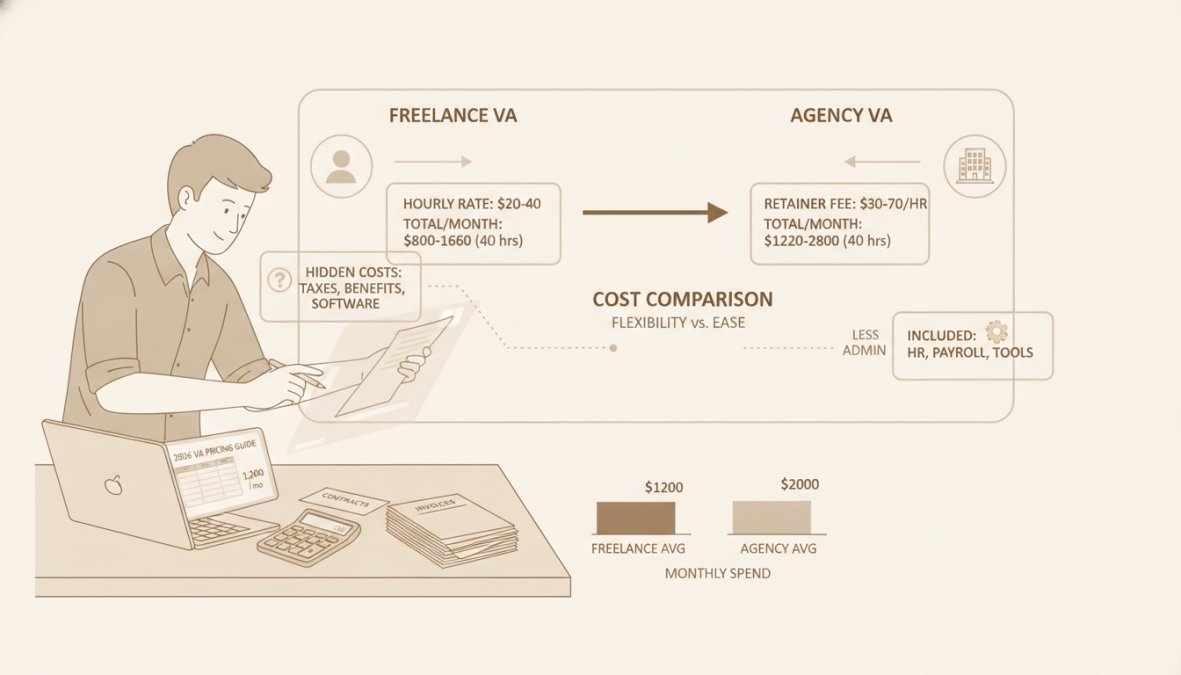
Freelance Virtual Assistants
Hiring a freelancer directly through platforms like Upwork or Fiverr gives you the lowest per-hour cost, typically $10-50/hour. However, you’re responsible for vetting, onboarding (40-80 hours), performance management (5-10 hours per week), backup coverage, and handling disputes. Freelancers juggle multiple clients simultaneously, so your work competes with others’ deadlines. Turnover is high, with experienced freelancers moving within 12-18 months.
Agency-Managed Virtual Assistants
Agencies charge a markup (typically 30-50% above base rate) but handle all management, training, performance monitoring, and backup coverage. You pay $30-80/hour for a service including thorough vetting, onboarding, continuous monitoring, backup coverage, payroll administration, and a dedicated account manager.
| Hiring Model | Hourly Rate | Setup Time | Management Time | Turnover Risk | Best For |
|---|---|---|---|---|---|
| Freelancer Platform | $15-40/hr | 10-20 hrs | 5-10 hrs/week | High (12-18 mo) | Simple, documented tasks |
| Direct Hire (US) | $25-75/hr | 40-80 hrs | 5-10 hrs/week | Medium (2-3 yrs) | Full-time, complex work |
| Agency Managed | $30-80/hr | 5-10 hrs | 1-2 hrs/week | Low (24+ mo) | Mission-critical roles, fast scaling |
How to Hire a Virtual Assistant for Small Business: Cost-Effective Strategies
Building a realistic budget requires understanding both direct costs and hidden expenses.
Defining Your Budget and Scope
Track how many hours per week you spend on administrative work someone else could handle: scheduling, email management, data entry, invoicing, customer follow-up, social media posting, and basic bookkeeping. Be honest about complexity, simple data entry is easily outsourced; complex client communication requires significant training.
For a small home services business, plan to spend:
- Part-time support (15-20 hrs/week): $2,000-3,500/month
- Full-time support (40 hrs/week): $3,500-6,500/month (US-based) or $1,500-2,500/month (offshore)
- Agency-managed support: add 30-50% to the above figures
Evaluating Total Cost of Ownership
True cost extends beyond hourly rates. Calculate total cost of ownership by adding direct costs (base compensation, payroll taxes, software licenses, equipment) and indirect costs (your management time, training and onboarding, quality control, backup coverage, turnover costs).
Example TCO Calculation:
- US-based part-time VA: 15 hours/week at $35/hour = $27,300/year
- Payroll taxes (15.3%): $4,178/year
- Software and tools: $1,200/year
- Your management time (5 hrs/week at $50/hr): $13,000/year
- Training and onboarding (60 hours at $50/hr): $3,000/year
- Total TCO: $48,678/year or $4,056/month
If the VA handles 15 hours per week of work worth $50/hour, you’re saving $39,000/year in freed-up time. The net benefit is positive $30,322 in year two.
Calculate your personal hourly rate (annual revenue ÷ annual hours worked). If it’s $75/hour and you spend 10 hours per week on administrative work, outsourcing to a $30/hour VA saves you $45/hour, a $23,400 annual benefit.
Virtual Assistant Contract Template and Interview Questions: Protecting Your Investment
A proper contract and thorough interview process protect both you and the VA.
Essential Contract Elements
Your agreement should specify scope of work (list specific responsibilities clearly), compensation (hourly rate, payment schedule, overtime handling), hours and availability, confidentiality requirements, performance standards, termination notice period, and intellectual property ownership.
Key Virtual Assistant Interview Questions
Ask candidates: "Walk me through a time you had to learn a new software system quickly," "Describe your experience with [specific software your business uses]," "How do you handle a situation where you’re unsure how to complete a task?", "Tell me about a time you made a mistake and how you handled it," and "How do you stay organized when managing multiple projects with different deadlines?"
Ask candidates to complete a small test task (30-60 minutes) that mimics actual work: organizing data, drafting an email response, or scheduling tasks.
Hidden Costs and Total Cost of Ownership When Hiring a Virtual Assistant
Most business owners budget only for hourly rates and miss expenses that add 30-50% to total cost.
Onboarding and Training Expenses
Bringing a new VA up to speed requires significant time investment: system access setup (2-4 hours), software training (8-16 hours), process documentation review (4-8 hours), shadowing (8-16 hours), and initial quality review (10-20 hours per week for first 4 weeks). Total onboarding typically requires 40-80 hours of your time. At $50/hour, that’s $2,000-4,000 in hidden cost. Offshore VAs often require longer training (50-100 hours).
Management, Monitoring, and Payroll Administration
Budget for weekly check-ins and feedback (1-2 hours per week), quality review and revision (2-5 hours per week initially), and performance tracking (1 hour per week). For a full-time VA, this totals 5-10 hours per week of management time. At $50/hour, that’s $13,000-26,000 per year. Payroll administration includes processing timesheets, calculating taxes, and handling 1099 or W2 reporting, budget 2-4 hours per week or use a payroll service ($50-200/month).
Risk Mitigation and Contingency Costs
Budget for backup coverage, turnover and replacement (40-80 hours), quality issues and rework (5-10 hours per month initially), and compliance documentation ($500-2,000 one-time).
Industry-Specific Rate Benchmarks and ROI Calculation Framework
VA rates and ROI vary significantly by industry. Home services businesses have specific needs and opportunities.
Home Services Industry Benchmarks
In home services (plumbing, HVAC, electrical, landscaping, cleaning), virtual assistant roles typically include dispatchers (manage scheduling and customer communication; US-based: $30-50/hour or $2,500-4,500/month full-time), estimators/sales support (prepare quotes and manage leads; US-based: $35-60/hour), office managers (handle billing and administrative coordination; US-based: $28-45/hour), and data entry and scheduling (routine work effectively handled by offshore talent at $10-18/hour).
Measuring ROI: Time Savings and Overhead Reduction
Calculate ROI using this framework:
Step 1: Quantify Time Savings Track your actual hours spent on administrative work for 2-4 weeks and multiply by your hourly rate. Example: 10 hours/week at $60/hour = $31,200/year in freed-up time.
Step 2: Calculate Tangible Revenue Impact Estimate how many additional billable hours you can deliver with freed-up time. Example: 5 additional billable hours/week at $150/hour = $39,000/year in additional revenue.
Step 3: Quantify Overhead Reduction Improved scheduling reduces travel time and gas costs. Better follow-up improves retention. Accurate billing reduces payment delays. Example: 10% reduction in operational waste = $7,500/year.
Step 4: Calculate Total Benefit
- Time savings value: $31,200
- Additional revenue: $39,000
- Overhead reduction: $7,500
- Total annual benefit: $77,700
Step 5: Subtract Total Cost
- VA compensation and taxes: $48,000
- Management time and tools: $15,000
- Total annual cost: $63,000
Step 6: Calculate ROI
- Net benefit: $77,700 – $63,000 = $14,700
- ROI: $14,700 ÷ $63,000 = 23% return
For most home services business owners, hiring a quality VA pays for itself within 3-4 months through freed-up time alone. Additional revenue impact from better customer follow-up and operational efficiency creates 20-30% annual ROI.
Hiring a virtual assistant is one of the highest-ROI investments a home services business can make, but only if you approach it strategically. The cost extends far beyond hourly rates. Hidden expenses in training, management, and risk mitigation can add 30-50% to your budget. Hard Hat Helpers specializes in eliminating these hidden costs by providing pre-trained professionals who integrate seamlessly into your operations, managing all payroll and benefits administration, and providing continuous performance monitoring. You get experienced dispatchers, estimators, and office managers ready to work within your systems, reducing your administrative burden and cutting overhead costs by over 50%. Book a consultation to explore how a managed virtual assistant can transform your business operations.
Frequently Asked Questions
How much should I pay a virtual assistant per hour?
Virtual assistant hourly rates vary significantly based on location and skill level. US-based VAs typically charge $15-$50+ per hour, while offshore assistants range from $3-$15 per hour. Administrative tasks like calendar management and data entry fall on the lower end, while specialized roles like graphic editing or estimating command premium rates. Your budget should reflect the complexity of work and the VA's experience level.
What is the total cost of hiring a virtual assistant beyond the hourly rate?
Beyond hourly wages, factor in onboarding and training costs ($500-$2,000), payroll administration, software tools, and performance monitoring systems. If using an agency, management fees typically add 20-40% to base rates. For full-time contractors, include contingency costs for turnover and backup staffing. A comprehensive Total Cost of Ownership analysis often reveals 30-50% additional expenses beyond base compensation.
Is it cheaper to hire a virtual assistant from overseas?
Offshore virtual assistants offer lower hourly rates, often 60-80% less than US-based alternatives, making them cost-effective for routine administrative tasks. However, time zone differences, communication challenges, and potential quality variations can increase management overhead. For home services businesses requiring real-time coordination with dispatchers and estimators, the hidden costs of offshore hiring may offset initial savings. Consider a hybrid approach or agency-managed offshore talent to mitigate risks.
What is the difference between hiring a freelance VA and using an agency?
Freelance virtual assistants offer lower base rates and flexibility but require you to handle onboarding, payroll, and performance monitoring. Agencies manage all administrative burden, provide backup staffing, and offer service level agreements, but charge 20-40% markups. For small businesses lacking HR infrastructure, agencies reduce operational risk. Freelancers suit businesses with variable workloads and strong internal management capacity. The right choice depends on your operational maturity and budget for indirect management costs.