

Table of Contents
- Understanding Owner-Operated Business Challenges
- Step 1: Shift Your Mindset to Enable Transition to Scalable Business
- Step 2: Master Delegation in Business Growth
- Step 3: Document and Systematize Processes
- Step 4: Automate Business Processes for Efficiency
- Step 5: Build a Strong Leadership Team for Scalability
- Common Mistakes to Avoid When Scaling
- How Hard Hat Helpers Supports Your Transition to Scalable Business
Last Updated: July 24, 2026
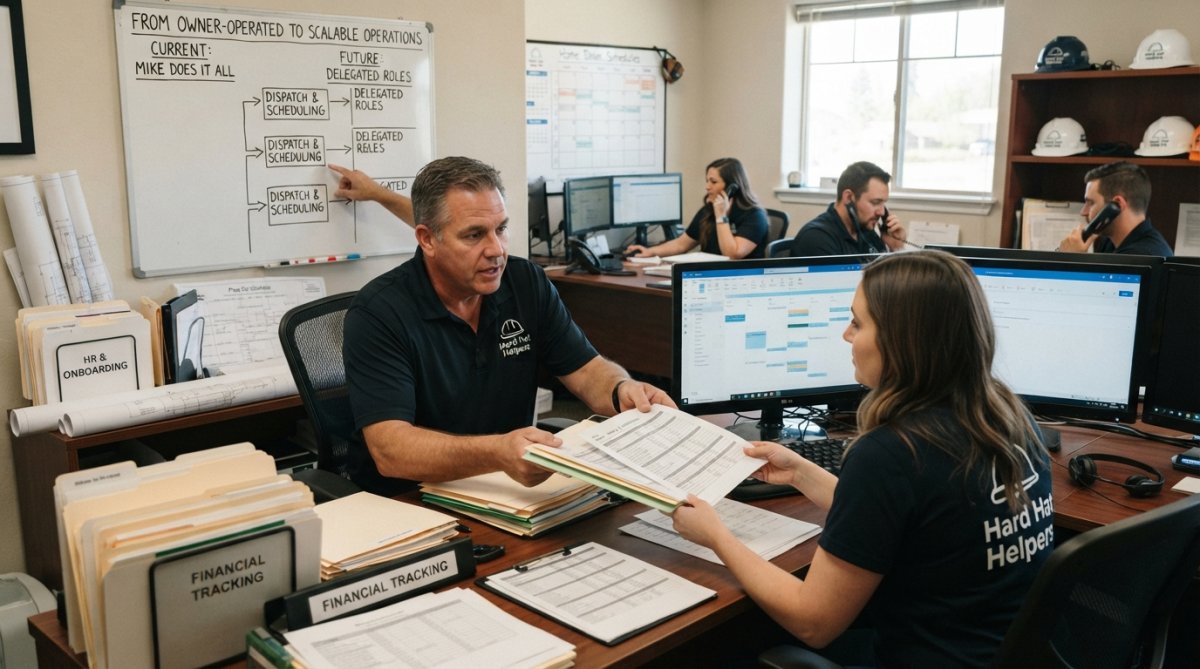
Understanding Owner-Operated Business Challenges
When you’re handling estimates, managing the team, chasing invoices, and solving every problem, growth hits a ceiling. Most owner-operated businesses don’t fail because the service is bad, they fail because the owner can’t scale themselves. You can only work so many hours, be in one place at a time, and hold so much information in your head.
The Operator Mindset vs. CEO Mindset
An operator does the work. A CEO creates the conditions for others to do the work. When you’re operating, your value comes from your hands and expertise. But the moment you take a day off, revenue stops.
The CEO mindset is different. Your value shifts from doing the work to designing the system that enables others to do it. Instead of being the best estimator, you create a process that produces consistent estimates. Instead of managing crews directly, you build a management structure that handles that.
The operator asks “How do I do this better?” The CEO asks “How does this get done without me?” This question fundamentally changes how you approach every decision.
Common Bottlenecks in Owner-Operated Companies
You’re personally handling estimates because no one else understands your pricing. You’re reviewing every invoice because you don’t trust the process. You’re the one clients want to talk to because they’ve built relationships with you, not the company. These bottlenecks prevent growth. Your business can’t grow faster than you can personally handle work, and when you’re spending 60 hours a week on execution, you have zero hours for strategy.
Step 1: Shift Your Mindset to Enable Transition to Scalable Business
You cannot transition from owner-operated to scalable business without changing how you think about your role. If you’re still operating like you need to do everything yourself, no process, hire, or technology will fix that.
From Doer to Decision-Maker
The shift from doer to decision-maker means moving from "I do the work" to "I decide how the work gets done." Stop measuring your productivity in hours worked and start measuring it in decisions made and systems built.
Set a hard rule: no more than 20 hours per week on execution work. The remaining 40 hours go to strategy, systems, hiring, and delegation. This forces you to stop being the bottleneck.
Block your calendar for strategic work the same way you block time for client meetings. Treat “system building” as a non-negotiable appointment, not something you’ll get to when you have time.
Overcoming Control and Trust Issues
You built this business. The idea of trusting someone else to represent your company feels risky. That feeling is accurate, but it’s riskier to stay small and dependent on yourself.
Start with low-stakes delegation: administrative work, scheduling, data entry, email management. When you delegate, people often do things differently than you would. Different doesn’t mean worse. Document your standards, show examples of what good looks like, and explain why it matters. Then give people the autonomy to execute within those guidelines.
Step 2: Master Delegation in Business Growth
Delegation is not dumping work on someone else. It’s a specific skill that requires clarity, trust, and follow-up.
Identifying What to Delegate First
Your competitive advantage typically lives in three areas: customer relationships, service quality, and strategic decision-making. Everything else is fair game.
List all the work you do in a typical week. Categorize each task:
- Only you can do this: Major client negotiations, strategic planning, quality control on complex jobs.
- Someone with training can do this: Scheduling, estimation, crew management, invoice review.
- Anyone can do this: Data entry, email management, appointment confirmation, basic bookkeeping.
Delegate from the bottom up. Start with "anyone can do this" tasks. This frees your time without requiring extensive training.
| Task Category | Examples | Delegation Timeline | Impact on Scale |
|---|---|---|---|
| Anyone can do this | Email, scheduling, data entry | Immediately | High (frees 10-15 hours/week) |
| Someone with training can do this | Estimation, crew coordination, invoicing | Month 1-2 | Very high (frees 15-20 hours/week) |
| Only you can do this | Strategic decisions, major clients, quality control | Keep for now | Shifts your focus to growth |
Don’t delegate your weaknesses. Delegate tasks that are stealing your time, not tasks you’re avoiding because you’re bad at them.
Creating Accountability Without Micromanagement
Once you’ve delegated work, the next mistake is hovering. Accountability without micromanagement requires three things: clear expectations, regular check-ins, and trust in the process.
Clear expectations means spelling out what success looks like before the work starts. Not vague goals like "manage dispatch well," but specific outcomes: "Dispatch crews by 7 a.m. each day. Schedule no crew more than 45 minutes away from the previous job. Track all changes in the system."
Weekly 15-minute check-ins work well for most delegated roles. Review what’s working, what’s not, and what support is needed. Then step back and let the person do the work. Accept that mistakes are part of learning.
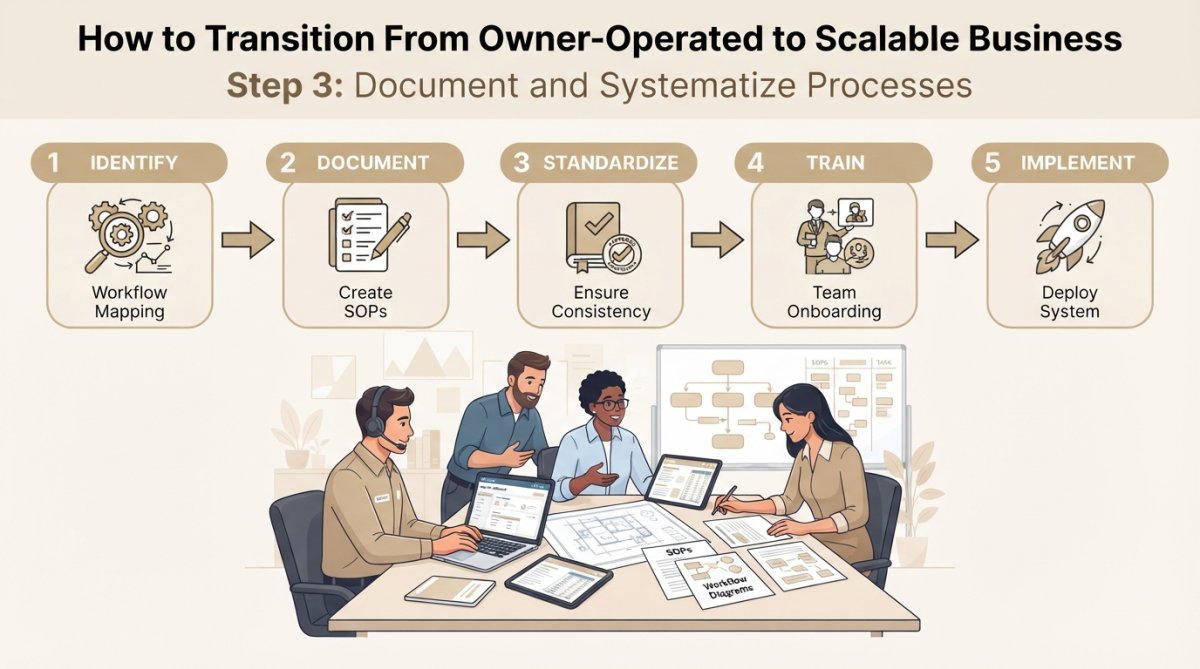
Step 3: Document and Systematize Processes
You can’t delegate what you haven’t documented. You can’t scale what you haven’t systematized.
Building Standard Operating Procedures (SOPs)
An SOP is a written guide for how a specific task gets done. Start with your highest-impact processes: how estimates are created, how jobs are scheduled, how crews are dispatched, how invoices are sent, how customer complaints are handled.
Pick one process and spend a few hours documenting exactly how you do it. Write it for someone who’s never done it before. Include screenshots, examples, decision trees, and specific language to use. The first SOP will take 3-4 hours for a complex process. Most teams can document their core processes in 2-3 weeks of focused work.
Once you have SOPs, use them to train new people. Update them when you find a better way. SOPs are the foundation of scalability because they let you replicate your expertise across multiple people.
Creating Your One-Page Owner Dashboard
As you delegate more, you need a way to see the business without being in the weeds. A one-page owner dashboard shows the health of your business at a glance: revenue (this week, this month, year-to-date), number of jobs completed, customer satisfaction score, crew use rate, cash position, and key metrics for whatever you’re focused on growing.
Update your dashboard weekly. Instead of asking "How are we doing?" you look at the dashboard. Instead of micromanaging daily operations, you review weekly trends.
Step 4: Automate Business Processes for Efficiency
Once you’ve documented processes, the next step is automating them. Not all processes should be automated, but many repetitive, rules-based tasks can be.
Tools and Software for Home Services Automation
The home services industry has specific software needs: scheduling, dispatching, estimation, invoicing, and customer communication. According to industry research on home services software adoption, businesses that automate scheduling and dispatch reduce administrative overhead by 25-30% and improve crew productivity by 15-20%.
Start with your biggest pain point. If scheduling is chaos, invest in a scheduling tool. If estimation is slow, get estimation software. Pick one area, implement it well, then move to the next. The tools you choose should integrate with each other so a job created in your scheduling software automatically populates dispatch information.
Don’t buy software because it’s trendy. Buy software because it solves a specific problem that’s costing you time or money.
Workflow Automation Best Practices
Automate after you’ve documented and refined, not before. If you automate a broken process, you just automate the brokenness at scale.
When you implement automation, start with the simplest version. Get comfortable with it, then add complexity as you need it. Before automating, clean your data to ensure addresses are correct, phone numbers are valid, and customer names are spelled consistently. Monitor automated processes and set up alerts for failures.
Step 5: Build a Strong Leadership Team for Scalability
You can’t scale alone. The transition from owner-operated to scalable business requires building a team that can run the business without you making every decision.
Hiring and Onboarding for Your Specific Business
The first hire is usually a dispatcher or office manager, someone who handles the administrative side and frees you to focus on customers and growth.
Hire for culture fit and trainability, not just technical skills. You can train someone to use your software and teach them your estimation process. What you can’t teach is reliability, work ethic, and alignment with your values.
Invest in onboarding. Use your SOPs to train them. Pair them with someone experienced. Review their work in the first month. The first 90 days are critical. If it’s not working out, make a change quickly.
Managing Resistance to Change Within Your Team
When you start delegating and building systems, your existing team might resist. Address this directly. Explain why you’re making changes and help them understand that you’re not criticizing their work, you’re building systems so the business can grow.
Involve them in the process. Ask for their input on new systems. Communicate constantly about what’s changing, why it’s changing, and how it affects them. Some people will adapt and thrive. Some will struggle. Some will leave. That’s okay.
Legal and Contractual Considerations
As you build your team, make sure you have the legal structure right. You need clear employment agreements that spell out responsibilities, compensation, benefits, and expectations. You need to classify people correctly as employees or independent contractors. Work with an employment attorney to set this up properly.
Common Mistakes to Avoid When Scaling
Scaling Too Fast Without Systems
This is the most common mistake. You get a big contract or sudden influx of work. You hire quickly. You take on more than you can handle. Then everything falls apart because you don’t have systems to support the growth.
Growth without systems is chaos. The right approach is slower. Build systems first. Prove they work. Then grow into those systems.
Scaling too fast creates debt, technical debt, quality debt, and team debt. Slow, systematic growth is faster in the end.
Hiring the Wrong People for Leadership Roles
The best estimator doesn’t always make the best project manager. Technical skill and leadership skill are different. When you hire for leadership roles, look for people with management experience and the ability to develop others.
Be willing to move people out of roles that aren’t working. If you promote someone to management and they struggle, move them back to an individual contributor role or find them a better fit.
Neglecting Financial Clarity and KPIs
Many owner-operators focus on revenue and ignore everything else. You can have growing revenue and a failing business if your costs are out of control or your profit margins are shrinking.
Know your gross profit, not just revenue. Know your overhead. Know your profit margin by service or by crew. Know your cash position. Review these numbers weekly. Also track operational KPIs: How many jobs per crew per week? What’s your customer satisfaction score? What’s your crew turnover rate?
How Hard Hat Helpers Supports Your Transition to Scalable Business
The biggest bottleneck for most home services companies is administrative work. You need someone to answer the phone, schedule appointments, manage dispatch, follow up with customers, and handle invoicing.
Hard Hat Helpers specializes in providing pre-qualified virtual staff trained specifically for the home services industry. Instead of hiring a full-time office manager and managing payroll, benefits, and training, you get access to trained professionals who understand your industry. Dispatchers who know how to optimize routes. Estimators who understand your pricing structure. Office managers who can handle customer communication.
The advantage is significant. You get experienced staff without the overhead of a full-time hire. Hard Hat Helpers handles payroll, benefits, performance monitoring, and replacement if someone isn’t working out. You get 24/7 availability and people trained on your specific products, services, and processes, so they’re productive from day one. Hard Hat Helpers reduces your administrative burden by over 50% while giving you access to talent that would be expensive and difficult to hire locally.
The transition from owner-operated to scalable business requires shifting your mindset from doing the work to building systems. It requires documenting processes, delegating ruthlessly, and hiring people who can execute without you. It requires measuring what matters and making decisions based on data.
The payoff is significant. You build a business that doesn’t depend on you. You reclaim your time. You can take a vacation without the business falling apart. You can focus on growth instead of execution. Within a year, you’ll have a fundamentally different business, one that scales because it doesn’t depend on you doing everything yourself.
Frequently Asked Questions
What's the difference between growth and scaling when transitioning from owner-operated to scalable business?
Growth means increasing revenue or customer volume, often by working harder or hiring more hands-on staff. Scaling means growing revenue without proportionally increasing operational burden or overhead, it requires systems, delegation, and automation. To transition to a scalable business, you must focus on scaling, not just growth. This means documenting processes, empowering team members to make decisions, and leveraging technology so your business can serve more customers without you doing all the work yourself.
How long does it take to transition from an owner-operated business to a scalable operation?
Timeline varies based on your business complexity and team size, typically ranging from 6 months to 2 years. The first 3 months focus on mindset shift and documenting core processes. Months 4-8 involve delegation and hiring key roles. Months 9-12 emphasize automation and refinement. Ongoing improvement continues beyond that. Home services businesses often see faster transitions when they prioritize documenting their unique pricing structures, service areas, and client workflows, areas where specialized virtual staff trained on your specific business can accelerate the process.
What should I delegate first when building a scalable business?
Start with administrative and repetitive tasks: dispatch, scheduling, invoicing, and basic customer communication. These are high-volume, lower-risk, and free up your time for strategic decisions and client relationships. Next, delegate estimation and quoting if you have reliable processes documented. Avoid delegating decision-making about pricing, service scope, or client relationships until your team demonstrates mastery of your systems. For home services businesses, hiring a trained dispatcher or office manager is often the highest-impact first delegation, it immediately reduces your daily operational load while improving customer response times.
How do I ensure delegated work maintains quality and represents my brand when scaling?
Quality depends on three factors: clear SOPs, proper training, and accountability metrics. Document exactly how you want tasks done, including your pricing structure, service standards, and brand voice. Train your team on your specific products, services, and client expectations, not generic processes. Use KPIs and regular check-ins to monitor quality, not constant oversight. For specialized roles like estimators, ensure they understand your remodeling quotes complexity or HVAC pricing before they handle client interactions independently. Continuous performance monitoring and feedback loops help maintain consistency as you scale.