


Table of Contents
- What Is Administrative Outsourcing and How It Works
- Key Benefits of Outsourcing Admin Tasks
- Administrative Tasks to Delegate to Remote Staff
- How to Outsource Administrative Tasks: A Step-by-Step Process
- Cost of Outsourcing Administrative Tasks: What to Expect
- Legal and Compliance Frameworks for Remote Administrative Staff
- Common Mistakes and How to Avoid Them
- Conclusion
Last Updated: July 23, 2026
What Is Administrative Outsourcing and How It Works
When you outsource administrative work, you’re delegating time-consuming back-office tasks to external professionals so your internal staff can focus on revenue-generating activities. At Hard Hat Helpers, we’ve seen home services companies transform operations by moving repetitive work like scheduling, data entry, and customer follow-up to specialized virtual teams. This isn’t hiring a generic virtual assistant, it’s accessing pre-trained professionals who understand your industry, pricing models, and service workflows.
Business Process Outsourcing (BPO) for administrative tasks operates on a simple principle: identify tasks that don’t require your direct involvement, define clear procedures, and hand them off to qualified professionals. The key difference between effective and failed outsourcing is specificity. Vague instructions like "manage our calendar" fail. Clear procedures like "block 30-minute slots for roof inspections, confirm appointments 24 hours prior via text, and log all changes in the CRM by 3 PM daily" work.
For home services companies, administrative outsourcing typically covers dispatch coordination, appointment scheduling, invoice processing, lead follow-up, and estimating support. These tasks form your operational backbone but don’t require personal expertise in HVAC, plumbing, roofing, or electrical work.
The real win with administrative outsourcing isn’t just cost, it’s consistency. A dedicated remote team member handling your dispatch daily will develop muscle memory for your workflows faster than even your best internal hire.
Key Benefits of Outsourcing Admin Tasks
Cost Savings and Overhead Reduction
Outsourcing administrative tasks cuts overhead significantly compared to hiring full-time employees. A full-time office manager costs salary, benefits, payroll taxes, workers’ compensation insurance, and downtime during slow seasons. Outsourced support means you pay only for hours worked and avoid fixed costs that crush small businesses during slower months.
For a home services company with 2-3 office staff, shifting one full-time position to outsourced support often reduces annual overhead substantially. The financial model scales with your business, reduce hours during seasonal slowdowns without legal complexity, or instantly increase capacity during peak season without recruiting delays.
Operational Efficiency and Productivity Gains
When administrative tasks stop consuming your team’s focus, the ripple effects are immediate. Dispatchers not handling calls and billing can process more jobs daily. Estimators not chasing measurements can focus on closing sales. Owners not doing admin work at night can actually manage the business.
When your best technician spends two hours less per week on administrative tasks, that’s 100 hours per year of billable time recovered. At $150-300 per hour in service revenue, that’s $15,000-30,000 in additional revenue from one person.
The most underestimated benefit of outsourcing administrative work is its effect on team morale. When people do what they were hired for instead of busywork, retention improves and quality increases.
Administrative Tasks to Delegate to Remote Staff
The most effective outsourcing candidates are repetitive, rule-based tasks that don’t require personal judgment or client relationship skills:
- Receiving and logging service requests from multiple channels
- Scheduling appointments while respecting technician availability and routing
- Confirming appointments 24 hours before service
- Rescheduling cancellations and managing waitlists
Inbox and Communication Management
- Responding to routine customer emails with templates
- Sorting and prioritizing messages by urgency
- Following up on quotes not yet accepted
- Managing customer service inquiries
Bookkeeping and Invoice Processing
- Data entry of invoices into accounting systems
- Matching invoices to purchase orders and receipts
- Processing customer payments
- Generating aging reports for overdue accounts
Lead Management and Follow-Up
- Logging new leads into your CRM
- Sending initial follow-up emails or texts to prospects
- Scheduling callbacks for your sales team
- Preparing daily or weekly lead reports
Calendar and Meeting Management
- Managing personal and team calendars
- Scheduling internal meetings and sending reminders
- Preparing meeting notes and action items
Document Management
- Organizing and filing customer documents
- Creating and updating Standard Operating Procedures
- Scanning and digitizing paper records
- Maintaining a centralized document library
Don’t delegate tasks requiring deep product knowledge, client relationship judgment, or decision-making authority. Your estimators should estimate. Your sales team should sell. Your owner should set strategy.
How to Outsource Administrative Tasks: A Step-by-Step Process
Defining Your Workflow and Standard Operating Procedures
Before handing off work, you need to know exactly what you’re delegating. Most outsourcing attempts fail because companies try to outsource vague responsibilities without defining what they actually mean.
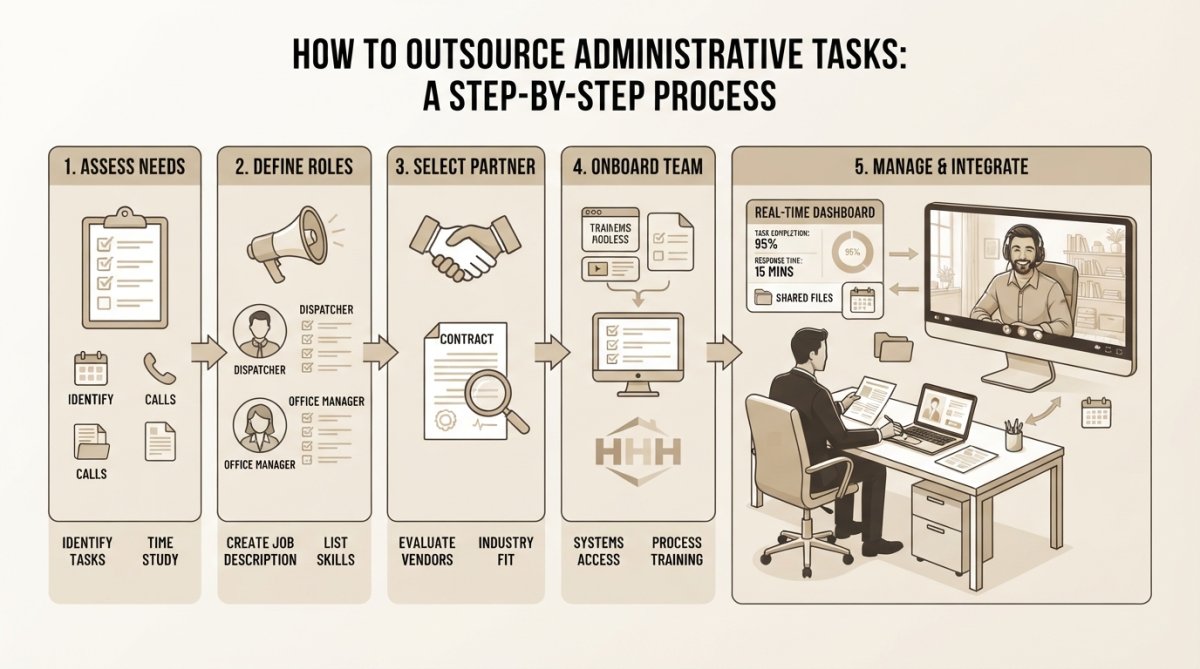
Document your current workflows by tracking what your office staff actually does for a week. Where do customer calls come from? What happens when an appointment request arrives? How do you handle rescheduling? Write down the steps and identify the decision rules embedded in your workflows.
Your SOP should be specific enough that someone with no prior knowledge could follow it. Instead of "manage the schedule," write: "Check for appointment requests every 2 hours. For residential calls, offer the next available 2-hour window within 48 hours. Confirm all appointments via text with technician name, time window, and address. Log confirmation in ServiceTitan by 5 PM."
The most common mistake is creating SOPs that are too flexible. “Use your judgment” creates inconsistency. Define specific rules: always do X in situation A, always do Y in situation B.
Selecting the Right Outsourcing Provider
The outsourcing landscape includes global staffing companies, generalist virtual assistant services, and specialized providers focused on specific industries. For home services companies, industry-specific expertise matters enormously.
Generic virtual assistants struggle with operational specifics of home services. They won’t understand why a roof inspection can’t be scheduled at 10 AM when slots are available, or that HVAC calls in summer are revenue-critical. Hard Hat Helpers provides virtual staff pre-trained for home services operations, including dispatchers, estimators, and office managers who understand your industry’s unique workflows.
When evaluating providers, ask: How do you handle industry-specific onboarding? What’s your team turnover rate? How do you monitor performance and attendance? What’s the process if a team member isn’t working out? Check references from companies similar to yours in size and service type.
Onboarding and Integration into Your Operations
The transition phase is where most projects stumble. Start with a two-week overlap where your internal staff and remote team member work in parallel. Your dispatcher still handles the schedule while the new person shadows and learns. After two weeks, flip it, they take the lead while your dispatcher reviews their work.
Expect a 20-30% efficiency drop during transition. By week 4-6, they’re typically at or above your previous efficiency level because they’re focused on that single task.
Document everything that comes up during onboarding. When the new team member asks "What should I do if a customer requests a specific technician who’s booked?" you’ve found an edge case to add to your SOP.
Ensure your remote team member has access to your scheduling system, CRM, accounting software, and communication platforms. If using ServiceTitan, HubSpot, or QuickBooks, they need login access and training on your workflows.
Managing Performance and Monitoring Attendance
Unlike internal employees you see daily, managing remote staff requires deliberate monitoring systems. Define specific metrics for each role. For a dispatcher: average time to schedule appointments, percentage of appointments confirmed via text within 2 hours, no-show rate. For a bookkeeper: invoices processed per day, data entry error rate, aged receivables accuracy.
Track metrics weekly. Most providers offer performance dashboards. If yours doesn’t, create a simple spreadsheet. Compare week-to-week trends.
Attendance monitoring is non-negotiable. Hard Hat Helpers provides continuous performance monitoring and attendance tracking, so you know if your remote team member is actually working during scheduled hours.
Schedule weekly check-ins to catch issues early.
Cost of Outsourcing Administrative Tasks: What to Expect
Pricing depends on specific tasks, experience level, geographic location, and whether the provider handles payroll and benefits. A dispatcher costs less than an estimator who needs pricing knowledge.
Discuss your specific needs with potential providers. Describe exact tasks, required hours, and specialized knowledge needed. Request a detailed quote breaking down what’s included: staff time only, or benefits, payroll processing, performance monitoring, and replacement coverage?
Compare total cost of employment, not just hourly rates. A cheaper provider might charge less per hour but offer minimal training or monitoring, requiring you to spend time managing the relationship.
Legal and Compliance Frameworks for Remote Administrative Staff
When you outsource administrative work, you’re creating a business relationship with an external provider, not hiring an employee.
Classification and Employment Law
Working with a staffing provider like Hard Hat Helpers means the provider is the employer. You’re contracting for staffing services. The remote team member is the provider’s employee, not yours. You’re not responsible for payroll taxes, workers’ compensation, or unemployment insurance.
If you hire an independent contractor directly, ensure proper classification. The IRS has specific tests for determining contractor versus employee status. Misclassification can result in significant back taxes and penalties.
Data Security and Confidentiality
Your administrative staff will access sensitive information: customer contact details, pricing, financial records, and property information. You need written agreements protecting this data.
Ensure your provider has data security policies in place. Do they use encrypted connections? How do they store customer information? What happens to data when the relationship ends? Have them sign a confidentiality agreement before accessing any customer information.
Compliance with Service Provider Agreements
Review your software platforms’ terms regarding third-party access. Most major platforms like QuickBooks, ServiceTitan, and HubSpot explicitly allow access by contractors and service providers.
Liability and Service Level Agreements
You’re still responsible for the quality and timeliness of outsourced work to your customers. Establish clear Service Level Agreements (SLAs) with your provider. What’s the expected response time? What’s the acceptable error rate? What happens if performance drops below standards? A written SLA protects both parties.
Common Mistakes and How to Avoid Them
Mistake 1: Outsourcing Before Documenting Workflows
Companies try to outsource before documenting what they’re outsourcing, leading to confusion and inconsistency. Fix: spend a week documenting your current processes before contacting a provider.
Mistake 2: Expecting Immediate Productivity
There’s always a ramp-up period. Companies that expect immediate results abandon outsourcing before it works. Fix: plan for 4-6 weeks of reduced efficiency during transition. By week 5-6, they’re typically at or above your previous efficiency.
Mistake 3: Choosing Based on Price Alone
The cheapest provider often delivers the cheapest results. You save $500 monthly but spend 10 hours managing the relationship and fixing mistakes. Fix: evaluate total cost of relationship, not just hourly rate.
Mistake 4: Not Monitoring Performance
Without clear metrics and regular check-ins, you won’t know if outsourcing is working until things have gone wrong. Fix: define specific performance metrics before starting. Review them weekly.
Mistake 5: Delegating Tasks Requiring Deep Product Knowledge Without Proper Training
Outsourcing estimating work without thoroughly training someone on your pricing structure leads to mistakes damaging customer relationships. Fix: reserve estimating and complex sales tasks for your team or outsourced staff with extensive industry training. Start with rule-based administrative tasks.
The biggest reason outsourcing projects fail isn’t that outsourcing doesn’t work, it’s that companies try to outsource without first documenting what they’re outsourcing. Vague instructions produce vague results. Clear procedures produce consistent results.
Conclusion
Outsourcing administrative work isn’t about finding someone cheaper to do busywork. It’s about reclaiming time and focus for work that grows your business. When your team spends less time on scheduling, invoicing, and follow-up, they spend more time on customer relationships, technical excellence, and revenue generation.
Companies succeeding with administrative outsourcing share three things: they document workflows before delegating, they choose providers with industry-specific expertise, and they monitor performance consistently. Hard Hat Helpers specializes in virtual staffing for home services companies, offering pre-trained dispatchers, estimators, and office managers who integrate seamlessly into your operations. With continuous performance monitoring, managed payroll and benefits, and a dedicated Client Success Manager, you get operational efficiency gains without management complexity.
Ready to reclaim your team’s focus? Book a consultation with Hard Hat Helpers and discover how much time and money you can recover by outsourcing administrative work to professionals trained specifically for your industry.
Supporting Sources:
According to the U.S. Bureau of Labor Statistics, administrative support occupations represent one of the largest employment categories, reflecting the significant time home services companies dedicate to back-office operations.
Research from the National Association of Home Builders indicates that construction and home services businesses frequently cite administrative burden as a limiting factor in growth, with many owners spending 20+ hours per week on tasks unrelated to core service delivery.
The Society for Human Resource Management provides guidance on outsourcing employment relationships and contractor classification, offering frameworks that help businesses navigate the legal considerations of remote staffing arrangements.
Frequently Asked Questions
What administrative tasks can be outsourced?
You can outsource a wide range of time-consuming tasks including calendar management, inbox management, data entry, bookkeeping, document management, lead generation, customer support, and live answering services. For home services businesses specifically, dispatching, estimating, and office management are commonly outsourced. The key is identifying repetitive, non-core tasks that don't require your direct decision-making authority.
How much does it cost to outsource administrative work?
The cost of outsourcing administrative tasks depends on the scope of work, number of staff needed, specific skill requirements, and your geographic location. Pricing varies significantly based on role complexity and hours required. For accurate pricing tailored to your business, contact Hard Hat Helpers directly for a custom quote that reflects your actual operational needs.
What makes specialized outsourcing providers different from generic virtual assistant services?
Specialized providers like Hard Hat Helpers focus exclusively on your industry, in this case, home services, and provide pre-qualified staff with tailored training on your specific products, services, and pricing structures. Generic providers lack this industry expertise. Specialized providers also manage onboarding, payroll, benefits, and performance monitoring, reducing your administrative burden significantly and ensuring staff understand your business from day one.
How long does it take for outsourced staff to become productive?
The transition phase varies based on role complexity and your onboarding process. Roles like dispatching and customer support typically see productivity within 2-4 weeks with proper SOP documentation and training. More complex roles like estimating may require 4-8 weeks to handle client interactions independently. Having clear Standard Operating Procedures and a dedicated Client Success Manager accelerates this timeline significantly.