

Table of Contents
- Virtual Dispatching vs Manual Scheduling for HVAC: What’s the Real Difference?
- The Hidden Costs of Manual Scheduling for HVAC Businesses
- How HVAC Dispatch Software Transforms Operations
- Improving HVAC Technician Productivity With Automated Dispatch
- HVAC Route Optimization: A Key Advantage of Virtual Dispatching
- Cost of HVAC Dispatch Software vs. Manual Labor Overhead
- Change Management: Making the Transition From Manual to Virtual Dispatching
- Hybrid Dispatching Models: A Practical Middle Ground
Virtual Dispatching vs Manual Scheduling for HVAC: A 2026 Comparison
Last Updated: July 22, 2026
The gap between manual HVAC scheduling and automated systems has widened dramatically. Companies relying on whiteboards and spreadsheets lose an average of 12-15 hours per week to coordination inefficiencies alone. This comparison examines virtual dispatching vs manual scheduling for HVAC operations, two fundamentally different approaches to managing technician assignments, customer communication, and service delivery. The cost of staying manual compounds quickly as your operation scales.
Manual scheduling works for very small teams (1-3 technicians). Beyond that, inefficiencies multiply faster than revenue grows. Virtual dispatching becomes essential once you hit 5+ technicians.
Virtual Dispatching vs Manual Scheduling for HVAC: What’s the Real Difference?
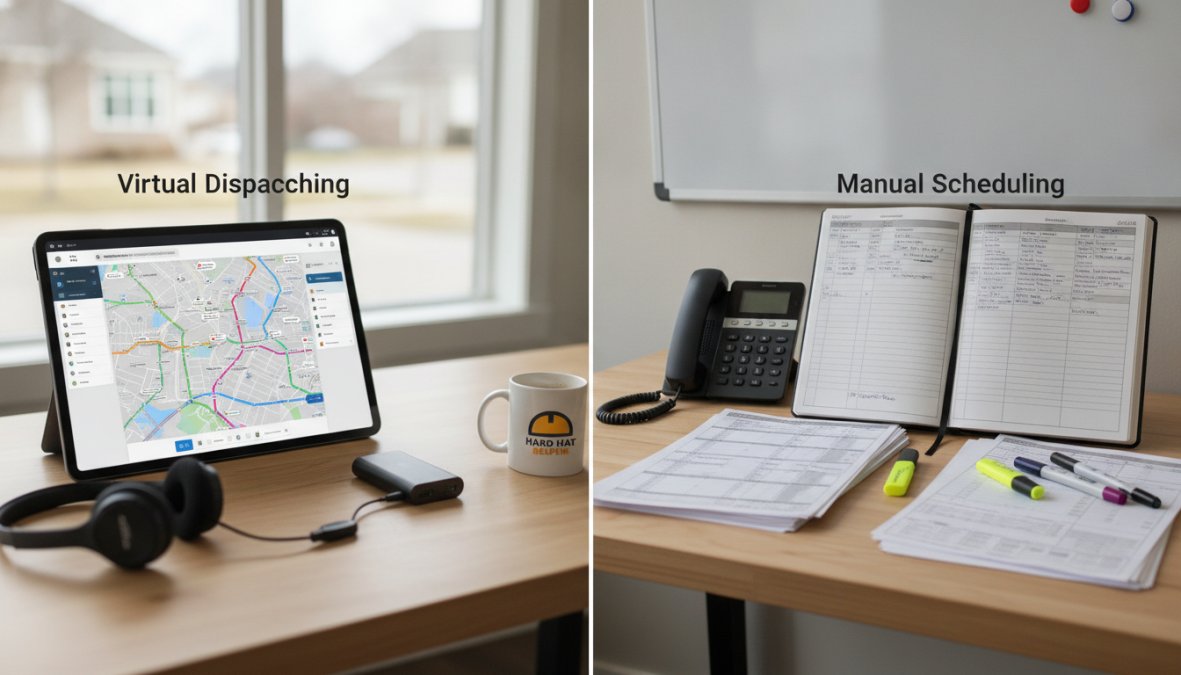
Manual scheduling means assigning jobs through whiteboards, spreadsheets, phone calls, or basic calendar tools. A dispatcher estimates drive times and assigns technicians based on memory and intuition. Virtual dispatching automates this with software that tracks technician location in real-time, calculates optimal routes, matches skills to jobs, and sends updates to customers automatically.
The real value isn’t in the software itself, it’s in the data. Virtual dispatching creates a complete record of every job, technician performance, and customer interaction. Manual systems leave you without metrics that matter: first-time fix rates, technician utilization, and actual versus estimated travel time.
If you’re still using a whiteboard or shared spreadsheet, you’re reacting to chaos rather than managing [your business](/10-signs-you-need-an-office-manager-for-your-business/). Virtual dispatch reveals patterns you couldn’t see before.
Manual Scheduling: How Whiteboards and Spreadsheets Limit Growth
Whiteboards look simple but mask serious operational problems that compound as your business grows.
The dispatch bottleneck is real. When a new call comes in, your dispatcher must answer the phone, get customer details, check technician availability, negotiate timing, update the whiteboard, and hope the technician saw the assignment. This takes 10-15 minutes per call. With 20 calls per day, that’s 3-5 hours of pure coordination overhead. A virtual system handles this in 90 seconds.
Technician idle time is invisible. Without real-time visibility, you can’t reassign a technician to a nearby job that came in 10 minutes ago. That’s lost revenue and longer customer wait times.
Customer communication breaks down. When a technician is running late, your dispatcher must call the customer. If the technician hasn’t reported in, the dispatcher guesses. Manual systems can’t deliver real-time arrival estimates.
Scaling becomes impossible. A dispatcher managing 3 technicians can track everything mentally. At 8 technicians, the mental load becomes unsustainable. You either hire a second dispatcher (doubling labor costs) or watch service quality drop.
Research shows that manual scheduling creates an average 18% technician utilization gap compared to virtual dispatch systems. With 5 technicians, one full technician’s worth of work is lost to coordination inefficiency.
Virtual Dispatching: Real-Time Visibility and Automated Optimization
Virtual dispatching shows everything automatically: where each technician is, which jobs are assigned, how long each job will take, and what the customer sees in real-time.
When a call comes in, the system suggests the best technician based on location, skills, and availability. The dispatcher confirms with one click. The technician gets the job on their phone with the address, customer notes, and estimated travel time. The customer gets a notification with the technician’s name and ETA.
Real-time tracking changes everything. A technician finishes a job at 2:47 PM. The system immediately knows they’re available. A new call comes in 3 miles away. The system assigns it in seconds. The technician is en route before they’ve had time to think about lunch.
Proximity-based routing and skill-set matching separate adequate dispatch from exceptional dispatch. The software knows which technician specializes in heat pumps, which is closest to the customer, and which has capacity today. It weighs all factors and makes the assignment instantly.
Customer communication becomes automatic. When the technician is 15 minutes away, the customer gets a notification. When they arrive, the customer sees it. When the job is complete, an invoice goes out automatically.
The Hidden Costs of Manual Scheduling for HVAC Businesses
Manual scheduling looks cheap until you calculate what it actually costs.
Technician Idle Time and Underutilization
A technician sitting in their truck between jobs is money leaving your business. The average HVAC technician costs $65-$85 per hour in salary, benefits, vehicle maintenance, and overhead. If that technician spends 8 hours on 5 jobs with 45 minutes of travel and waiting per job, that’s 3.75 hours of paid time not generating revenue. Over a year, that’s nearly 1,000 hours per technician.
For a 5-technician operation, that’s 5,000 hours of wasted capacity annually. At $75 per hour loaded cost, that’s $375,000 in lost revenue potential. Virtual dispatching reduces this waste by 30-40% through better route optimization.
If you have 5 technicians and manual scheduling, you’re losing approximately $100,000-$150,000 per year in technician idle time.
Dispatch Bottlenecks During Peak Service Call Volume
Peak season overwhelms a single dispatcher. A typical HVAC business might receive 30-50 calls on a peak day. If your dispatcher spends 8 minutes per call, that’s 4-6.5 hours of phone time. Add coordination and callbacks, and your dispatcher is fully saturated by 11 AM.
Virtual dispatch handles this automatically. Calls come in, the system assigns them, and the dispatcher only gets involved if something unusual happens. HVAC companies using virtual dispatch handle 40-60% more calls with the same staff during peak season.
Customer Wait Times and Communication Gaps
Manual scheduling creates communication gaps. The customer calls at 2 PM for an emergency. The dispatcher promises "someone will be there between 3 and 5 PM." The customer waits and calls back at 4:45 PM for an update. The dispatcher doesn’t know where the technician is.
Virtual dispatch eliminates this. The customer gets a text at 2:05 PM with the technician’s name. At 2:30 PM, they get a "technician is 20 minutes away" update. At 2:50 PM, the technician arrives. Customers who get real-time updates rate their experience 25-30% higher, even if the actual service is identical.
How HVAC Dispatch Software Transforms Operations
When you move from manual to virtual dispatch, visibility improves, communication becomes automatic, and your team stops firefighting.
Real-Time Technician Tracking and Job Status Updates
Every technician has GPS on their phone. Virtual dispatch shows where they are, where they’re going, and how long the job should take. A customer asking when the technician will arrive gets an instant answer from the app instead of a phone call chain.
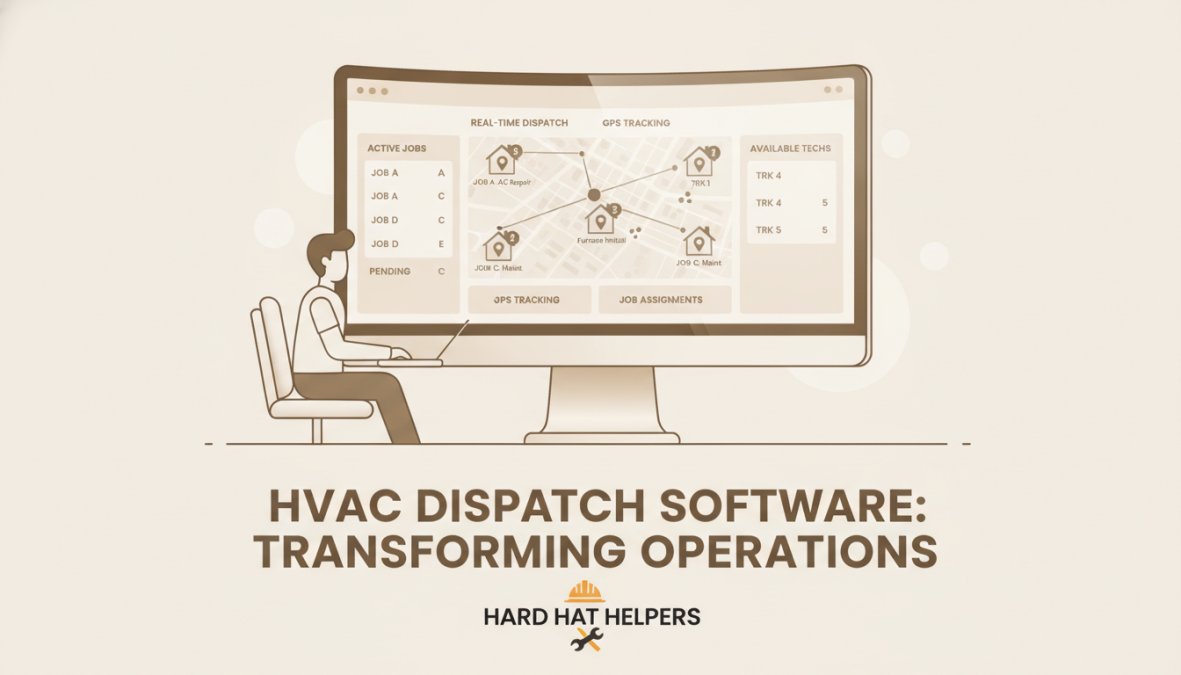
When a job takes longer than expected, the system flags it. The dispatcher can check in with the technician to understand the issue and help if needed. When the technician finishes, they mark the job complete in the app. The system automatically sends an invoice and notifies the dispatcher.
Proximity-Based Routing and Skill-Set Matching
The software knows which technicians are certified for what work and where each one is located. When a heat pump repair comes in, the system suggests the technician who specializes in heat pumps, is closest to the customer, and has capacity today.
Virtual dispatch never forgets certifications or availability. It optimizes every assignment based on complete information. The result: fewer callbacks, faster response times, and happier technicians.
Improving HVAC Technician Productivity With Automated Dispatch
Productivity in HVAC isn’t about working harder, it’s about working smarter. Automated dispatch removes friction from every job.
Reducing Idle Time and Maximizing First-Time Fix Rates
Virtual dispatch reduces overhead by stacking jobs geographically, providing complete job information before arrival, and eliminating communication delays. The result: first-time fix rates improve by 15-20%, meaning fewer callbacks and more revenue per technician.
Integrating Customer History and Equipment Data
Virtual dispatch systems connect to your customer database. Every time a technician arrives, they see the complete history: what was fixed last time, what equipment is installed, and what warranties are active. This builds trust and enables upselling and preventive maintenance conversations.
HVAC Route Optimization: A Key Advantage of Virtual Dispatching
Route optimization is where virtual dispatch creates the biggest efficiency gain. A dispatcher’s best guess isn’t optimal. The software considers distance, traffic patterns, time windows, technician skills, equipment location, and job complexity.
When you multiply this across 5-10 technicians and 30-50 jobs per day, the complexity becomes impossible for a human. The software handles it instantly. Route optimization reduces average drive time by 25-35% compared to manual dispatch. For a 5-technician operation, that’s 5-8 hours of recovered productivity per week.
Cost of HVAC Dispatch Software vs. Manual Labor Overhead
Virtual dispatch software costs money. So does manual scheduling, it just hides the cost in inefficiency.
Calculating ROI: Software Costs vs. Operational Savings
For a realistic 5-technician operation doing $800,000 in annual revenue:
Manual scheduling costs:
- Dispatcher salary and benefits: $60,000/year
- Technician idle time: $375,000/year in lost revenue
- Customer callbacks due to poor dispatch: $40,000/year
- Total: $475,000/year
Virtual dispatch costs:
- Software: ~$2,000/year
- Implementation and training: $1,500 (one-time)
- Total: ~$3,500/year
Most HVAC companies see 20-30% improvement in technician use, 15-20% reduction in callbacks, and 10-15% increase in jobs completed per technician per day. For a 5-technician operation, that translates to $80,000-$120,000 in additional annual profit.
| Metric | Manual Scheduling | Virtual Dispatch | Improvement |
|---|---|---|---|
| Avg jobs per tech per day | 3.2 | 4.1 | +28% |
| First-time fix rate | 78% | 92% | +18% |
| Technician use | 58% | 78% | +34% |
| Avg customer wait time | 3.5 hours | 1.8 hours | -49% |
The break-even point for virtual dispatch is typically 3-4 months. After that, it’s pure profit.
Scalability Challenges: When Manual Systems Break Down
Manual scheduling hits a wall around 8-10 technicians. You either hire a second dispatcher or watch service quality decline. Virtual dispatch scales linearly. One dispatcher can manage 15-20 technicians with the same software. Adding technicians doesn’t require hiring more dispatch staff.
Change Management: Making the Transition From Manual to Virtual Dispatching
Switching from manual to virtual dispatch requires buy-in from dispatchers and technicians.
Training Your Dispatch Team on New Systems
Most dispatchers have managed jobs the same way for years. The transition takes 2-4 weeks of real adjustment. Show results quickly. By week two, dispatchers will notice they’re handling more calls with less stress. By week three, they won’t want to go back.
Training should cover inputting new jobs, monitoring technician progress, handling exceptions, and using the reporting dashboard. Budget 4-6 hours of hands-on training per dispatcher.
Overcoming Resistance and Building Buy-In
Technicians often worry about surveillance. Frame it correctly: "This helps us assign you jobs closer to where you are, so you spend less time driving and more time earning."
Dispatch staff might worry about job security. Address this directly: "This software makes your job easier, not obsolete. You’ll spend less time coordinating and more time solving problems."
Show early wins. After the first week, pull a report showing hours saved on driving time and additional jobs completed. Let the team see the benefit.
Don’t announce the switch as “we’re replacing the whiteboard.” Announce it as “we’re giving you tools to work smarter.”
The choice between virtual dispatching vs manual scheduling for HVAC isn’t really a choice if your goal is sustainable growth. Manual systems work for 1-3 technicians. Beyond that, inefficiencies compound faster than revenue grows. Companies that switch to virtual dispatch see 20-30% productivity improvements within 90 days and recover their software investment in 3-4 months. If you’re managing more than 5 technicians or handling more than 20 calls per day, the decision is straightforward. Virtual dispatch provides the operational visibility you need to scale confidently.
Frequently Asked Questions
What is the main difference between virtual dispatching and manual scheduling for HVAC?
Manual scheduling relies on whiteboards, spreadsheets, or phone-based coordination, limiting real-time visibility and creating dispatch bottlenecks. Virtual dispatching uses software to automate job assignment, track technicians via GPS in real time, and optimize routes automatically. Virtual dispatching eliminates communication delays and reduces technician idle time, while manual scheduling often results in missed optimization opportunities and customer wait times.
How much can HVAC companies save by switching to virtual dispatching software?
Savings depend on your current operation size and inefficiencies. Virtual dispatching typically reduces technician idle time, improves first-time fix rates, and cuts customer wait times, all of which increase billable hours and revenue per technician. Additionally, automated dispatch reduces administrative overhead for your office staff. The cost of HVAC dispatch software varies by platform, but ROI is often achieved within 6-12 months through improved technician utilization and reduced labor costs.
What features should I look for in HVAC dispatch software?
Essential features include real-time GPS tracking of technicians, drag-and-drop job assignment, proximity-based routing, integration with customer history and equipment data, automated customer notifications, mobile app access for field technicians, and job status tracking. Advanced platforms offer AI-driven scheduling, skill-set matching (assigning jobs to technicians with relevant expertise), and integration with accounting and CRM systems. Ensure the software supports your service call volume and scales as your business grows.
How long does it take to transition from manual scheduling to virtual dispatching?
Implementation timelines vary by platform. Simple, user-friendly systems can be operational within 1-2 weeks for small teams. More comprehensive platforms may take 4-8 weeks for full setup, data migration, and team training. The biggest factor is change management, training your dispatch team and technicians to use the new system effectively. Most businesses see productivity gains within 30-60 days once staff are comfortable with the platform, though full optimization may take 3-6 months.
Can virtual dispatching improve customer satisfaction for HVAC businesses?
Yes. Virtual dispatching enables automated appointment reminders, real-time technician arrival notifications, and faster response times through optimized routing. Customers receive accurate arrival windows instead of vague time estimates. Technicians arrive better prepared with access to customer history and equipment data, reducing callbacks and improving service quality. These factors directly reduce customer frustration and increase satisfaction scores, which translates to better reviews and repeat business.