


Table of Contents
- Why Building a Leadership Team Matters for Home Services Growth
- Step 1: Define Your Organizational Structure for Home Service Business
- Step 2: Establish Clear Expectations and Performance Metrics
- Step 3: Recruiting Leaders for Home Service Companies
- Step 4: Develop Leadership Skills Through Industry-Specific Training
- Step 5: Foster Team Engagement and Company Culture
- Step 6: Plan for Succession and Leadership Growth in Home Services
- Common Mistakes When Building a Leadership Team for Home Services
Build a Leadership Team for Home Services: 7 Steps
Last Updated: July 30, 2026
Why Building a Leadership Team Matters for Home Services Growth
Companies with structured leadership teams experience 40% higher retention rates among field staff compared to solo owner-operators. At Hard Hat Helpers, we’ve observed that teams with clear leadership structures scale faster, handle customer complaints more effectively, and retain their best technicians longer. Understanding how to build a leadership team for home services is essential for businesses aiming to grow beyond a handful of crews.
The challenge most home services owners face is knowing how to organize talented people. Without a clear leadership structure, staff operate in silos, dispatchers don’t coordinate with field supervisors, estimators work independently of service managers, and no one owns accountability for customer satisfaction or operational efficiency.
This guide walks you through seven concrete steps to build a functioning leadership team that reduces your administrative burden, improves service delivery, and creates a foundation for sustainable growth.
The hardest part isn’t hiring leaders, it’s clarifying what you need them to do. Most home services businesses fail at leadership because they promote their best technician without defining the role itself. Start with structure. People follow.
Step 1: Define Your Organizational Structure for Home Service Business
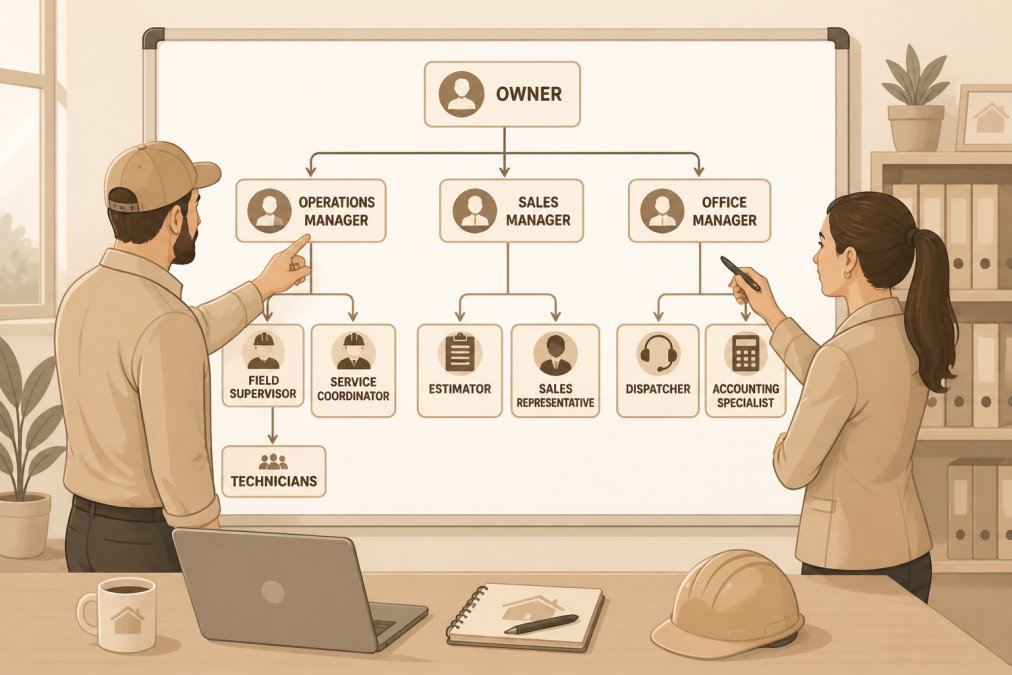
Map out who reports to whom and what each person owns. Most home services companies operate without a documented organizational structure, leaving decision-making authority unclear.
Start by listing every function your business needs: dispatch, scheduling, customer service, estimating, invoicing, technician management, quality control, and compliance. Group these into logical departments. A small operation might have three tiers: owner, operations manager, and field/office staff. A mid-sized company might add a service manager, estimating lead, and office manager.
Map roles and reporting lines
Document who reports to whom using a simple org chart or text outline. Every person should know their direct manager and who they manage. For home services, consider whether field staff report to an operations manager or directly to you. Many successful companies create a service manager role that owns all field operations, scheduling, technician performance, customer follow-up, and safety compliance.
(/scale-home-service-business-without-more-staff/)]
Clarify leadership responsibilities and accountability
Write down what each leader is responsible for. Instead of "manage the team," write "ensure all technicians pass safety certification by Q2, maintain 4.5+ customer rating average, and reduce no-shows by 20%."
Each leadership role should own a process (what they manage), a metric (how success is measured), and a frequency (how often they report on it). This clarity prevents overlap and finger-pointing.
Step 2: Establish Clear Expectations and Performance Metrics
Leaders can’t manage what they can’t measure. Set specific, measurable expectations for each leadership position before you hire or promote anyone into it.
Set KPIs aligned with business goals
Identify the three to five metrics that matter most to your business. For a plumbing company, that might be average job completion time, first-call resolution rate, customer satisfaction score, technician use rate, and invoice accuracy. Each leader should have clear targets and visibility into weekly performance.
Document operational compliance requirements
Home services businesses operate under specific regulations: licensing requirements, insurance mandates, safety certifications, background check protocols, and state-specific contractor laws. Assign clear ownership for compliance and track it weekly.
The businesses that scale smoothest have one person accountable for compliance and one metric tracked weekly. Ambiguity kills compliance. Clarity makes it routine.
Step 3: Recruiting Leaders for Home Service Companies
You can promote from within or hire experienced leaders from outside. Most successful home services companies do both.
Source candidates from within and outside your organization
Internal promotions are powerful, your best technician already knows your systems and customers. But promoting someone without management experience often fails. Consider a hybrid approach: identify high-potential internal candidates for development while recruiting experienced leaders externally.
For external recruiting, use industry-specific job boards like Wizehire or LinkedIn. Be specific about requirements: "Service Manager for HVAC company, 3+ years managing technician teams, experience with dispatch software."
Evaluate leadership potential and industry knowledge
Look for two things: leadership capability (they’ve managed people before, handled conflict, made tough decisions) and industry knowledge (they understand your business, pricing, licensing, seasonal nature). Ask specific questions: "Walk me through how you’d handle a technician who consistently misses appointments." "How would you improve our customer satisfaction score from 4.2 to 4.6?"
For internal promotions, look for people who solve problems without being asked, mentor others informally, and take accountability for outcomes.
Step 4: Develop Leadership Skills Through Industry-Specific Training
Promoting a great technician to supervisor doesn’t automatically make them a great leader. They need training designed for home services leadership challenges.
Invest in formal training programs and coaching
Organizations like BDR’s Leadership Excellence Academy and PHCC Academy’s Business Leadership Essentials offer training directly relevant to home services. Consider one-on-one coaching to help new leaders navigate their first 90 days. A service manager who completes leadership training typically improves team retention by 15-20% within six months.
Build communication and delegation skills
Most leadership failures stem from poor communication or weak delegation. Create a simple communication framework: weekly one-on-ones with direct reports, monthly all-hands meetings, documented decision-making authority, and clear escalation paths.
Teach leaders to assign tasks with clear outcomes. Instead of "manage the schedule," say "ensure all jobs are scheduled 48 hours in advance and technicians have no more than 6 jobs per day."
The most common mistake: promoting someone without teaching them how to lead. You end up with a frustrated ex-technician isolated from the work they loved, managing people they used to work alongside. Invest in training immediately after promotion.
Step 5: Foster Team Engagement and Company Culture
A leadership team only works if the people below them feel engaged and valued. Culture is how you treat people when things go wrong.
Create open communication channels with field staff
Field staff feel isolated in customers’ homes. Use a group chat app (Slack, Teams) for daily updates and questions. Hold brief weekly huddles where you share wins, acknowledge good work, and explain upcoming changes. Many home services companies use tools like Applause, which combines performance tracking with recognition and feedback.
Recognize achievements and build accountability
Public recognition matters more than raises for field staff. When someone solves a customer problem creatively or hits a safety milestone, celebrate it. Address performance issues directly within 24 hours. Create a simple feedback loop with weekly check-ins where leaders discuss what’s working and what needs improvement.
Step 6: Plan for Succession and Leadership Growth in Home Services
Your first leadership team won’t be your last. Plan for growth and change from the beginning.
Identify high-potential employees early
Look for people who take initiative, mentor others informally, and ask good questions about the business. Document potential successors for each key role and start investing in their development now.
Create development pathways for future leaders
Don’t wait until someone quits to develop a successor. Assign high-potential employees to lead small projects, have them shadow current leaders, send them to training, and give them increasing responsibility. A technician on the succession plan for service manager might start by leading a safety training session, then mentoring a new hire, then managing the schedule for one crew.
| Role | Current Leader | Successor 1 | Successor 2 | Development Needed |
|---|---|---|---|---|
| Service Manager | John | Marcus (technician) | Sarah (dispatcher) | Leadership training, scheduling software course |
| Operations Manager | Lisa | David (dispatcher) | Business finance course, delegation coaching | |
| Estimating Lead | Tom | Jessica (CSR) | Estimating software training, sales coaching |
Common Mistakes When Building a Leadership Team for Home Services
Promoting your best technician without training them. A great technician doesn’t automatically become a great leader. They need training, coaching, and explicit permission to stop doing technical work and start managing people.
Creating leadership roles without clear metrics. If your service manager doesn’t know whether they’re succeeding, they’ll optimize for the wrong things. Define success upfront with specific targets.
Hiring experienced leaders without cultural fit. An operations manager from a big company might bring best practices but struggle with your family-owned culture. Hire for both competence and fit.
Skipping the documentation step. Document roles, reporting lines, and responsibilities. When you’re busy, you’ll default to old patterns. Documentation keeps the structure intact.
Not investing in ongoing development. Building a leadership team isn’t a one-time event. Allocate budget for coaching, training, and conferences.
Ignoring compliance and accountability. Assign clear ownership for compliance, licensing, insurance, background checks, and safety certifications. Track it weekly.
Building a leadership team transforms a home services business from a solo operation into a scalable company. The seven steps above, defining structure, setting expectations, recruiting strategically, investing in development, fostering culture, planning succession, and avoiding common mistakes, create the foundation for sustainable growth.
The transition is hard. You’ll need to let go of some control and trust people to make decisions. But the payoff is significant: better customer satisfaction, higher technician retention, reduced owner stress, and a business that runs even when you’re not there. Hard Hat Helpers helps home services companies accelerate this transition by providing trained virtual staff for administrative roles, dispatchers, estimators, and office managers who understand your industry and integrate seamlessly into your leadership structure. With experienced support handling administrative work, your leadership team can focus on what matters: managing field operations, developing people, and growing the business.
Frequently Asked Questions
What qualities should I look for when recruiting leaders for home service companies?
Look for candidates with proven field experience, strong communication skills, and ability to manage both field staff and operational compliance. They should understand your service delivery model, pricing structure, and customer relationships. Industry-specific knowledge matters, someone who has worked in HVAC, plumbing, or electrical is more valuable than a generic manager. Leadership potential includes delegation skills, accountability mindset, and willingness to invest in team development and professional growth.
How long does it take to develop effective leadership in a home services business?
Most home services leaders benefit from 3-6 months of structured development before operating independently. This includes onboarding, role-specific training, and hands-on coaching. Industry-specific leadership development programs like PHCC Business Leadership Essentials typically run 10 weeks. However, the timeline depends on the candidate's background, your operational complexity, and the depth of your company culture and systems. Ongoing development should continue indefinitely as your business scales.
How do I structure succession planning for home services to avoid losing key leaders?
Identify high-potential employees early and create clear development pathways. Document critical processes so knowledge isn't locked in one person's head. Cross-train team members on essential functions. Establish mentorship relationships between senior leaders and emerging talent. Consider formal succession planning tools or coaching programs. Regularly review your organizational structure and leadership bench strength. This approach reduces the risk of operational disruption if a key leader leaves and ensures continuity as your business grows.
Can I build a leadership team without significantly increasing overhead costs?
Yes, by leveraging specialized virtual staffing for administrative and operational roles, you can reduce overhead by focusing your in-house leadership on field operations and client relationships. Outsourced dispatchers, estimators, and office managers can handle scheduling, CRM, and billing while your core leadership team focuses on strategy and team management. This approach lets you scale leadership capability without proportional increases in payroll. Many home services businesses report overhead savings of 50% or more by using this hybrid model while maintaining service quality and compliance.