


Table of Contents
- Understanding the Psychological Identity Shift
- How to Transition from Field to Office: Core Steps
- Resume Tips for Field to Office Transition
- Preparing for Interview Questions for Career Changers
- Field to Office Cover Letter Examples and Strategy
- Navigating Office Culture, Professional Communication, and Workplace Etiquette
- Managing Physical and Mental Exhaustion During Your Transition
- Salary and Benefits Negotiation for Your New Role
How to Transition from Field to Office: A Practical Guide
Last Updated: July 9, 2026
Making the shift from field work to an office environment represents one of the most significant career transitions you can make. Whether you’re moving from construction, HVAC, electrical work, or another hands-on trade, the adjustment involves far more than just changing your work location. This guide breaks down exactly how to transition from field to office work, addressing the psychological, physical, and professional hurdles you’ll face along the way.
Understanding the Psychological Identity Shift
Your identity in field work is deeply tied to tangible accomplishment. You finish a job, you see the result, you know what you’ve built. The transition to office work strips away that immediate, visible feedback loop. Many field professionals experience this as an identity crisis rather than just a job change.
Office work measures success differently. Instead of "I installed 12 units today," it becomes "I coordinated between three departments to resolve a process bottleneck." The accomplishment is real but abstract.
Reframe what “building something” means in an office context. You’re building systems, relationships, processes, and organizational knowledge. These are harder to see but often more valuable to the business than any single project outcome.
In the field, competence is obvious. In an office, competence is more ambiguous. People judge you on communication, political awareness, and how well you navigate unwritten rules. The key is accepting that this transition requires a mental reset. Your field experience is valuable, but it doesn’t automatically translate to office credibility.
How to Transition from Field to Office: Core Steps
The practical transition from field to office work follows a clear sequence. These steps overlap, but they create a framework for managing the change systematically.
Step 1: Assess Your Transferable Skills from Field to Office
Before you start applying for office roles, audit the skills you actually have. Field professionals consistently undervalue what they bring to the table.
Transferable skills from field work include:
- Problem-solving under pressure. Field work teaches you to diagnose issues quickly and implement solutions when things break.
- Project management fundamentals. If you’ve managed crews, coordinated schedules, or tracked materials, you understand project sequencing, resource allocation, and deadline management.
- Safety and compliance mindset. Field work embeds a culture of documentation, accountability, and following procedures that offices run on.
- Technical documentation. You’ve likely written reports, filled out work orders, or tracked job details.
- Customer communication. You’ve explained technical problems to non-technical people and managed expectations.
You just need to translate these into office language.
Step 2: Master Office Technology and Collaboration Tools
Start with the core tools you’ll encounter in almost any office:
- Email management. Learn to organize folders, use filters, write professionally, and manage inbox volume.
- Spreadsheets. Excel or Google Sheets are used to track projects, manage budgets, organize data, and create reports. Learn formulas and pivot tables.
- Project management platforms. Asana, Monday.com, or similar tools replace clipboard-and-schedule approaches. Spend a week learning the basic workflow.
- Document collaboration. Google Docs or Microsoft 365 require learning how to collaborate in real-time and manage versions.
- Video conferencing. Zoom, Teams, or Google Meet are now standard. Understand how to join meetings, manage your camera and microphone, and present over video.
Most of these tools have free trials and YouTube tutorials. Focus on the tools your new role actually uses.
Step 3: Adapt to a Sedentary Lifestyle
Field work is physically demanding. Office work is the opposite. The first two weeks will feel strange physically.
Adapt by building movement into your office day:
- Take walking meetings when possible.
- Use a standing desk for part of the day.
- Walk during lunch instead of eating at your desk.
- Use the stairs instead of elevators.
- Set a timer to stand and stretch every hour.
Ignoring the physical transition creates a downward spiral. Back pain leads to worse posture, which leads to more pain. Address this immediately, not after six months of discomfort.
Resume Tips for Field to Office Transition
Your resume needs to translate field experience into office language. Lead with transferable skills and outcomes, not job titles.
Instead of: "Installed HVAC systems for residential and commercial clients"
Write: "Managed installation projects for 15+ commercial accounts, coordinating between technicians, ensuring compliance with building codes, and delivering projects on schedule and budget"
For your resume structure:
- Highlight leadership experience. If you’ve supervised anyone or managed crews, put this prominently.
- Quantify outcomes. Use numbers: "Reduced installation time by 20% through process optimization."
- Use office terminology. Replace "job site" with "project," "crew" with "team," "client" with "stakeholder."
- Include technical knowledge. Mention industry software, compliance requirements, or technical systems.
- Add professional development. Include courses, certifications, or training that show commitment to learning.
Preparing for Interview Questions for Career Changers
Interviews will focus on one central concern: Why are you leaving the field, and can you actually do office work?
"Why are you making this transition?"
Frame the transition as moving toward something, not running away.
Better answer: "I’ve spent the last eight years managing projects and coordinating teams in the field. I’ve learned that I enjoy the planning, coordination, and problem-solving aspects most. I want to focus on those strengths in a role where I can build systems and lead teams full-time."
"How will your field experience help you in this office role?"
Connect specific field skills to the job description. If the role involves project management, talk about how you’ve managed timelines and budgets.
"Tell me about a time you had to learn something new quickly."
Use a field example that demonstrates learning ability: "When our company switched to a new scheduling system, I took initiative to learn it and then trained the rest of the team."
"What do you know about office culture?"
Do research on the company. Understand their communication style, pace, and values. Reference this in your answer.
Field to Office Cover Letter Examples and Strategy
Your cover letter explains why this transition makes sense.
Open with a specific accomplishment:
"In my eight years as a project manager for [Company], I coordinated installations for 200+ commercial clients while managing a team of 12 technicians, maintaining a 98% on-time delivery rate, and reducing project costs by 15% through process optimization."
Then explain the transition:
"As my career has progressed, I’ve become increasingly focused on the planning, coordination, and strategic aspects of project management. I’ve realized that my greatest strengths lie in building systems, leading teams, and solving complex organizational problems."
Finally, connect your experience to the specific role:
"Your position requires someone who can manage multiple projects simultaneously while coordinating between departments. My experience managing complex installations with multiple stakeholders has prepared me to excel in exactly this environment."
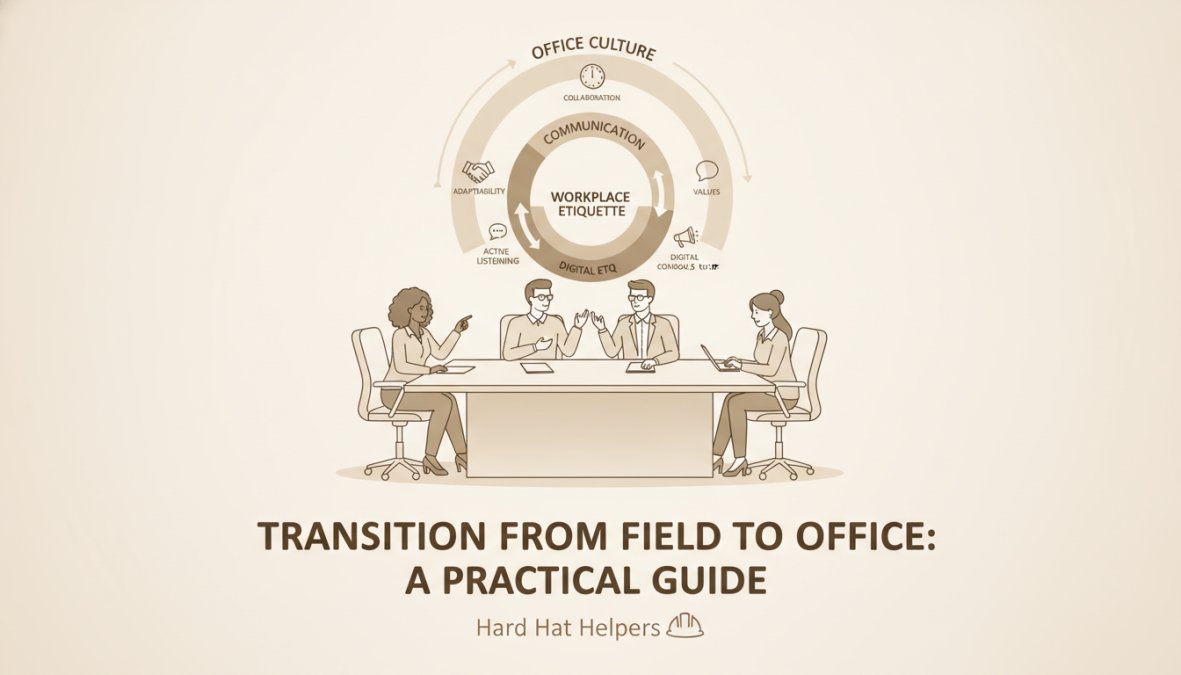
Navigating Office Culture, Professional Communication, and Workplace Etiquette
Office culture is unwritten. You’re expected to figure it out. This is where field professionals often struggle most.
Communication norms. In the field, you communicate directly. In offices, there’s often more indirectness. Observe how people communicate before adopting the same style.
Hierarchy and decision-making. Field work often has clear hierarchy. Office hierarchy is murkier. Decisions involve consensus and input from multiple people.
Work-life boundaries. Field work has clear boundaries. Office work often bleeds into personal time through email and Slack. Observe what your colleagues do.
Professional dress codes. Even casual offices have unwritten dress codes. Spend your first week observing what people wear.
Workplace etiquette. Reply to emails promptly. Show up to meetings on time. Don’t eat at your desk if others don’t. These signal that you understand office norms.
Your first 30 days in an office, your job is to observe more than to act. Watch how people interact, how decisions get made, how conflict gets handled. This observation period is when you learn office culture.
Building credibility with office-based teams requires proving yourself through reliability, communication, and understanding how things work. Show up prepared to meetings. Deliver what you promise. Communicate proactively about problems.
Managing Physical and Mental Exhaustion During Your Transition
The transition creates a unique form of exhaustion. You’re physically less tired but mentally more tired. Your brain is processing constant information: new software, new people, new processes, unwritten rules, political dynamics.
Strategies for managing the transition exhaustion:
- Recognize that this is temporary. The exhaustion peaks in weeks 2-4, then gradually decreases. By week 8-12, your brain has adapted.
- Protect your sleep. Mental exhaustion is worse when you’re sleep-deprived.
- Build in recovery time. After work, give yourself 30-60 minutes to decompress.
- Maintain some physical activity. Exercise, walking, or stretching helps your brain recover.
- Separate work from home. Create a boundary. When you leave the office, actually leave it mentally.
The exhaustion you feel during the transition is real and expected. It’s not a sign you’re not cut out for office work, it’s a sign your brain is adapting to a fundamentally different way of working. This adaptation takes time, usually 8-12 weeks.
Salary and Benefits Negotiation for Your New Role
Field professionals often underestimate their market value when transitioning to office work. Your field experience has value in an office context. You bring maturity, work ethic, and often management experience.
Before you interview, research the market. Use Glassdoor, PayScale, and LinkedIn Salary to understand what the role typically pays. You’re not entry-level; you’re a mid-level candidate with transferable skills.
Understand what you’re negotiating. It’s not just salary:
- Signing bonus. Can offset accumulated benefits or seasonal income you’re leaving behind.
- Remote work flexibility. Often worth more than a small salary increase.
- Professional development budget. Ask for budget for training or certifications.
- Vacation and time off. Understand what you’re getting and negotiate if needed.
- Health insurance. Often better in office roles than field work.
Negotiation strategy:
Don’t accept the first offer. Thank them, express enthusiasm, and ask for time to consider. Come back with a counteroffer that’s 10-15% higher than their initial offer.
When you counteroffer, anchor your request to market research, not to what you made in field work. "Based on my research, similar roles in this market pay between $X and $Y. Given my experience, I’m requesting $Z."
Be prepared to walk away if the offer doesn’t meet your needs. A lowball offer often indicates a company that doesn’t value you.
Transitioning from field to office work is challenging, but it’s absolutely achievable with the right approach. The key is understanding that this isn’t just a location change, it’s a fundamental shift in how you work, how you’re evaluated, and how you build credibility. Your field experience is valuable, but it needs to be translated into office language and applied to office contexts. Start by assessing your transferable skills, master the software tools you’ll use daily, adapt to the physical and mental differences, and navigate office culture deliberately rather than reactively. Many field professionals successfully make this transition and thrive in office environments.
At Hard Hat Helpers, we work with field professionals transitioning into administrative and office roles every day. Our team provides specialized virtual staffing solutions for the home services industry, including trained office managers, dispatchers, and estimators who understand both field operations and office requirements. If you’re managing a team making this transition or building an office team from field talent, Hard Hat Helpers offers pre-qualified professionals with tailored training to help seamlessly integrate field expertise into your operations. Book a consultation to explore how our team can support your transition strategy.
Frequently Asked Questions
What transferable skills from field to office work matter most to employers?
Employers value problem-solving, adaptability, time management, and hands-on experience from field work. Technical skills like safety compliance and equipment operation translate well. Soft skills, teamwork, communication, and reliability, are equally crucial. When listing transferable skills, frame field experience as evidence of these competencies. For example, managing field schedules demonstrates project management; coordinating with crews shows stakeholder management.
How do I explain my transition from field to office on a resume?
Use a professional summary that bridges your experience. Example: 'Field professional transitioning to office operations with 5+ years managing logistics, scheduling, and team coordination.' In your work history, emphasize office-adjacent duties: reporting, documentation, client communication, or training. Quantify achievements (reduced delays by 20%, managed $X budget). Include relevant certifications or software training. This approach shows employers you understand the role while leveraging your field background.
Is it hard to move from field work to an office job?
The transition involves adjusting to a sedentary lifestyle, learning new software, and adapting to corporate culture, but it's entirely manageable with preparation. The biggest challenge is often psychological: identity shift from hands-on work to desk-based tasks. Physical exhaustion changes to mental fatigue. Most people adapt within 3-6 months. Success depends on your willingness to develop professional communication skills, embrace office protocols, and invest in learning collaboration tools your company uses.
What office jobs are suitable for someone with field experience?
Field professionals excel in roles like project coordinator, operations manager, dispatcher, estimator, field supervisor, or office manager, especially in industries matching your background (construction, HVAC, plumbing, electrical). These roles leverage your industry knowledge and credibility. Entry-level office positions like administrative assistant or junior coordinator are also accessible. Look for roles that value hands-on experience and problem-solving over pure desk skills. Your field background is an asset in companies serving the home services industry.