

Table of Contents
- Understanding the Growth Challenge in Home Service Businesses
- Home Service Business Growth Strategies That Protect Operations
- Hiring for Home Service Growth: Building Your Team Infrastructure
- Home Service Business Software Solutions for Managing Scale
- Home Service Business Marketing Strategies for Sustainable Growth
- Financial Management and KPI Tracking During Growth
- Common Mistakes When Managing Growth in Home Service Companies
- Conclusion: Sustainable Growth Requires Systems, Not Just Hard Work
Last Updated: July 26, 2026
Managing growth in home service companies requires fundamentally different thinking than running a solo operation. Many companies that double revenue in a single year experience operational collapse within 18 months. Below, we’ll show you exactly how to manage growth without sacrificing the quality that built your reputation.
Understanding the Growth Challenge in Home Service Businesses
Rapid growth creates a specific problem: your systems, team, and operational capacity were built for smaller volume. When you scale from 8 jobs per week to 15 without changing anything else, you’ve created chaos. The dispatcher managing schedules on a notepad can’t anymore. The estimator who memorized pricing becomes a bottleneck.
The moment you hire your first office manager or dispatcher, you’ve shifted from being a technician business to being a management business. If you haven’t adapted your thinking, you’ll spend the next 18 months frustrated, micromanaging, and wondering why growth feels worse than stagnation.
Growth exposes hidden inefficiencies. At small scale, workarounds feel acceptable: the owner stays late to fix mistakes, calls get returned personally, pricing adjusts on the fly. These adaptations fail spectacularly when you have five people doing things five different ways.
Growth also requires investment before revenue arrives. You need to hire before you have enough work to keep them busy. You need software before you can comfortably afford it. This timing mismatch creates cash flow pressure exactly when you need stability most.
The mental health crisis that comes with scaling is rarely discussed. As an owner-operator, you were exhausted but in control. The moment you delegate, many owners respond by refusing to actually delegate. They hire people, then don’t trust them with real decisions, creating bottlenecks around themselves. Research shows owners who scale without building real management infrastructure report higher stress, lower satisfaction, and often exit within 5 years.
Home Service Business Growth Strategies That Protect Operations
Companies that scale successfully treat growth as a process, not an event. They build the system first, then hire into it.
Start building your operational systems at 60% capacity. Don’t wait until you’re drowning. The best time to document your process is when you still have time to think clearly about what you’re actually doing.
Scaling without sacrificing service quality
The fear most owners have is that growth means lower quality. This is true if you scale by hiring cheaper labor. It’s false if you scale by standardizing your process.
Successful companies document exactly how they want work done, then hire people capable of following that standard. A plumbing company doesn’t hire cheaper plumbers; they hire quality plumbers trained on the company’s specific process. This requires three things: document your process with specific steps and quality checks, hire people capable of executing that standard, and implement ongoing quality monitoring through dispatch software that tracks completion times, customer ratings, and job profitability by technician.
Companies that maintain quality during growth see higher retention, better pricing power, and word-of-mouth that keeps lead costs down.
Building recurring revenue models
One of the most underutilized growth strategies is shifting from transactional to recurring revenue. A plumber doing one-off repairs makes $150 per service call. The same plumber offering a $40/month maintenance plan generates $480 per year per customer with much lower customer acquisition cost.
The advantage is cash flow predictability. Instead of wondering whether next month has enough work, you have a baseline of recurring revenue. HVAC companies offer seasonal maintenance plans. Plumbing companies offer drain cleaning and inspection plans. Electrical companies offer panel inspections and safety checks. You need field service management software to track which customers are on which plans and ensure they’re serviced on schedule.
Hiring for Home Service Growth: Building Your Team Infrastructure
The decision to hire is the most consequential decision a home service owner makes. It changes your business from "I do the work" to "I manage people who do the work."
Transitioning from owner-operator to manager
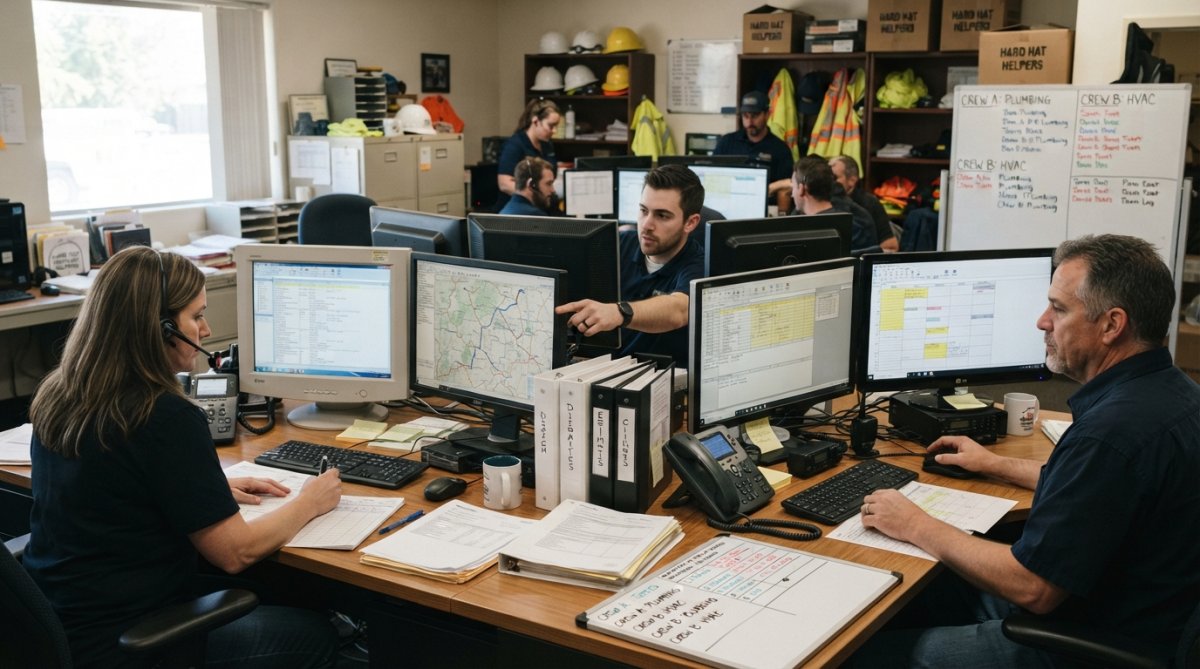
The first person you should hire is not a technician, but someone who can manage the administrative side: a dispatcher, office manager, or estimator who handles work currently pulling you away from being strategic.
This transition is harder than it sounds. You’ve been doing everything because you’re the only one who cares about it being done right. The moment you delegate, you must accept that things will be done differently, not wrong, differently. Most owner-operators fail here. They hire someone, then can’t stop redoing the work or micromanaging every decision.
Be deliberate about what you’re delegating. Some decisions stay with the owner: pricing strategy, hiring, major vendor relationships, customer relationship decisions. Most operational decisions go to the manager: scheduling, day-to-day customer communication, standard invoicing, routine vendor issues. Document this boundary clearly.
Staffing models: in-house, virtual, and hybrid approaches
In-house staff gives you direct control and cultural alignment. A full-time office manager costs $45K-$65K annually plus benefits and taxes.
Virtual staff from specialized providers offers cost efficiency and flexibility. You pay for hours worked, not a full-time salary. Virtual dispatchers, estimators, and office managers trained specifically in home services can integrate into your operations without employment overhead. Specialized providers like Hard Hat Helpers pre-train staff on home service industry specifics, cutting your onboarding time from 4-6 weeks to 1-2 weeks.
Hybrid models combine in-house and virtual resources. You might have a full-time office manager handling strategic relationships plus virtual dispatchers handling day-to-day scheduling. Solo operators should consider virtual staff first; the cost savings and flexibility are substantial. Companies with 10-20 technicians should consider hybrid. Companies over 30 technicians usually need full in-house management.
Home Service Business Software Solutions for Managing Scale
Growth is impossible without software. You cannot manage 50 jobs on a notepad.
Field service management and dispatch software essentials
Field service management software is the backbone of scaling. It handles scheduling, dispatch, customer communication, invoicing, and payment processing. Home service companies using integrated field service software see 20-30% improvements in technician use and 15-25% faster invoice-to-payment cycles.
Key features: real-time dispatch showing technician location and availability, online booking reducing phone volume, mobile access for technicians to view job details and take payments, and integration with accounting software so invoices flow automatically to QuickBooks.
Housecall Pro starts at $59/month and emphasizes scheduling and mobile functionality. Jobber starts at $49/month and includes CRM features. Service Fusion operates at $149/month with unlimited users, cost-effective at 10+ team members.
CRM and work order management during growth
As you grow, customer relationships become harder to track. A CRM tracks every interaction: calls, emails, service history, payment history, notes from technicians. This information is available to anyone on your team, not just the person who knows the customer.
The best field service software includes CRM functionality. Jobber has strong built-in CRM features. If using Housecall Pro, add Thryv or HubSpot’s free CRM. Digital work orders reduce errors and ensure consistency by telling technicians exactly what they’re supposed to do.
Home Service Business Marketing Strategies for Sustainable Growth
Scaling operations is only half the battle. You also need to scale lead generation. Many companies grow operations faster than marketing, creating a capacity gap.
Lead generation and customer acquisition cost control
The fundamental metric is customer acquisition cost (CAC): how much you spend to acquire one customer. If CAC is $150 and customer lifetime value is $2,000, you’re in good shape. If CAC is $500 and lifetime value is $1,500, you’re on a path to unprofitability.
Most home service companies rely heavily on word-of-mouth, which is smart and lowest-cost. But word-of-mouth alone doesn’t scale predictably. Complement it with paid channels you can control.
The most effective paid channels are local search (Google Local Services Ads and Google Maps), local SEO (organic search for "plumber near me"), and targeted Facebook/Instagram advertising. Google Local Services Ads are most direct: you pay per qualified lead, not per click. Track which channels produce customers at what cost through your field service software’s integration with Google Analytics.
Local SEO and digital marketing as you scale
Optimize your Google Business Profile completely: add photos of your team and work, write detailed service descriptions, respond to all reviews, and post updates regularly. Companies with complete, active profiles get significantly more clicks than bare-bones profiles.
Ask customers to leave reviews immediately after service. Make it easy by sending a text or email with a direct link. Companies with 50+ reviews see measurably higher conversion rates. Email marketing to past customers promotes maintenance plans and seasonal services, driving revenue from existing customers at near-zero acquisition cost.
Financial Management and KPI Tracking During Growth
Growth without financial visibility is growth toward a cliff. Many companies experience explosive revenue growth while margins collapse, cash flow tightens, and profitability disappears.
Cash flow management and job profitability analysis
Cash flow is the lifeblood of a growing business. You pay technicians and vendors before customers pay you. Growing 50% year-over-year means your cash needs grow 50% too.
The key metric is days sales outstanding (DSO): how many days between invoice and payment. If you invoice on service day and customers pay within 7 days, DSO is 7. Growing from $1M to $1.5M with 30-day DSO means you need an extra $12,500 in cash just to cover the gap.
Reduce DSO by collecting payment on-site, invoicing immediately, and following up aggressively on past-due accounts. Job profitability analysis is equally important. Track which jobs make money and which lose money. A job looking profitable on the invoice might be unprofitable when factoring in travel time, overhead, and fully-loaded technician cost. If one technician is consistently more profitable, understand why. If a service type is unprofitable, raise the price or stop offering it.
Scaling financial models: what metrics matter most
A solo operator can manage finances on a spreadsheet. A company with 10 technicians needs proper accounting software. A company with 30 technicians needs accounting software plus job costing, forecasting, and reporting.
QuickBooks Online is the standard for small to mid-sized home service companies. QuickBooks Online Advanced ($200/month) adds forecasting and custom reporting for deeper financial visibility.
Key metrics to track:
| Metric | What It Measures | Why It Matters |
|---|---|---|
| Gross Profit Margin | (Revenue – Direct Costs) / Revenue | Shows if pricing covers labor and materials |
| Operating Margin | (Revenue – All Costs) / Revenue | Shows if the business is actually profitable |
| Customer Lifetime Value | Total revenue per customer over time | Determines how much you can spend to acquire them |
| Customer Acquisition Cost | Marketing spend / New customers acquired | Determines if marketing is efficient |
| Technician use | Billable hours / Total available hours | Shows if technicians are working or idle |
| Days Sales Outstanding | Days between invoice and payment | Determines how much cash you need to operate |
Growing companies should aim for: 50-65% gross margin, 15-25% operating margin, CAC less than 20% of customer lifetime value, and technician use above 70%.
Common Mistakes When Managing Growth in Home Service Companies
Hiring too fast without systems in place
The most common mistake is hiring before documenting what you want them to do. You feel overwhelmed, hire someone, and spend all your time managing the new person instead of getting relief.
Hiring feels urgent; building systems feels optional. But hiring without systems is like building a house on sand. The right sequence is: document the process, build the system, then hire someone to execute it. If drowning in dispatch work, spend two weeks documenting your dispatch process before hiring a dispatcher.
Hiring without documentation is the fastest way to create a bottleneck around yourself. Your new hire will constantly ask questions. You’ll constantly redo their work. You’ll end up more overwhelmed than before you hired them.
Neglecting operational efficiency during expansion
Growth creates urgency. You’re focused on getting new customers and serving them; operational efficiency feels like a luxury. This is backwards. Operational efficiency is what makes growth sustainable.
A company 20% inefficient can survive at small scale. At scale, that 20% inefficiency becomes a massive cost drag. A plumbing company with 5 technicians losing 20% to inefficiency loses one technician’s worth of productivity. With 25 technicians, they lose 5 technicians’ worth. Implement dispatch software before drowning in scheduling problems. Build a CRM before customer information scatters across different people’s heads. Measure profitability before building unprofitable habits.
Ignoring mental health and owner burnout
Owners scale their business, hire people, and work harder than ever. They’re stressed, exhausted, and wondering why growth feels worse than survival. The root cause is they haven’t actually stepped back. They’ve added responsibility (managing people) without removing responsibility (doing the work).
The solution is to actually delegate, not pretend to delegate while micromanaging. Hire someone you trust, document what you want them to do, give them authority to make decisions, and step back even when they do things differently. This is incredibly hard for owner-operators who built the business because they care about quality. But if you don’t step back, you’ll burn out, and your business will suffer because an exhausted owner makes bad decisions.
Companies that scale successfully transition from being the business to running the business. This takes conscious effort and usually requires external support: a business coach, a peer group of other owners, or a trusted manager.
Managing growth in home service companies is fundamentally about building systems that work without you. The companies that scale successfully aren’t the ones with the best technicians or smartest owners; they’re the ones with the clearest processes, the best team, and the discipline to measure what matters. Hard Hat Helpers specializes in providing the team infrastructure that growing home service companies lack, offering pre-qualified dispatchers, estimators, and office managers trained specifically in home service operations. With virtual staff handling administrative work, you can focus on scaling operations and strategy instead of being pulled into day-to-day management. Book a consultation to see how specialized virtual staffing can accelerate your growth without the overhead of traditional hiring.
Frequently Asked Questions
What are the biggest operational challenges when managing growth in home service companies?
The primary challenges include maintaining service quality while scaling, managing technician productivity across more jobs, controlling customer acquisition costs, and preventing owner burnout. Many home service companies struggle with dispatch efficiency, work order accuracy, and technician accountability as they add staff and customers. Without proper field service management software and documented processes, growth often leads to service delays, customer dissatisfaction, and margin erosion. Building systems before rapid scaling is critical.
How can home service business software solutions help manage growth effectively?
Field service management platforms like Housecall Pro, Jobber, and Service Fusion automate scheduling, dispatching, invoicing, and customer communication, reducing manual work and human error. These tools provide real-time visibility into technician productivity, job profitability, and customer history. CRM features track customer lifetime value and retention patterns. Integration with accounting software like QuickBooks helps monitor cash flow and profit margins. Proper software eliminates the need for constant owner oversight, freeing you to focus on strategy instead of daily operations.
What's the best hiring approach for home service growth, in-house staff, virtual assistants, or a mix?
Most growing home service companies benefit from a hybrid model. In-house technicians handle field work, while virtual staff manage dispatch, estimating, scheduling, and customer communication. Virtual staffing for administrative roles reduces overhead costs significantly, often by 50% or more, while maintaining quality control through proper training and performance monitoring. This approach lets you scale without the burden of managing payroll, benefits, and onboarding for every new hire. Choose virtual partners with home service industry expertise to ensure they understand your specific workflows, pricing structures, and service areas.
How do you transition from owner-operator to manager without losing control of quality?
Document your processes, pricing, and service standards before hiring. Create checklists for estimating, dispatch protocols, and customer communication. Implement field service software with built-in quality checks and customer feedback loops. Train replacements thoroughly on your specific products, services, and pricing models. Start by delegating administrative tasks (dispatch, scheduling) before moving to estimating or sales. Use performance monitoring and regular check-ins to catch issues early. This transition takes time, expect 2-3 months for new staff to reach full productivity, but it's essential for sustainable growth without burnout.