


Table of Contents
- Is Virtual Bookkeeping Worth It for Trade Businesses? A Direct Answer
- What Is Virtual Bookkeeping and How Does It Work for Trades?
- Virtual Bookkeeping Benefits for Small Business in the Trades
- Cost of Virtual Bookkeeping Services vs. Traditional In-House Accounting
- Virtual Bookkeeping vs In-House Bookkeeping: Key Differences for Trade Businesses
- Best Accounting Software for Trade Businesses Using Virtual Bookkeeping
- Trade-Specific Financial Challenges Virtual Bookkeeping Can Solve
- Data Security, Trust, and Risk Mitigation for Remote Bookkeeping Access
Last Updated: July 25, 2026
Is Virtual Bookkeeping Worth It for Trade Businesses? A Direct Answer
For most trade companies, plumbers, electricians, HVAC contractors, and general construction firms, virtual bookkeeping offers compelling value. Trade businesses operate in a fundamentally different financial landscape than other small businesses. Job costing, seasonal revenue fluctuations, field-to-office coordination, and complex payroll structures create accounting demands that generic bookkeeping solutions often miss. Virtual bookkeeping eliminates administrative friction and frees you to focus on revenue-generating work.
The real question isn’t whether virtual bookkeeping works, it’s whether your business has the right infrastructure and trust framework to make it work. Companies that offload administrative functions see measurable improvements in cash flow management and decision-making speed. Virtual bookkeeping for trade businesses specifically addresses pain points that in-house staff often can’t solve: real-time financial data from the field, integration with job costing software, and expert knowledge of trade-specific tax compliance.
What Is Virtual Bookkeeping and How Does It Work for Trades?
Virtual bookkeeping is the delivery of accounting services, bank reconciliation, accounts payable and receivable, payroll processing, and financial reporting, by remote professionals using cloud-based accounting software. For trade businesses, virtual bookkeeping integrates directly with the tools you already use on job sites. A virtual bookkeeper can access QuickBooks Online or Xero in real time, reconcile payments from multiple job locations, track job-specific expenses, and generate profit-and-loss reports by project.
Cloud Accounting and Real-Time Financial Data
Cloud accounting software like QuickBooks Online and Xero stores all financial data in the cloud, allowing your bookkeeper, you, your accountant, and authorized team members to access the same information simultaneously from different locations.
Real-time financial data access is transformative for trade businesses. Instead of waiting until month-end to see your cash position, you can check your accounts receivable aging report on a Tuesday afternoon and immediately follow up on overdue invoices. You can see which jobs are profitable before the project finishes, enabling faster decision-making about pricing, resource allocation, and project acceptance.
Set up automated bank feeds in your cloud accounting platform. This eliminates manual data entry errors and gives your virtual bookkeeper clean transaction data to reconcile daily. Most trade businesses see a 40% reduction in reconciliation time when they implement this.
Remote Expertise vs. In-House Staff
A virtual bookkeeper is typically a trained accounting professional with experience across multiple industries, including the trades. The advantage is expertise without overhead. A virtual bookkeeper has likely handled accounting for plumbing companies, HVAC contractors, and electrical firms, understanding job costing, change order accounting, and seasonal revenue patterns. An in-house bookkeeper hired fresh would need months of training to understand your specific business model.
The tradeoff is reduced day-to-day presence. Communication happens via email, video calls, and project management tools. For businesses comfortable with asynchronous communication and clear documentation, this works seamlessly.
Virtual Bookkeeping Benefits for Small Business in the Trades
Trade businesses face unique financial management challenges: multiple job sites, variable labor costs, material expenses that fluctuate with market prices, and cash flow timing mismatches between invoicing and payment. Virtual bookkeeping addresses these challenges directly.
Scalability Without Hiring Full-Time Staff
As your trade business grows, adding crews, expanding service territories, taking on larger projects, your financial complexity increases. More invoices, more vendors, more payroll entries, more job codes to track. An in-house bookkeeper becomes overwhelmed, requiring additional hires and proportional overhead.
Virtual bookkeeping scales differently. You don’t hire another person; you allocate more hours from your existing provider. The service adjusts to your volume without adding headcount. This is particularly valuable for trade businesses with seasonal fluctuations. In summer, you might need 40 hours per week of bookkeeping work. In winter, maybe 15. A virtual provider flexes with you.
For trade businesses planning to grow from $500K to $2M in annual revenue, virtual bookkeeping typically costs 40-50% less than maintaining in-house accounting staff while delivering faster financial reporting.
Operational Efficiency and Reduced Administrative Burden
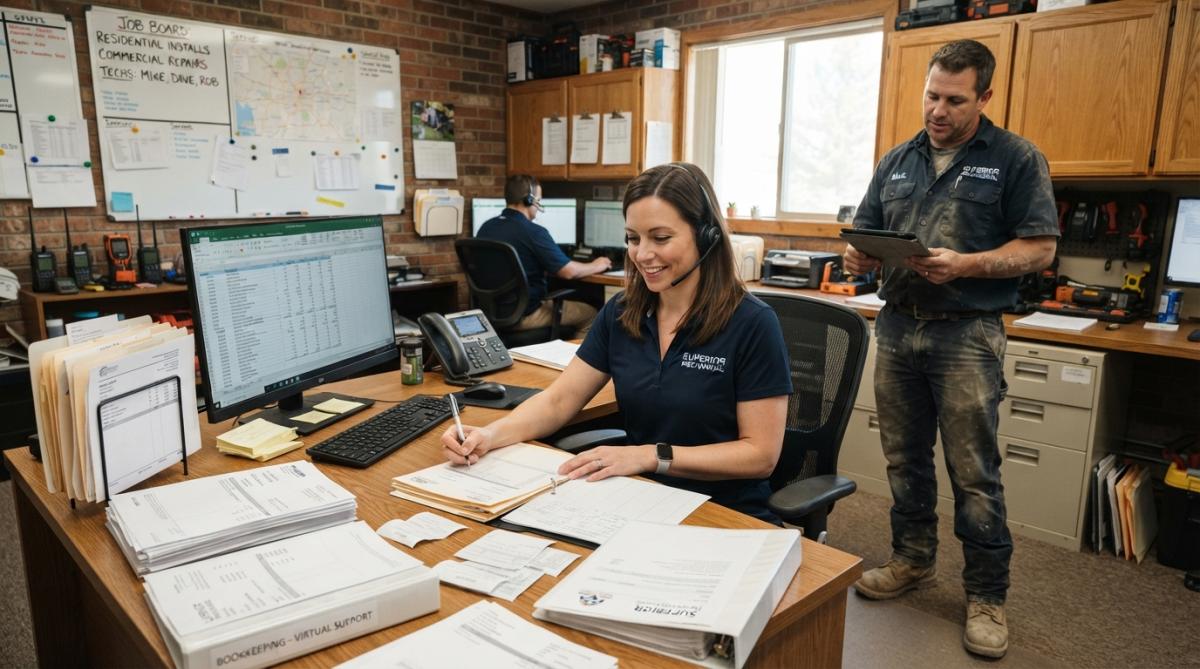
Virtual bookkeeping reduces the administrative burden on you and your office team. Instead of your dispatcher or office manager spending 8 hours per week on invoice entry and reconciliation, that work flows to your virtual bookkeeper. Your team focuses on customer communication, job scheduling, and operational decisions, improving response time and accuracy.
Cost of Virtual Bookkeeping Services vs. Traditional In-House Accounting
Overhead Cost Reduction for Trade Operations
An in-house full-time bookkeeper earning $45,000 per year costs your business closer to $70,000 when you account for benefits, payroll taxes, workers’ compensation insurance, office space allocation, equipment, and training.
Virtual bookkeeping typically costs less per hour but is billed only for hours worked. If you need 20 hours per week of bookkeeping work, you pay for exactly 20 hours. You don’t pay for slow weeks, vacation time, benefits, payroll taxes, insurance, office space, or equipment. Many business owners report reducing their administrative costs by over 50% when switching from in-house to virtual bookkeeping.
Hidden Costs to Watch
Virtual bookkeeping isn’t free from hidden costs. Budget for:
- Software subscriptions: QuickBooks Online or Xero cost $30-150 per month depending on features and user count.
- Integration tools: Some integrations require paid connectors.
- Onboarding time: Getting a new virtual bookkeeper up to speed takes 4-6 weeks.
- Transition costs: Moving from in-house to virtual involves a parallel period where both systems run simultaneously.
Virtual Bookkeeping vs In-House Bookkeeping: Key Differences for Trade Businesses
Control, Flexibility, and Accessibility
In-house bookkeeping gives you direct control. Your bookkeeper is available for questions and can be trained on your specific workflows. Virtual bookkeeping trades some control for flexibility. You don’t set the bookkeeper’s schedule; you set your needs and they deliver. A virtual bookkeeper trained specifically for the trades arrives with that knowledge already embedded. Accessibility is different but not necessarily worse, a virtual bookkeeper might respond to emails within 4 hours instead of immediately, but they’re also available outside your office hours.
Learning Curve and Trade-Specific Knowledge
A new in-house hire needs 2-3 months to understand your business, your job costing structure, and your financial workflows. A virtual bookkeeper trained specifically for trade businesses needs 2-3 weeks.
Trade-specific knowledge is critical. Your bookkeeper needs to understand why you track labor costs by job code, why material costs need to be tied to specific projects, and why seasonal revenue patterns create cash flow challenges. A trade-trained virtual bookkeeper has this framework already, generating job-specific profit-and-loss reports that tell you which projects are profitable.
Best Accounting Software for Trade Businesses Using Virtual Bookkeeping
Not all accounting software is equally suited to trade business workflows. Your choice of platform directly impacts how effectively your virtual bookkeeper can manage your finances.
QuickBooks Online and Xero for Trade Financial Management
QuickBooks Online dominates the small business accounting market and has strong trade business functionality. It supports job costing through class or location tracking, allows unlimited users, integrates with hundreds of field service and invoicing tools, and generates customizable financial reports. Xero is the alternative, particularly popular with accountants and virtual bookkeepers, offering similar job costing capabilities, stronger multi-currency support, and a cleaner interface. Both platforms support real-time bank feeds, automated reconciliation, and mobile access.
Integration with Field and Job Costing Tools
The real value of your accounting software emerges when it integrates with the tools your field teams use. If your crews use a mobile app to log time and materials on job sites, that data should flow directly into your accounting system. QuickBooks Online and Xero both integrate with popular field service software like ServiceTitan, Housecall Pro, and Jobber, as well as time-tracking apps and invoicing tools.
When evaluating accounting software for your trade business, prioritize integration capability over feature count. A platform with fewer built-in features but better integration with your existing tools will serve you better than a feature-rich platform that requires manual workarounds.
If you’re currently using QuickBooks Desktop (the on-premise version), migrating to QuickBooks Online is non-negotiable for virtual bookkeeping. Desktop versions can’t be accessed remotely and don’t support real-time collaboration. Plan for a 2-3 week transition period and budget for data migration support.
Trade-Specific Financial Challenges Virtual Bookkeeping Can Solve
Virtual bookkeeping isn’t a generic solution; it’s valuable precisely because it addresses challenges unique to the trades.
Job Costing, Profit and Loss by Project, and Cash Flow Management
Trade businesses live and die by job profitability. Without accurate job costing, you don’t know which jobs are profitable until weeks after completion. Virtual bookkeepers trained in the trades set up your accounting system so that every labor hour, material cost, and subcontractor expense is tied to a specific job code. They generate weekly or daily job profitability reports showing which projects are tracking to budget and which are running over, letting you make mid-project adjustments before losses accumulate.
Cash flow management is equally critical. Trade businesses often invoice customers on net-30 or net-45 terms, meaning you wait 30-45 days for payment while you’ve paid your crew and suppliers immediately. A virtual bookkeeper tracks aging accounts receivable daily, flags overdue invoices for follow-up, and projects cash position 30-60 days forward so you can plan for payroll and vendor payments.
Tax Compliance and Seasonal Revenue Fluctuations
Trade businesses face specific tax compliance challenges. Subcontractor vs. employee classification has serious tax and liability implications. Quarterly estimated tax payments are often overlooked until penalties accrue. A virtual bookkeeper trained in trade business taxes understands these nuances, classifying workers correctly, calculating quarterly estimated taxes accurately, and tracking sales tax by jurisdiction.
Seasonal revenue fluctuations create accounting complexity. A virtual bookkeeper helps you normalize this volatility, setting aside reserves during busy months to cover slower periods and managing cash flow through seasonal cycles.
Data Security, Trust, and Risk Mitigation for Remote Bookkeeping Access
Handing financial access to a remote person creates legitimate security and trust concerns. How do you know your bookkeeper won’t steal information? How is your financial data protected?
Financial Transparency and Bank Reconciliation Controls
Your virtual bookkeeper doesn’t have access to your bank account or payment systems. They access your accounting software, which you control completely. You set their user permissions, deciding what they can see and what they can edit. They can’t move money or create unauthorized transactions.
Bank reconciliation is the primary control mechanism. Each month, you or your accountant reconcile the bank statement against your accounting records. This process catches any discrepancies immediately. Most virtual bookkeeping arrangements include monthly bank reconciliation as a standard service, creating an audit trail and ensuring accountability.
Vetting and Accountability in Virtual Arrangements
Choosing the right virtual bookkeeper is critical. Vet them thoroughly: request references, verify credentials, ask about experience with trade businesses specifically, and check their background. Many virtual bookkeeping providers handle this vetting for you, providing pre-qualified professionals who’ve been trained and vetted already.
Establish clear service level agreements, response time expectations, deliverable deadlines, and quality standards. Documentation is your protection.
Virtual bookkeeping is worth serious consideration for trade businesses struggling with cash flow visibility, job profitability tracking, or administrative overhead. The model works particularly well for companies with variable accounting needs, seasonal revenue patterns, or complex multi-job operations. The cost savings are real; many trade business owners reduce administrative expenses by over 50% when they transition to virtual bookkeeping. The financial visibility improvements are immediate: real-time job costing, daily cash flow projections, and accurate profit-and-loss reporting by project.
If your trade business is ready to offload financial administration and gain real-time financial visibility, virtual bookkeeping delivers measurable value.
| Aspect | In-House Bookkeeping | Virtual Bookkeeping |
|---|---|---|
| Full-Loaded Cost | $60K-90K annually | $15K-35K annually |
| Setup Time | 8-12 weeks | 2-4 weeks |
| Scalability | Requires hiring | Adjusts with hours |
| Trade Expertise | Requires training | Pre-trained |
| Accessibility | Immediate | 4-24 hour response |
| Overhead | Office space, benefits, equipment | Software only |
| Control | High day-to-day | High through permissions |
| Real-Time Data | Limited | Full cloud access |
Frequently Asked Questions
What are the main benefits of virtual bookkeeping for trade businesses?
Virtual bookkeeping offers trade businesses significant overhead cost reduction, real-time financial data access, and scalability without hiring full-time staff. Trade contractors gain better cash flow management, accurate job costing by project, and reduced administrative burden. Remote expertise allows access to experienced bookkeepers trained in trade-specific challenges like seasonal revenue fluctuations and tax compliance without the expense of in-house salaries and benefits.
How much does virtual bookkeeping cost for a trade business compared to hiring in-house staff?
Virtual bookkeeping services typically cost significantly less than employing a full-time bookkeeper or office manager. In-house staff require salary, benefits, payroll taxes, and workspace, expenses that accumulate quickly. Virtual bookkeeping pricing depends on your business size, complexity, and specific needs. For accurate pricing tailored to your trade operation, contact providers directly for quotes. Many trade businesses report overhead reductions exceeding 50% by switching from in-house to virtual arrangements.
Is virtual bookkeeping secure for sensitive trade business financial data?
Reputable virtual bookkeeping providers use bank-level data security, encrypted cloud platforms, and strict access controls to protect financial information. Look for providers offering multi-factor authentication, regular security audits, and clear data protection policies. The key is vetting your provider thoroughly, verify their credentials, ask about their security certifications, and review their track record with similar trade businesses. Proper controls like bank reconciliation oversight and segregated duties add extra protection.
What's the difference between virtual and in-house bookkeeping for trade businesses?
In-house bookkeeping offers direct control and immediate availability but requires full-time salary, benefits, and training costs. Virtual bookkeeping provides flexible, scalable expertise without overhead, you pay for services used, not idle time. For trade businesses, the key difference is adaptability: virtual arrangements scale up during busy seasons and down during slow periods. However, in-house staff may develop deeper familiarity with your specific pricing structure, service areas, and client relationships over time.
What accounting software works best for trade businesses using virtual bookkeepers?
QuickBooks Online and Xero are industry standards for trade businesses, offering robust job costing, accounts payable, accounts receivable, and profit-and-loss reporting by project. These platforms integrate with field management tools, enabling seamless data flow from job sites to office bookkeeping. The best choice depends on your specific trade needs, HVAC, plumbing, and electrical contractors often benefit from software that handles service-based billing, material tracking, and labor cost allocation. Verify your virtual bookkeeper's expertise with your chosen platform.