


Table of Contents
- Why Franchises Need Virtual Support
- Core Virtual Assistant Services for Franchise Owners
- The Complete Virtual Assistant Hiring Checklist for Franchises
- Cost of Virtual Support for Franchise Businesses
- Best Practices for Managing Remote Franchise Staff
- Compliance and Legal Frameworks for Hiring Virtual Support
- Integration with Franchise Management Software and SOPs
- Getting Started: Your Action Plan for Hiring Virtual Support for Franchises
Last Updated: June 20, 2026
Franchise growth creates a staffing paradox: the faster you scale, the harder it becomes to hire locally without destroying margins. Hiring virtual support solves this directly, giving you access to pre-qualified talent without the overhead of a full in-house team. This guide covers everything from defining roles to managing compliance and integrating remote staff into your operations.
The common assumption is that virtual assistants are a stopgap. They’re not. For franchise operations in home services, virtual staffing is increasingly the primary model for administrative, dispatch, and customer-facing roles.
Why Franchises Need Virtual Support
Franchise operations must maintain brand standards, reporting requirements, and operational consistency across locations while competing in local hiring markets that vary dramatically in cost and availability. Virtual staffing breaks this tension by enabling scalable workforce models that reduce overhead while maintaining continuity.
Virtual staffing for franchises is hiring remote professionals to handle administrative, operational, and customer-facing functions that don’t require physical presence. The result is a scalable workforce model that reduces overhead while maintaining operational continuity.
Common Franchise Hiring Challenges
Most franchise owners face the same wall: local talent is expensive, turnover is high, and the administrative burden of hiring and managing staff pulls focus from business growth. A multi-unit operator dealing with simultaneous vacancies across locations faces a different problem than a single-location franchise. The talent pool for specialized roles like estimators, dispatchers, and office managers is often thin in any given market.
How Virtual Staffing Solves These Problems
Remote staffing breaks the geographic constraint. Instead of competing for local candidates, you access a global talent pool that includes experienced professionals across time zones. This is especially relevant for 24/7 support functions, where offshore staffing enables round-the-clock coverage without night-shift premiums.
Virtual staff handle the administrative load that otherwise falls on franchise owners or their highest-paid local employees. Bookkeeping, scheduling, customer follow-up, and recruitment support can all move to a remote workforce, freeing on-site staff for higher-value work.
The biggest operational gain from virtual staffing isn’t cost reduction. It’s the recovery of owner time, which is the actual limiting factor in franchise growth.
Core Virtual Assistant Services for Franchise Owners
Virtual assistant services for franchises span a wider range than most guides acknowledge. Think of it as business process outsourcing applied specifically to franchise operations.
Administrative Support and Bookkeeping
Administrative support is the entry point for most franchises moving to remote staffing. This includes calendar management, document processing, vendor coordination, and internal communications. For home services franchises, dispatching and job scheduling are high-volume tasks that translate well to remote workflows.
Bookkeeping is the other anchor service. Franchise accounting has specific requirements: royalty reporting, brand fund contributions, and multi-location reconciliation all need accurate, timely handling. A virtual bookkeeper trained on your systems can manage these functions without the cost of a full-time in-house accountant.
Define each function before hiring. Dispatch, bookkeeping, and general admin require different skill sets, and bundling everything into one generalist role produces weaker results.
Customer Service and 24/7 Support
Customer service is where virtual staffing delivers the most immediate impact for franchises. Missed calls and delayed follow-ups cause home services franchises to lose jobs to competitors. A remote customer service team can handle inbound calls, quote requests, and appointment booking around the clock.
24/7 support is achievable through offshore staffing. Professionals in different time zones cover overnight and weekend shifts at a fraction of the cost of domestic night-shift staffing.
Set up a dedicated call routing protocol before your virtual customer service team goes live. Calls requiring on-site judgment should route to a local contact, not sit in a queue. This prevents the most common complaint about remote customer service: delayed escalations.
Marketing and Recruitment Assistance
Marketing support from a virtual team covers social media management, review response, local SEO updates, and email campaign execution. A virtual marketing assistant can address local market nuances that brand-level marketing misses.
Recruitment assistance is equally useful. A virtual recruiter can source candidates, screen applications, and schedule interviews, reducing the time franchise owners spend on hiring cycles.
The Complete Virtual Assistant Hiring Checklist for Franchises
Most failed virtual hires trace back to vague role definition, not a bad candidate. Get the pre-hire work right and everything downstream becomes easier.

Pre-Hire Assessment and Role Definition
Before recruiting, answer three questions: What tasks are currently falling through the cracks? Which require physical presence? What does success look like in 90 days?
Use this pre-hire checklist:
- Document all tasks the role will own
- Identify tasks requiring specific software access or credentials
- Define working hours and time zone requirements
- Set a 30/60/90 day performance benchmark
- Confirm required tool proficiency on day one
- Determine whether the role is full-time, part-time, or project-based
- Establish communication protocols and response time expectations
Recruitment and Talent Acquisition
Talent acquisition for virtual roles requires evaluating candidates you may never meet in person, often across cultural and language differences. The screening process must compensate for this.
Practical recruitment steps:
- Write a role-specific job description with concrete deliverables
- Include a skills assessment in the application process
- Conduct video interviews to assess communication quality
- Check references with specific questions about remote work performance
- Run a paid trial period before committing to a long-term contract
According to International Labour Organization’s remote work guidance, structured trial periods significantly improve long-term remote hire retention.
Onboarding and Integration Process
Onboarding is where most virtual hires succeed or fail. A remote employee who doesn’t understand your systems, culture, and expectations within the first two weeks rarely recovers.
Effective onboarding includes:
- Provide access to all required tools and systems on day one
- Assign a dedicated point of contact for the first 30 days
- Record training sessions for independent reference
- Schedule daily check-ins for the first two weeks, then shift to weekly
- Share Standard Operating Procedures in writing
- Set clear escalation paths for decisions requiring franchise owner input
Written procedures are the difference between a VA who operates independently and one who needs constant supervision. If your SOPs don’t exist yet, building them is the first step before hiring.
Cost of Virtual Support for Franchise Businesses
The cost of virtual support varies based on role complexity, geographic location, and whether you work with a staffing agency or hire directly. Virtual staffing is substantially less expensive than equivalent in-house hiring.
Pricing Models and Budget Planning
Three pricing models dominate the virtual staffing market:
| Model | Structure | Best For |
|---|---|---|
| Hourly | Pay per hour worked | Part-time or variable workloads |
| Monthly retainer | Fixed fee for set hours | Consistent, ongoing roles |
| Managed service | Agency handles payroll, benefits, oversight | Franchises wanting reduced admin burden |
Managed service models include payroll management, benefits administration, and performance monitoring. This eliminates the administrative overhead of being a direct employer while providing reliable, trained staff.
ROI and Cost Reduction Benefits
The ROI calculation for virtual staffing is straightforward when accounting for the full cost of an in-house hire. Salary is only part of it. Add employer taxes, benefits, office space, equipment, and recruitment costs, and the true cost of a local employee is substantially higher than their base wage.
According to Society for Human Resource Management’s cost-per-hire research, the average cost to replace an employee ranges from one-half to two times their annual salary. Virtual staffing reduces both replacement frequency and cost per hire.
Hard Hat Helpers clients in home services report overhead cost reductions of over 50% compared to equivalent in-house staffing.
Best Practices for Managing Remote Franchise Staff
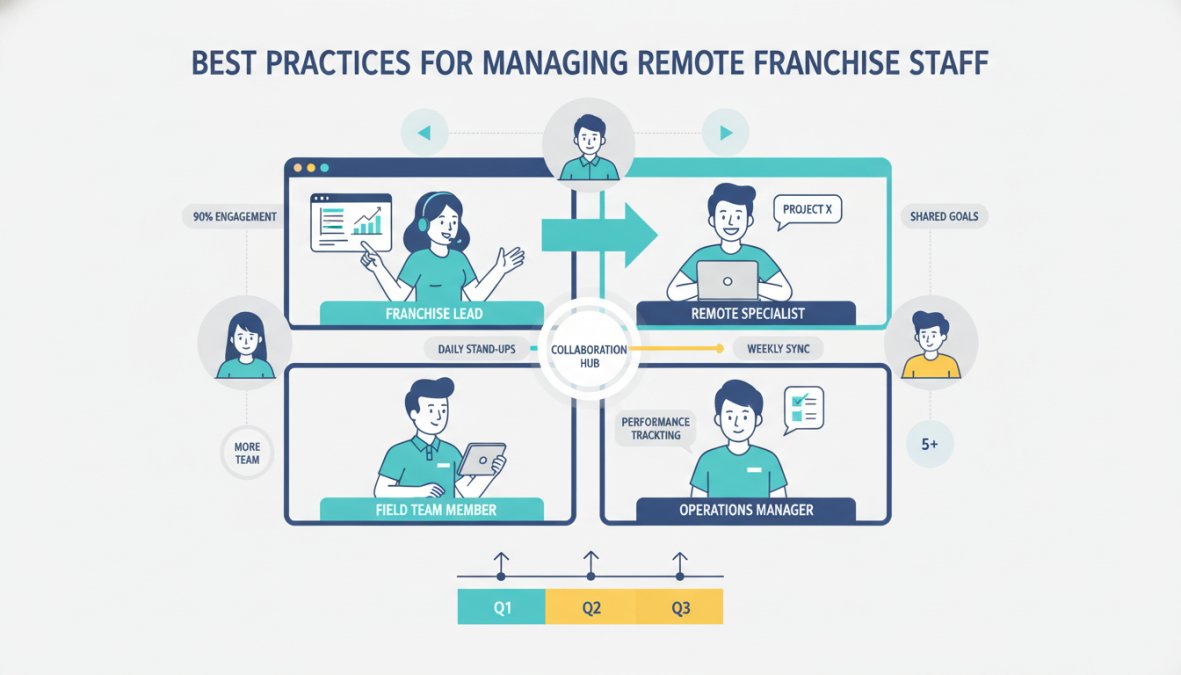
Managing a remote workforce requires different habits than managing an in-office team. Output-based accountability replaces the instinct to monitor presence.
Performance Monitoring and Accountability
Performance metrics for franchise VAs should connect directly to business outcomes. Define KPIs before the hire starts and review them on a regular cadence.
Practical metrics by role:
- Dispatcher: Call answer rate, average handle time, job booking conversion rate
- Bookkeeper: Report accuracy, submission timeliness, reconciliation error rate
- Customer service: First-contact resolution rate, customer satisfaction score, response time
- Recruitment VA: Time-to-fill, candidate quality score, interview-to-offer ratio
Avoid setting KPIs once and never revisiting them. As your franchise operations evolve, the metrics that matter change. A quarterly KPI review prevents your VA’s performance benchmarks from becoming irrelevant.
Communication and Team Integration
Remote franchise staff integrate better when treated as team members, not contractors at arm’s length. Include them in relevant team meetings, share business updates affecting their work, and create clear communication channels.
Practical communication structure:
- Weekly team standup (video, not just chat)
- Shared project management tool for task visibility
- Defined response time expectations by channel
- Monthly one-on-one between VA and direct supervisor
A dispatcher who understands your franchise’s growth goals will make better judgment calls than one who sees their role as purely transactional.
Compliance and Legal Frameworks for Hiring Virtual Support
Compliance is critical when hiring virtual support across international borders. Hiring creates real legal obligations that vary by country, state, and employment classification.
Answer these core compliance questions before hiring:
- Employment classification: Is the VA an employee or independent contractor? Misclassification carries significant legal and financial risk.
- Data privacy: If your VA handles customer data, you must comply with applicable privacy regulations (GDPR for EU-based staff, CCPA for California customer data).
- Intellectual property: Service agreements should clearly assign ownership of work product to the franchise.
- Tax obligations: Offshore contractors may trigger withholding or reporting requirements depending on your jurisdiction.
The U.S. Department of Labor’s guidance on worker classification provides the federal framework for distinguishing employees from independent contractors. State-level rules vary and are often stricter.
Working through a managed staffing provider substantially reduces compliance exposure. When the staffing agency is the employer of record, they handle the legal obligations of employment, including tax filings, benefits compliance, and labor law adherence.
Before signing any virtual staffing agreement, confirm in writing who holds employer-of-record status. This single document determines your legal exposure across tax, benefits, and labor law compliance.
Integration with Franchise Management Software and SOPs
Virtual staff only perform as well as the systems you give them. Your VA needs access to the same systems your in-office staff use: CRM, scheduling software, accounting platforms, and communication tools.
Standard Operating Procedure templates are the connective tissue between your systems and your VA’s daily work. A well-written SOP covers:
- Step-by-step task instructions with screenshots
- Decision trees for common scenarios
- Escalation protocols for situations outside the VA’s authority
- Tool-specific workflows for each software platform
Build SOPs before you hire. The process forces clarity about how your operation actually works, making hiring and onboarding significantly more effective.
For home services franchises, common software integrations include field service management platforms, VoIP systems, and cloud-based accounting tools. Your virtual staffing provider should confirm proficiency with your specific stack before placement.
Getting Started: Your Action Plan for Hiring Virtual Support for Franchises
The gap between knowing you need virtual support and having a functioning remote team is usually a process problem. Here’s a concrete action plan.
Week 1: Role definition and SOP development
- Audit your current operations for tasks that don’t require physical presence
- Select one role to start with (dispatcher or administrative support are lowest-risk entry points)
- Draft SOPs for the top five tasks that role will own
Week 2: Recruitment
- Write a role-specific job description with concrete 90-day deliverables
- Decide between direct hire and managed staffing (managed is recommended for first-time virtual hires)
- Begin screening candidates with a skills assessment
Week 3: Selection and pre-onboarding
- Conduct video interviews with shortlisted candidates
- Run reference checks focused on remote work performance
- Prepare system access, communication tools, and onboarding documentation
Week 4: Onboarding
- Assign a dedicated point of contact for the first 30 days
- Schedule daily check-ins for the first two weeks
- Review KPIs at the 30-day mark and adjust as needed
According to Harvard Business Review’s research on remote team performance, the first 30 days of a remote hire’s tenure are critical for building effective working habits. Front-loading your onboarding investment pays off in long-term performance.
Hiring virtual support for franchises doesn’t require a leap of faith. With the right role definition, structured recruitment, and clear performance metrics, remote staffing becomes a repeatable, scalable system.
Franchise owners who wait until overwhelmed typically make reactive, expensive decisions. Hard Hat Helpers provides a structured alternative: pre-qualified virtual professionals trained specifically for home services, with managed payroll and benefits, continuous performance monitoring, and a dedicated Client Success Manager for every client. Book a consultation to see how the model works for your specific locations and roles.
Frequently Asked Questions
What tasks can virtual assistants handle for franchises?
Virtual assistants for franchises manage administrative support, bookkeeping, customer service, scheduling, and marketing tasks. They handle 24/7 support capabilities, data entry, appointment management, and franchise operations coordination. Many virtual staffing companies offer pre-trained professionals who understand your franchise systems and can integrate seamlessly into existing workflows. The scope depends on your franchise's specific needs and industry requirements.
What should be included in a virtual assistant hiring checklist for franchises?
A comprehensive virtual assistant hiring checklist for franchises should include: defining role requirements, assessing talent pools, verifying qualifications, establishing onboarding procedures, setting performance metrics, confirming compliance requirements, and planning integration with your franchise management software. Include remote recruitment timelines, SOP documentation, communication protocols, and monitoring systems. This checklist ensures you hire the right remote staffing talent and set them up for success from day one.
How much does virtual support cost for franchise businesses?
The cost of virtual support for franchise businesses varies by role, location, and service provider. Offshore virtual assistants typically cost $8-15/hour, while domestic options range from $15-25+/hour. Full-service virtual staffing companies may charge monthly retainers covering recruitment, onboarding, payroll, and benefits management. Many franchises achieve over 50% overhead cost reduction by outsourcing administrative support. Request quotes from multiple providers to compare pricing models and ROI potential for your franchise.
How do you maintain brand consistency with remote virtual staff?
Maintain brand consistency by providing detailed SOP templates, standard operating procedures, and comprehensive training on your franchise's specific products, services, and brand voice. Use franchise management software for centralized documentation and communication. Implement performance metrics tracking, regular feedback sessions with your dedicated client success manager, and periodic quality audits. Clear onboarding that emphasizes your franchise culture and values ensures remote staff represent your brand accurately across all customer interactions.