


Table of Contents
- Why HVAC Contractors Outsource Dispatching
- Benefits of Outsourcing Your HVAC Dispatch Operations
- Step 1: Assess Your Current Dispatching Workflows
- Step 2: Define Dispatcher Responsibilities and Service Level Agreements
- HVAC Virtual Assistant for Dispatching: What to Look For
- Step 3: HVAC Dispatcher Training Manual and Onboarding Process
- Step 4: Managing Remote Dispatchers for HVAC Operations
- HVAC Dispatching Services Cost and Pricing Models
How to Outsource HVAC Dispatching: A Step-by-Step Guide
Last Updated: August 3, 2026
Why HVAC Contractors Outsource Dispatching
Managing dispatch operations in-house stretches thin for most HVAC contractors. Technicians answer phones instead of installing systems, office staff juggle scheduling while handling complaints, and peak season creates chaos that internal hiring doesn’t solve cleanly.
Outsourcing dispatching transfers your entire logistics operation: call routing, job scheduling, technician tracking, and customer communication. This forces you to document workflows you’ve never written down, clarify pricing structures, and build systems that scale.
Contractors who make this transition report recovering 15-20 hours per week of field-time for senior technicians, real revenue recovery. For a two-person crew, that’s one full technician’s worth of billable work reclaimed.
The biggest mistake contractors make is outsourcing dispatch without first documenting their own workflows. You can’t hand off what you haven’t defined. Spend 2-3 weeks writing down your call routing, pricing tiers, service areas, and technician assignment rules before you talk to any service provider.
Benefits of Outsourcing Your HVAC Dispatch Operations
Reducing administrative overhead on your field team
Your lead technician shouldn’t be the de facto dispatcher. Outsourcing dispatch eliminates this friction. A trained remote dispatcher answers calls within two rings, quotes from your documented pricing structure, checks real-time technician availability, and books the job on the spot.
Technicians recover 10-15 hours per week, translating directly to billable hours. Your office staff shifts from reactive firefighting to proactive operations: scheduling maintenance plans, managing customer history, and tracking service level agreements.
Improving customer response times and booking conversion
Speed matters in dispatching. A customer calling for an HVAC emergency at 6 p.m. doesn’t want a callback promise, they want an appointment confirmed before hanging up.
In-house dispatchers often work 9-5, but peak call volume hits at 7 a.m. and 5 p.m. A remote dispatch team working staggered hours catches calls across your entire operating window. Businesses implementing 24/7 remote dispatching report 20-30% higher booking rates in their first month.
Real-time visibility into technician locations also matters. A dispatcher who can see your technician finishing a job 10 minutes away can offer the next customer a same-day appointment.
Scaling dispatch capacity without hiring full-time staff
Seasonal volatility is brutal in HVAC. Summer cooling emergencies and winter heating calls create weeks where you need double your normal dispatch capacity. Outsourcing solves this: you scale your dispatch team up for peak season, then scale back. You pay for capacity when you need it, not for idle time.
A remote dispatch service also handles recruitment, training, payroll, and performance management. If someone underperforms, the service replaces them.
The three main benefits, reducing administrative burden, improving response times, and scaling without hiring, compound. You recover technician time, close more jobs, and handle growth without building permanent office staff. Contractors who outsource dispatching often see 30-40% improvement in operational efficiency within six months.
Step 1: Assess Your Current Dispatching Workflows
Before outsourcing, understand what you’re actually outsourcing. Most HVAC contractors have never documented their dispatch process.
Start by mapping three things: call routing, job scheduling, and technician tracking.
Call routing is the decision tree for how calls get handled. When a customer calls, what information do you collect? How do you determine if it’s an emergency? Do you route by service type? Write this down.
Job scheduling is how you assign work. Do you schedule by technician capacity, service area, or equipment type? What’s your minimum job spacing? How do you handle no-shows? Document it.
Technician tracking is how you know who’s available. Do you use GPS, phone calls, or a work order app? How do dispatchers know if a technician is running late?
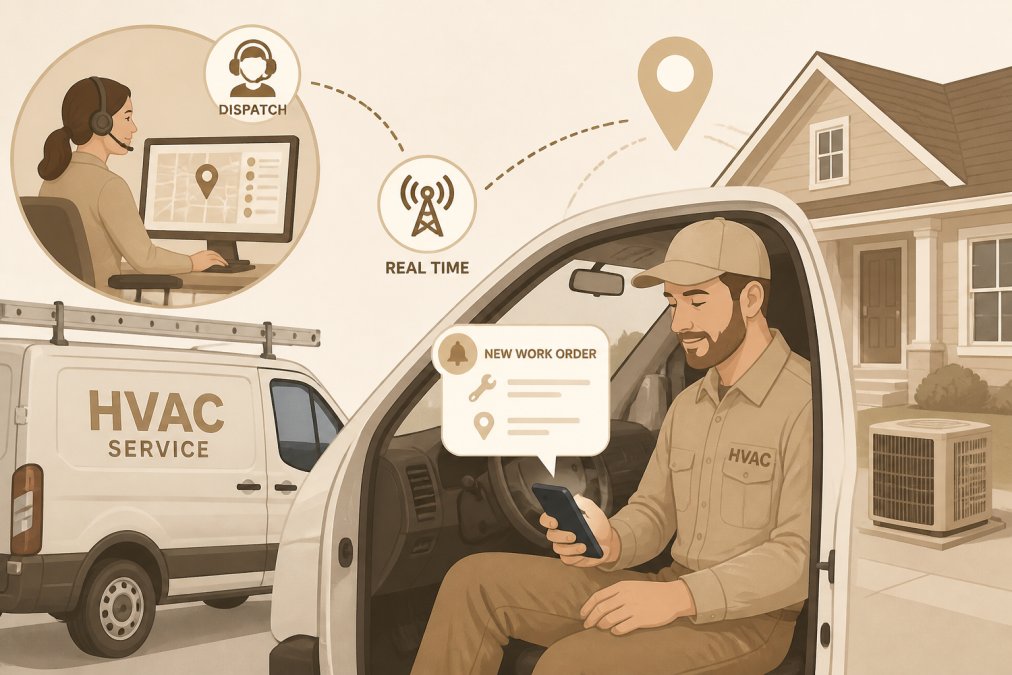
Document your call routing, job scheduling, and technician tracking processes
Write a one-page summary for each process. For call routing, include examples: emergency calls at 2 a.m., new customer estimates, routine maintenance requests. For job scheduling, document your actual rules: jobs per technician per day, average job duration by type, how you handle overlapping appointments. For technician tracking, describe your current system and status-check frequency.
Identify bottlenecks in your dispatch efficiency
Common bottlenecks include call abandonment during peak times, scheduling delays, technician downtime, pricing inconsistencies, after-hours emergencies, and high no-show rates. Identify three to five of your biggest bottlenecks. These become your outsourcing priorities.
Step 2: Define Dispatcher Responsibilities and Service Level Agreements
Define what you want your outsourced dispatcher to do and what you keep in-house.
Most HVAC contractors outsource: answering calls, quoting standard prices, scheduling appointments, providing technicians with job details, following up on confirmations, managing call queues, and handling after-hours emergencies.
Some also outsource: collecting payment information, upselling maintenance plans, rescheduling no-shows, and following up on completed jobs.
You probably keep in-house: complex pricing negotiations, technical troubleshooting, handling upset customers, and approving service recommendations beyond standard scope.
Handling after-hours service calls and emergency routing
Define your after-hours policy. Do you want all calls answered live, emergency-only calls answered, or voicemail with callbacks? Define your emergency criteria so your dispatcher knows when to escalate to an on-call technician.
Managing call queues and real-time visibility into job status
Define your service level agreements (SLAs):
- Call answer time: Target 30 seconds or less during business hours
- Appointment confirmation: Within 24 hours of the customer’s requested date
- Technician arrival window: Within 30 minutes of the scheduled appointment time
- Callback time for after-hours calls: Within 1 hour of the message
- Job completion communication: Technician confirms completion within 15 minutes
Set realistic SLA targets based on your actual service area and job duration. A missed SLA erodes customer trust faster than a slightly longer but honest window.
HVAC Virtual Assistant for Dispatching: What to Look For
Look for a dispatch service that provides:
- Industry-specific training on HVAC systems and service calls. Your dispatcher needs to understand the basics of emergency versus routine calls and your service area.
- Familiarity with dispatch software integration. They should have experience with ServiceTitan, Jobber, Housecall Pro, or your platform.
- Knowledge of your specific pricing structure and service areas. A good provider learns your pricing before taking their first call.
- Experience with after-hours and emergency call handling. Make sure they offer 24/7 coverage if that’s part of your plan.
- Dedicated support and performance accountability. You should have a dedicated person who knows your business, not a different dispatcher every day.
Hard Hat Helpers specializes in training dispatchers for home service businesses. They provide industry-specific onboarding, integration with your existing dispatch software, and a dedicated Client Success Manager who monitors performance and ensures your dispatcher stays trained on your pricing and service areas.
Step 3: HVAC Dispatcher Training Manual and Onboarding Process
The success of outsourced dispatching depends entirely on training.
Creating documentation for your pricing structure and service areas
Create a one-page pricing sheet including:
- Service call pricing (flat rate or hourly?)
- Repair pricing (standard rates or case-by-case?)
- Installation pricing
- Maintenance plan pricing
- Emergency pricing
- Service areas and travel fees
- Discounts and promotions
Include your service area map marking primary, secondary, and unserviced areas with response time targets.
Training remote dispatchers on your specific equipment and workflows
Create a simple reference guide including:
- Equipment list (brands and models you service)
- Common problems and diagnostic questions
- Red flags requiring escalation
- Call script or talking points
- Technician roster with specialties and availability
- Workflow for common scenarios (new customers, maintenance, emergencies, complaints)
Invest in a video walkthrough of your dispatch software. Record a 10-minute video showing [how to](/how-to-scale-home-service-business/) create a work order, assign it to a technician, and update job status. That single video cuts training time in half.
Step 4: Managing Remote Dispatchers for HVAC Operations
Once your dispatcher is trained and live, shift from training to management.
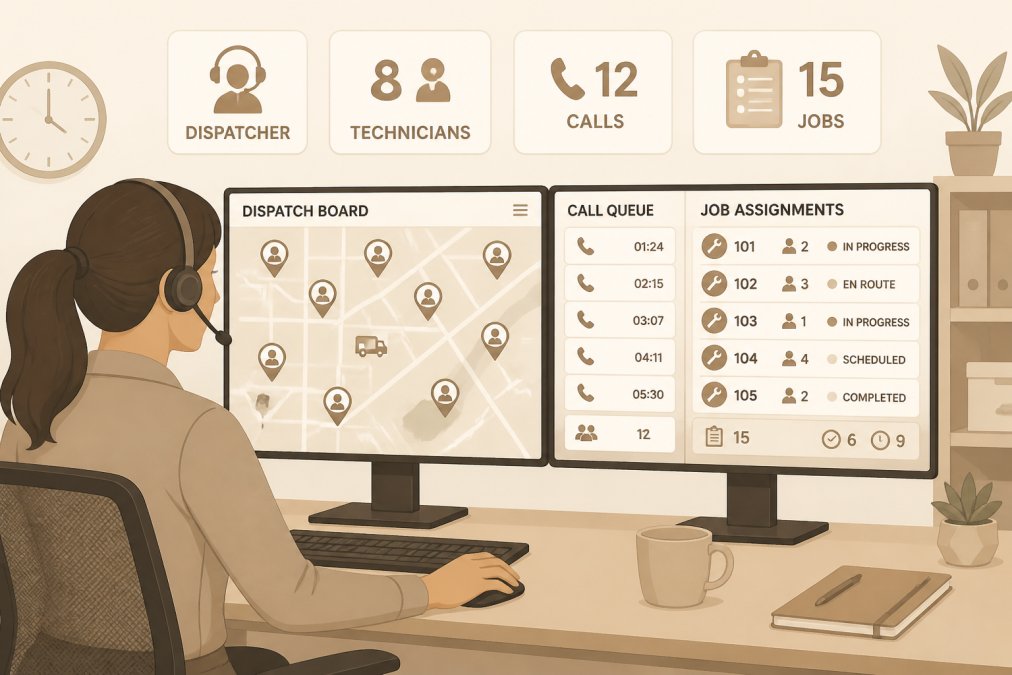
Monitoring technician use and real-time job tracking
Set up weekly check-ins reviewing:
- Call volume and answer metrics
- Appointment booking rate
- Scheduling accuracy
- Customer feedback
- Dispatcher questions or challenges
(/virtual-assistant-services-hvac/) Operations]
Use your dispatch software’s reporting tools to track technician use, job completion rates, and revenue per technician weekly.
Maintaining quality control and customer satisfaction metrics
Track these metrics:
- Customer satisfaction: Target average of 4.5 or higher on a 1-5 scale
- Pricing errors: Should be zero or near-zero after the first month
- Scheduling errors: Track and identify patterns
- No-show rate: If above 10%, improve confirmation calls
- Technician feedback: Ask if they received clear job information
Set up monthly performance reviews. If your dispatcher is hitting SLAs and customer satisfaction targets, continue. If there are problems, address them immediately. Your service provider should replace underperforming dispatchers.
The key to managing remote dispatchers is clear metrics and frequent communication. Weekly check-ins prevent small problems from becoming big ones. Monthly reviews ensure you’re hitting business goals.
HVAC Dispatching Services Cost and Pricing Models
Understanding pricing structures: per-call, hourly, or hybrid models
Per-call pricing: You pay $5-15 per call. Simple and scales with volume, but expensive for high call volume.
Hourly pricing: You pay $20-35 per hour. Good for consistent volume, but you pay for idle time.
Hybrid pricing: Base hourly rate plus per-call fee. Balances both models.
Most HVAC dispatching services use hybrid or per-call pricing because call volume varies seasonally.
Calculating ROI and overhead savings for your operation
The ROI depends on your current situation. If you’re missing calls, ROI is the revenue from captured calls. If you’re handling calls in-house, ROI is the cost savings from not hiring staff plus revenue from improved efficiency.
The real ROI comes from secondary effects:
- Improved booking conversion: 10% improvement on $500K revenue = $50K additional revenue
- Reduced technician downtime: 5% efficiency gain = one additional billable day per technician per month
- Eliminated missed calls: Capturing 20% of missed calls during peak season = $37,500+ monthly
Track metrics before and after: booking conversion, technician use, customer satisfaction, and revenue per technician. If those improve, outsourcing is working.
Frequently Asked Questions
What makes a good HVAC virtual assistant for dispatching different from a general administrative assistant?
A qualified HVAC virtual assistant understands your specific pricing structures, service areas, equipment types, and call routing priorities. They're trained on dispatching workflows, technician utilization metrics, and how to handle after-hours emergency calls. Generic virtual assistants lack this industry context and require extensive retraining on your business processes, costing you time and customer satisfaction.
How long does it take for a remote dispatcher to become productive in managing your HVAC service calls?
With structured HVAC dispatcher training, most remote dispatchers become productive within 2-4 weeks. The timeline depends on your documentation quality, dispatch software complexity, and how well you've documented your service areas and pricing. Providers offering industry-specific training and dedicated onboarding reduce this ramp-up time significantly. Expect 1-2 weeks of shadowing and supervised call handling before independent operation.
What are the key differences between managing remote dispatchers for HVAC versus other service industries?
HVAC dispatching requires understanding seasonal demand spikes, emergency response protocols, equipment-specific diagnostics, and route density optimization. Remote dispatchers must master your specific technician utilization targets, customer history systems, and how to prioritize service calls based on system type and urgency. They also need familiarity with work order management tied to equipment maintenance logs, which differs from generic service dispatching.
How do I know if outsourcing HVAC dispatching will actually reduce my overhead costs?
Compare your current costs: dispatcher salaries, benefits, payroll taxes, training time, and turnover. Outsourcing eliminates most of these fixed costs. Many HVAC contractors report 30-50% overhead reduction by outsourcing dispatching, particularly when outsourcing partners offer 24/7 availability without requiring full-time staff. Request references from similar-sized HVAC companies and ask about their specific cost savings and ROI timeline before committing.