




Table of Contents
- What Is Trade Dispatch Outsourcing and Why It Matters for Home Services
- Pros and Cons of Outsourcing Field Service Dispatch
- Cost Reduction and Overhead Savings
- Operational Efficiency and Scalability Gains
- 24/7 Dispatch Coverage and Time Zone Advantages
- How to Choose a Dispatch Answering Service
- Outsourced Dispatch Services Pricing and ROI
- Security, Data Privacy, and Integration Considerations
Last Updated: August 7, 2026
What Is Trade Dispatch Outsourcing and Why It Matters for Home Services
Outsourcing trade dispatch is delegating field service scheduling, customer communication, and job coordination to a specialized external team. For home services businesses, this means handing off phones, scheduling software, callbacks, and technician coordination to professionals trained in your industry’s workflows.
Dispatch isn’t just answering phones, it’s understanding your service areas, pricing, appointment availability, and customer expectations. It’s managing peak seasons, handling emergencies, and representing your brand during first contact. When done poorly, it costs you jobs. When done well, it becomes your competitive edge.
Hard Hat Helpers has worked with home services contractors losing revenue because dispatch was understaffed or undertrained. A plumber answering calls between jobs. An office manager juggling three phone lines while managing schedules. A remodeling company missing jobs due to slow callbacks. The pattern repeats across HVAC, plumbing, electrical, and general contracting.
The real question isn’t whether to outsource dispatch, it’s whether your current approach is costing you more than it saves.
Pros and Cons of Outsourcing Field Service Dispatch
Outsourcing dispatch isn’t one-size-fits-all. Understanding both advantages and challenges helps you make the right choice.
Key Advantages You’ll See Immediately
Reduced administrative overhead eliminates the salary, benefits, payroll taxes, and training costs of a full-time dispatcher, plus the recruiting headache when they leave. Hard Hat Helpers handles onboarding, training, payroll, and replacement.
24/7 dispatch coverage means your phones get answered at 2 AM for emergency calls. Your schedule stays current. Callbacks happen on time. Customers who can reach you after hours feel valued and remember that when choosing between you and competitors.
Faster job capture and scheduling accuracy happens when your dispatcher understands your pricing, service areas, and technical capabilities. A trained outsourced dispatcher knows which jobs fit your profile and schedules intelligently, avoiding double-booking and gaps. This directly translates to higher weekly revenue.
Scalability without headcount growth lets you flex capacity during peak season without hiring and laying off staff. You pay for what you use.
Focus on core business is what most owners value most. You spend less time managing office staff and more time growing the business, winning larger contracts, or improving service delivery.
Real Challenges to Plan For
Integration friction happens when your new dispatcher doesn’t know your systems, pricing, or customer base. The first two weeks are rough. This is temporary but real. Quality onboarding determines how fast you move past this phase.
Learning curve for complex pricing is specific to certain trades. Remodeling companies with custom quotes need estimators who understand cost structure and margin requirements. HVAC companies with multiple service tiers need dispatchers who know which jobs to bid.
Quality variability depends entirely on training and ongoing support. A generic staffing company with no home services expertise will struggle. A specialized provider trained on your operation will not.
Transition period disruption is unavoidable. Some customers notice. Some jobs might slip through during handoff. Plan for this short-term pain for long-term gain.
Dependency on a single provider means your business is tied to their reliability. This is manageable with a good partner who has redundancy built in.
Cost Reduction and Overhead Savings
A full-time dispatcher in most U.S. markets costs $35,000-$50,000 annually in salary alone. Add benefits, payroll taxes, training, and replacement costs, and total cost of employment reaches $50,000-$65,000 per year.
One dispatcher typically handles 30-50 jobs per day. If you’re doing 40 jobs daily, you need 1.5-2 people, $75,000-$130,000 per year for a non-core function.
Outsourced dispatch shifts this from fixed to variable cost. You pay for capacity you actually use. During slow months, costs drop. During peak season, you add capacity without hiring. Hard Hat Helpers clients typically report 40-50% overhead reductions on administrative staffing when transitioning from in-house to outsourced dispatch.
This includes recruiting, training, and management burden elimination. You’re not interviewing candidates, managing HR issues, or dealing with turnover.
ROI depends on your current staffing model and job volume. A contractor with one overworked office manager handling dispatch, scheduling, and estimating sees immediate savings. A contractor with two dedicated dispatchers sees smaller percentage gains but still meaningful reduction.
Operational Efficiency and Scalability Gains
A trained dispatch team working specifically for home services moves faster than generalist operations. They understand your day’s rhythm, know which jobs are high-value, and schedule intelligently, routing geographically, matching complexity to technician skill, and protecting margins.
This efficiency compounds. More correctly scheduled jobs means higher daily revenue. Fewer scheduling conflicts means fewer complaints. Faster callbacks mean more captured jobs. A single percentage point improvement in job capture rate translates to tens of thousands in annual revenue.

(/streamline-home-service-dispatch-workflows/)]
Scalability without chaos is the real win. Your business grows 30%, 50%, or 100%. With in-house dispatch, you’d hire, train, and manage more staff. With outsourced dispatch, you add capacity in days. Your partner handles recruiting and training.
This becomes critical during seasonal peaks. HVAC sees demand spike in summer and winter. Plumbing surges during cold snaps. Remodeling has project season. Outsourced dispatch lets you flex capacity up and down with demand without paying for idle staff.
A good partner also tracks metrics, callback times, job capture rates, scheduling accuracy, customer satisfaction. You get visibility into what’s working and make decisions based on data, not gut feel.
24/7 Dispatch Coverage and Time Zone Advantages
Most home services businesses operate during business hours but get emergency calls at night. A water heater fails at 11 PM. A pipe freezes at 2 AM. An electrical issue creates safety concerns at midnight.
24/7 coverage means someone answers immediately and trained on your operation. After-hours callbacks happen when promised because information is already there. No miscommunication. No missed opportunities.
Time zone distribution is underrated. If your dispatch team spans time zones, you have coverage during peak hours in every zone. A plumbing company in California gets calls answered immediately during California business hours. Customers don’t care where the dispatcher sits, they care that someone answered, understood their problem, and scheduled the job.
This becomes especially valuable for multi-state operations. A remodeling company with projects in three states can have dispatch coverage aligned to each state’s business hours without hiring separate staff in each location.
How to Choose a Dispatch Answering Service
Not all dispatch outsourcing providers are equal. A generic virtual assistant service won’t understand HVAC pricing. A call center trained on insurance claims won’t handle plumbing emergencies well.
The best dispatch provider for home services has three things: industry expertise, integration capability, and accountability.
Industry expertise means they’ve trained people specifically on home services workflows. They understand the difference between service calls, estimates, and emergencies. They know what questions to ask, can qualify leads, understand service areas and pricing. Hard Hat Helpers trains every dispatcher on your specific operation, products, pricing, service areas, and customer expectations.
Integration capability matters because dispatch connects to scheduling software, CRM, and estimating tools. A provider integrating seamlessly with your existing tools reduces friction. A provider requiring re-entry of information creates overhead, not saves it. Confirm specific integration with tools you use today.
Accountability is about what happens when something goes wrong. If a callback is missed, what’s the process? If a job is scheduled incorrectly, who fixes it? If your dedicated team member leaves, how fast is replacement? A good provider has service level agreements, tracks metrics, reports on performance, and has consequences for poor performance.
When evaluating providers, ask for references from contractors similar to your size and service type. Get specifics about training process, integration capabilities, and replacement process. Ask how they handle peak season demand and what metrics they track.
The cheapest provider often isn’t best. A provider saving 30% on cost but missing 10% of callbacks might cost more in lost revenue than you save. A provider costing slightly more but capturing 5% more jobs and handling your brand correctly is a better investment.
Outsourced Dispatch Services Pricing and ROI
Pricing varies based on volume, complexity, and service level. Some providers charge per call, per hour of coverage, or per technician. Some charge flat monthly fees. Some charge per job scheduled.
Hard Hat Helpers customizes pricing based on your needs. Rather than guessing, get a quote based on your specific operation to calculate ROI accurately.
Start with current dispatch costs: salary, benefits, payroll taxes, recruiting, management time, training, and turnover disruption. Compare to outsourced dispatch cost. The difference is your savings.
Then add revenue gains. If outsourcing improves job capture by 2%, what’s that worth? If it lets you schedule 10% more jobs daily by eliminating conflicts, what’s that worth?
A small plumbing company with one overworked office manager might see $30,000-$50,000 in annual savings plus $20,000-$40,000 in incremental revenue. A larger HVAC company might see $100,000+ in savings plus significantly more in revenue gains.
ROI timeline is typically 3-6 months. Cost savings appear immediately. Revenue gains follow as your dispatch team gets trained and integrated.
Security, Data Privacy, and Integration Considerations
Outsourcing dispatch means your business data, customer names, addresses, phone numbers, job details, pricing, goes to an external team. This requires trust and clear security practices.
A reputable provider has security protocols: encrypted connections, access controls, no data sharing with other clients, and compliance with privacy regulations. Ask about their security practices, data retention, and what happens to your data if you leave.
Integration challenges are practical concerns. Your dispatch system needs to connect to scheduling software, CRM, and estimating tools. If the provider doesn’t integrate with your current tools, you create manual work and lose efficiency gains.
Before signing up, confirm integration with your specific tools. Ask about setup process, timeline, and costs. A provider handling integration seamlessly is worth more than one leaving you figuring it out.
KPI tracking is essential for accountability. You need visibility into performance: calls answered, callback speed, jobs captured, customer satisfaction. A good provider reports regularly on these metrics and has improvement targets.
Hard Hat Helpers provides continuous performance monitoring and reporting. You see data and can identify what’s working and what needs adjustment. This transparency builds trust and enables data-based decisions.
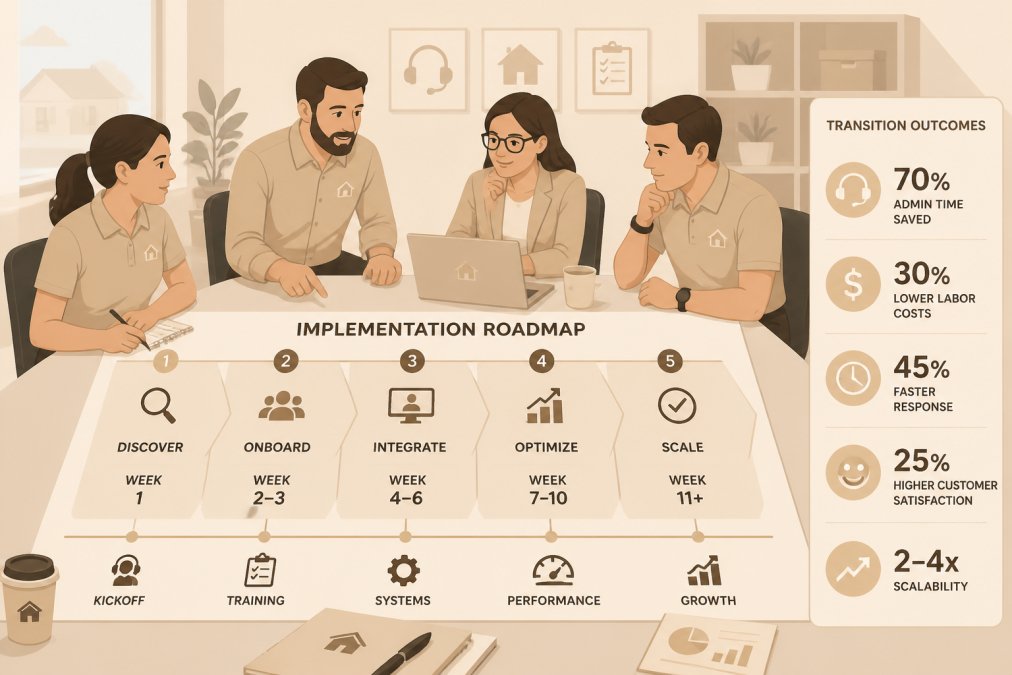
Making the Transition: Your Implementation Roadmap
Moving from in-house to outsourced dispatch requires planning. A smooth transition minimizes disruption.
(/how-to-manage-remote-dispatchers-effectively/)]
Phase 1: Planning and preparation happens before your outsourced team starts. Document current processes. Gather information about service areas, pricing, customer base, and technical capabilities. Identify tools needing integration. Set expectations with your team. This takes 1-2 weeks.
Phase 2: Training and soft launch is where your new dispatch team gets trained on your operation. They learn pricing, service areas, and customer expectations. They practice scheduling and handle a subset of calls while you monitor and provide feedback. This takes 2-4 weeks.
Phase 3: Full transition is when your new dispatch team takes over all calls and scheduling. Your previous staff transitions or leaves. Monitor closely for the first week or two and provide feedback. This takes 1-2 weeks of intensive focus.
Phase 4: Optimization is ongoing. Track metrics, identify improvement opportunities, adjust processes, and build partnership with your provider for continuous improvement. This is where real value emerges.
Clear communication is key. Your customers need to know dispatch is changing. Your team needs to understand why. Your provider needs complete information. Your internal staff needs clear roles during transition.
Most contractors report the transition is rough for 1-2 weeks, then improves rapidly. By week 4, the new team performs at or above previous in-house levels. By month 2, they typically perform better due to training and support in-house staff often lack.
The decision to outsource dispatch isn’t about cutting corners. It’s about focusing resources on what you do best while delegating administrative functions to specialists. For home services contractors, benefits are clear: lower overhead, better coverage, faster job capture, and scalability without proportional staff growth.
Hard Hat Helpers specializes in virtual staffing for home services businesses with dispatchers, estimators, and office managers trained on your specific operation. Our team handles onboarding, payroll, and benefits management, and every client gets a dedicated Client Success Manager for continuous support. We integrate seamlessly into your existing workflows while delivering cost savings and efficiency gains that make the transition worthwhile. Book a consultation to explore how outsourced dispatch could work for your business.
Frequently Asked Questions
What are the main benefits of outsourcing trade dispatch?
Outsourcing trade dispatch reduces overhead costs by eliminating full-time salary, benefits, and payroll administration expenses. It provides 24/7 coverage without hiring multiple staff, improves operational efficiency through specialized expertise, and allows you to focus on core business growth. Most home services owners see faster response times, better load capture, and improved customer satisfaction when dispatch operations are handled by trained professionals.
What are the pros and cons of outsourcing field service dispatch?
Pros include significant cost savings (up to 50% overhead reduction), access to trained dispatch professionals, 24/7 availability, and reduced administrative burden. Cons involve a learning curve for your outsourced team to understand your specific pricing, service areas, and customer base, plus potential integration challenges with your existing CRM or scheduling software. The key is choosing a provider with home services expertise who can be trained on your operations.
How long does it take for an outsourced dispatcher to become fully productive?
With specialized training in your business model, service areas, and pricing structure, most dispatchers reach productivity within 2-4 weeks. Providers like Hard Hat Helpers offer tailored onboarding to your specific products and services, accelerating this timeline. Your dedicated Client Success Manager monitors performance continuously, so you'll know immediately if adjustments are needed.
How does outsourced dispatch services pricing work for small operations?
Pricing depends on your current team size, call volume, and required hours of coverage. Rather than paying for a full-time employee's salary, benefits, and taxes, outsourced dispatch is typically structured as a service fee. For accurate pricing tailored to your operation size, contact Hard Hat Helpers directly for a consultation. Most small to mid-sized operations find the cost significantly lower than in-house staffing once you factor in all employment expenses.