

Table of Contents
- Why Streamlining Plumbing Business Operations Matters
- Implementing Plumbing Business Management Software
- Plumbing Dispatching Best Practices for Operational Efficiency
- Automate Plumbing Scheduling to Save Time and Money
- Plumbing Technician Productivity Tips for Peak Performance
- Change Management: Getting Your Team On Board
- Financial Health Metrics Beyond Revenue
- Scaling Operations While Maintaining Quality
simplify Plumbing Business Operations: A 2026 Guide
Last Updated: June 28, 2026
According to industry data, plumbing contractors waste an average of 8-12 hours per week on manual scheduling, dispatching, and administrative tasks that could be automated. This inefficiency directly impacts your bottom line and your team’s ability to take on more jobs. Simplifying plumbing business operations is no longer optional, it’s the difference between growing profitably and staying stuck.
Why simplifying Plumbing Business Operations Matters
Plumbing business management requires coordinating complex scheduling across multiple job sites, tracking expensive inventory in the field, and managing billing cycles that often stretch payment collection. When these processes rely on phone calls, spreadsheets, and memory, your operation bleeds money.
A technician sitting idle for 30 minutes between jobs because dispatch didn’t optimize the route costs you $50-150 in lost productivity. A customer waiting for a callback that never comes becomes a lost referral. An invoice that takes two weeks to process delays cash flow by weeks. These small failures compound into tens of thousands in annual losses.
Operational efficiency in plumbing isn’t about working harder. It’s about eliminating the friction points that force your team to repeat work, chase information, or wait for approvals. One plumbing company reduced their average job completion time by 2.5 hours per service call just by fixing their [dispatch process](/streamline-home-service-dispatch-workflows/).
Implementing Plumbing Business Management Software
Choosing the right plumbing business management software is the foundation for everything else. The best software combines three core capabilities: real-time job scheduling that accounts for travel time and technician skill levels, mobile access that lets technicians clock in and update job status from the field, and automated invoicing that generates estimates and final bills without manual data entry.
Core Features to Prioritize
Real-time job tracking shows you exactly where every technician is and what they’re working on. This visibility prevents double-booking and lets you handle customer calls with confidence.
Mobile app integration means your technicians can access everything they need on their phone: job details, customer history, parts inventory, pricing guides, and payment processing. They should photograph damage, document work, collect signatures, and send invoices before leaving the job site.
Automated scheduling and dispatch optimization removes guesswork from route planning. The system should automatically suggest the next job for each technician based on location, skill requirements, and availability, saving 3-5 hours per week in manual routing.
Customer communication automation handles appointment reminders, follow-ups, and service confirmations without your team sending individual texts or emails. Automated reminders reduce no-shows by 25-40%.
| Feature | Why It Matters | Impact |
|---|---|---|
| Real-time tracking | Know technician location and job status instantly | Faster customer service, better routing |
| Mobile app | Technicians work from the field, not the office | 2-3 extra billable hours per technician weekly |
| Automated scheduling | Optimal route planning without manual effort | 8-12 hours saved per week in dispatch |
| Customer communication | Reminders and updates without manual sending | 25-40% reduction in no-shows |
| Invoicing automation | Estimates and bills generated automatically | 5-7 hours saved per week in billing |
Integration with Legacy Systems
Many plumbing businesses operate with systems that have been in place for years. The solution is phased integration. Start with the plumbing business management software handling scheduling and dispatching, the most time-consuming manual processes. Let it run parallel to your existing accounting system for 30 days while your team gets comfortable. Then integrate invoicing and customer data.
Choose software with strong integration capabilities, API connections to QuickBooks, Xero, or whatever accounting platform you use. Phased implementation reduces risk and lets your team adopt changes gradually.
Plumbing Dispatching Best Practices for Operational Efficiency
Dispatching is where most plumbing operations lose their biggest opportunities. A well-designed dispatch process can add 2-3 billable hours per technician per week by minimizing drive time and maximizing billable hours.
Most plumbing companies dispatch reactively, a call comes in, the nearest technician gets sent. Better dispatching groups nearby jobs, turning two inefficient trips into one efficient route.
Real-Time Tracking and Optimization
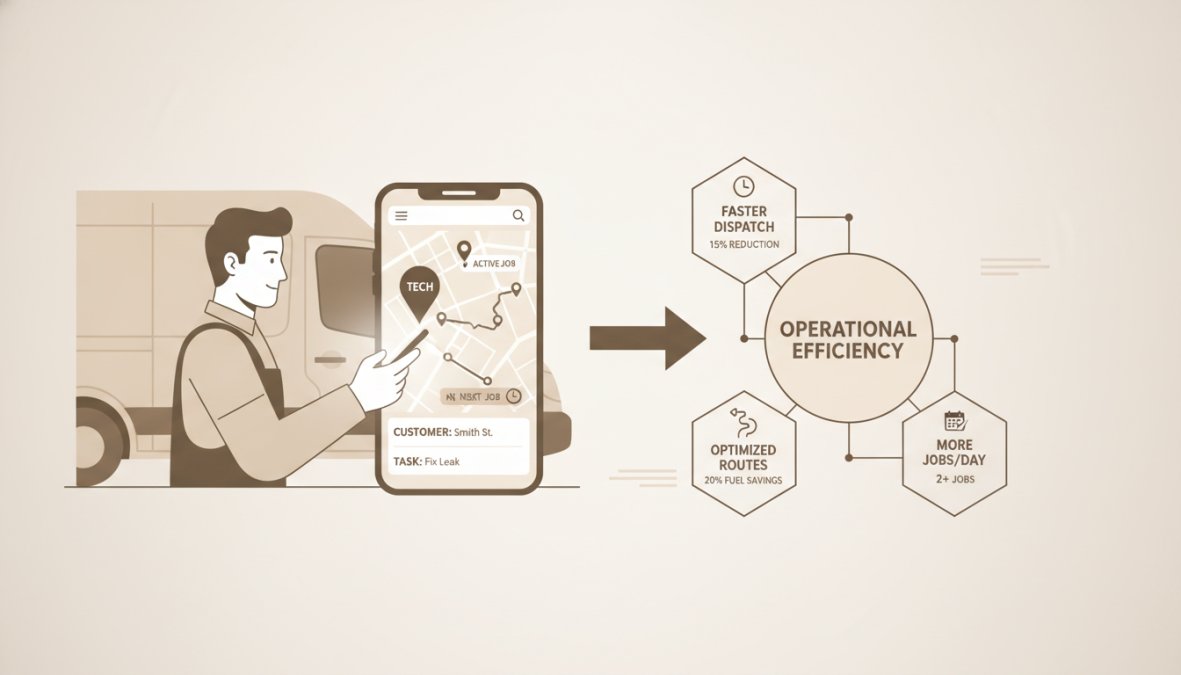
Real-time tracking transforms dispatching from guesswork to science. You see exactly where each technician is, how long they’ve been at the current job, and their estimated completion time. The best systems use predictive algorithms that account for traffic patterns, technician skill levels, parts availability, and job complexity.
When a customer calls with an emergency, real-time tracking lets you give an honest arrival time. You know your technician is 12 minutes away and will arrive between 2:15 and 2:30.
Track your current average drive time between jobs. Most plumbing operations average 25-40 minutes of drive time daily per technician. Optimized routing cuts this to 12-18 minutes. That’s 1-2 extra billable hours per technician per week, which compounds to $20,000-40,000 annually depending on your team size.
Reducing Service Call Delays
Automate the dispatch process so when a job completes, the system automatically assigns the next scheduled job to that technician and sends directions. For emergency calls, implement a priority queue that automatically bumps urgent jobs to the top and reassigns technicians if necessary.
Automate Plumbing Scheduling to Save Time and Money
Automated scheduling removes one of the biggest time drains in plumbing operations. Your dispatcher spends 10-15 minutes per call negotiating availability, checking the schedule, and confirming details. Multiply that by 20-30 calls per day and you’re looking at 3-5 hours of pure scheduling work daily.
Automation cuts that to 10-15 minutes total. Customers book online through your website or app, the system checks technician availability based on location and skill requirements, and the appointment is confirmed instantly.
Automated Scheduling Benefits
Automated scheduling increases appointment adherence and captures customer information automatically, reducing data entry errors. It also reveals your real capacity, you’ll discover that Tuesday afternoons are always booked solid while Wednesday mornings have gaps. This visibility lets you adjust pricing, run promotions, or schedule maintenance work during slow periods. Many plumbing companies find they can take 20-30% more jobs without hiring additional technicians.
The system should handle rescheduling and cancellations automatically. When a technician completes a job early, the system offers the next available appointment to waiting customers. When someone cancels, the system automatically fills the gap from your waitlist.
Customer Communication Automation
Implement a three-touch communication sequence: appointment confirmation within 2 hours of booking, a reminder 24 hours before the appointment, and a text 2 hours before the technician arrives with an estimated window. When the technician is 15 minutes away, send a final notification so the customer knows to expect them soon.
Many plumbing companies implement automation but set it and forget it. Regularly review your automation sequences. Are customers responding to reminders? Are they booking through your app? Are no-shows decreasing? If not, adjust based on data, not assumptions.
Plumbing Technician Productivity Tips for Peak Performance
Your technicians are your most valuable asset, but most plumbing operations leave significant productivity on the table. A technician working at 70% efficiency is costing you 2-3 billable hours per week. Scale that across a team of five technicians and you’re losing $50,000-80,000 annually in unrealized revenue.
Productivity isn’t about working harder. It’s about eliminating friction that prevents your team from doing billable work: unclear job information that requires callbacks, missing tools or parts that require a second trip, and administrative work that pulls them away from customer work.
Mobile App Integration and Field Tools
Your technicians should never need to return to the office during their shift. Everything they need should be on their phone: job details, customer history, parts inventory, pricing guides, and payment processing.
A mobile app should show the complete job history for each customer, previous repairs, parts installed, warranty information, and service dates. When a technician arrives and the customer mentions "the same problem happened last year," the technician can pull up exactly what was done. Payment processing on the mobile app is critical, technicians should accept credit cards, generate invoices, and collect signatures before leaving the job site.
Inventory Tracking in the Field
Real-time inventory tracking prevents technicians from wasting time on emergency parts runs. Every technician’s van is tracked in the system. When they use a part, it’s logged immediately. The system knows they’re down to two of a specific fitting and alerts them to grab more from the warehouse before their next job. For most plumbing operations, better inventory management alone frees up 2-4 hours per technician per week.
Change Management: Getting Your Team On Board
Technology and processes are only half the battle. The other half is getting your team to actually use them. Change management starts with honesty, in the first 30 days, the new system will be harder.
Frame the change around what’s in it for them. A technician doesn’t care that you’ll save money on fuel. They care that they’ll spend less time on paperwork and more time earning commission. Invest in proper training with 2-3 hours of hands-on practice on dummy jobs before using it with real customers. Assign a champion, someone on your team who gets excited about the new system and becomes the go-to person for questions.
Track adoption metrics. How many technicians are using the mobile app daily? How many jobs are being booked through your online scheduler versus phone calls? When adoption stalls, dig into why and adjust your implementation.
Financial Health Metrics Beyond Revenue
Most plumbing business owners track revenue and profit, but these numbers hide critical information about operational health.
Technician use rate measures what percentage of each technician’s paid time is billable. Industry benchmarks are 75-85%. Every percentage point improvement is money on the table.
Average revenue per service call shows whether you’re pricing appropriately and upselling effectively.
First-time fix rate measures what percentage of jobs are completed on the first visit without callbacks. Poor rates usually indicate technicians lack information before arrival or don’t have the right parts.
Days sales outstanding measures how long it takes to collect payment after invoicing. Most plumbing businesses can improve this to 15-20 days through better invoicing practices and payment processing.
Scaling Operations While Maintaining Quality
Growth requires operational discipline. You can’t scale on heroics and personality. You need systems that work regardless of who’s executing them.
Document your processes. How should a technician approach a water heater replacement? What steps are non-negotiable? Create checklists so new technicians can follow your playbook instead of learning through trial and error.
Implement quality control checkpoints. Before a technician leaves a job, they should verify that the work meets your standards. Use technology to enforce consistency, your mobile app should include job checklists that technicians complete before marking the job as done.
Simplifying plumbing business operations isn’t a one-time project, it’s an ongoing commitment to eliminating waste and improving efficiency. Start with your biggest pain point, whether that’s scheduling, dispatching, or technician productivity. Get that working smoothly, then move to the next area. The businesses that scale successfully build operational excellence incrementally.
Frequently Asked Questions
How can plumbing business management software help streamline operations?
Plumbing business management software centralizes dispatching, scheduling, invoicing, and customer communication in one platform. This reduces manual data entry, eliminates scheduling conflicts, automates customer reminders, and provides real-time visibility into job status. When integrated properly with your existing systems, it can cut administrative time by 30-40%, allowing your team to focus on revenue-generating work.
What are the best plumbing dispatching best practices?
Effective dispatching prioritizes jobs by urgency and technician location to minimize travel time. Use GPS tracking to optimize routes, assign jobs based on technician skill level, and maintain buffer time between appointments. Communicate changes immediately to technicians and customers. Regular analysis of dispatch data reveals patterns, peak call times, geographic bottlenecks, and technician efficiency, enabling continuous improvement and better resource allocation.
How do I automate plumbing scheduling without losing the personal touch?
Automation handles routine tasks like appointment confirmations, reminder texts, and rescheduling requests, freeing CSRs to focus on complex inquiries and upselling. Automated scheduling systems can suggest optimal time slots based on technician availability and customer location. Customers still speak with real people for initial estimates or special requests. This hybrid approach increases booking speed while maintaining customer relationships and improving service call conversion rates.
What plumbing technician productivity tips actually improve efficiency?
Equip technicians with mobile apps for job details, customer history, and parts inventory, reducing office calls and decision delays. Provide clear job information upfront so they arrive prepared. Track productivity metrics like jobs completed per day and first-time fix rates. Offer incentives for efficiency gains. Ensure preventative maintenance recommendations are easy to document and communicate. Training on your specific products and services also boosts confidence and reduces callbacks.