



Table of Contents
- Why Managing Remote Staff in Construction Requires a Different Approach
- Remote Team Communication Strategies for Construction Projects
- Construction Project Management Software for Remote Operations
- Tracking Remote Construction Employee Hours and Accountability
- Virtual Collaboration in Construction: Building Trust Across Distances
- Hardware, Infrastructure, and Legal Compliance for Remote Construction Staff
- Best Practices for Managing Remote Staff in Construction Long-Term
- Conclusion
Last Updated: June 24, 2026
Managing remote staff in construction is one of the most underestimated operational challenges in the industry today. Unlike remote work in tech or finance, construction projects involve physical sites, safety compliance, real-time field decisions, and complex coordination between office teams and on-the-ground crews. Construction remote work isn’t just about video calls and shared documents, it’s about bridging the physical reality of a job site with the digital workflows that keep projects on schedule. Get that bridge wrong and you lose visibility, accountability, and eventually, clients.
Why Managing Remote Staff in Construction Requires a Different Approach
Remote workforce management in construction is fundamentally different from managing distributed teams in other industries because the work is inherently physical, safety-critical, and location-dependent. A site supervisor working remotely still needs to review safety documentation, approve material deliveries, and respond to RFIs in real time.
Construction project management involves dozens of interdependent tasks: resource allocation, subcontractor coordination, document control, and compliance verification. When staff are distributed across offices, home setups, and remote sites, each task carries a higher failure risk. According to McKinsey’s research on digital transformation in construction, the construction sector has historically lagged other industries in digital adoption, which means remote management systems are often being built from scratch.
A common mistake is treating remote construction staff like any other remote worker. Their accountability structures, communication cadences, and technology requirements are distinct.
Don’t assume your existing HR or project management processes will cover remote construction staff without modification. Construction-specific compliance, safety documentation, and field reporting requirements create gaps that generic remote work policies don’t address.
Remote Team Communication Strategies for Construction Projects
Clear communication is the single highest-impact factor in remote team management for construction. When it breaks down, projects produce safety incidents, rework, and cost overruns.
Asynchronous Communication for Distributed Teams
Asynchronous communication is essential for distributed construction teams spanning multiple time zones or irregular shift patterns. Practical async setup includes: daily written standups documenting completed work and blockers, voice memos for complex field conditions, shared project logs for all decisions, clear response-time expectations by message type, and archived communications tied to specific project phases for compliance.
The critical requirement most teams miss: async communication only works when field staff have reliable mobile access. Without that infrastructure, async becomes a bottleneck.
Video Conferencing and Real-Time Reporting
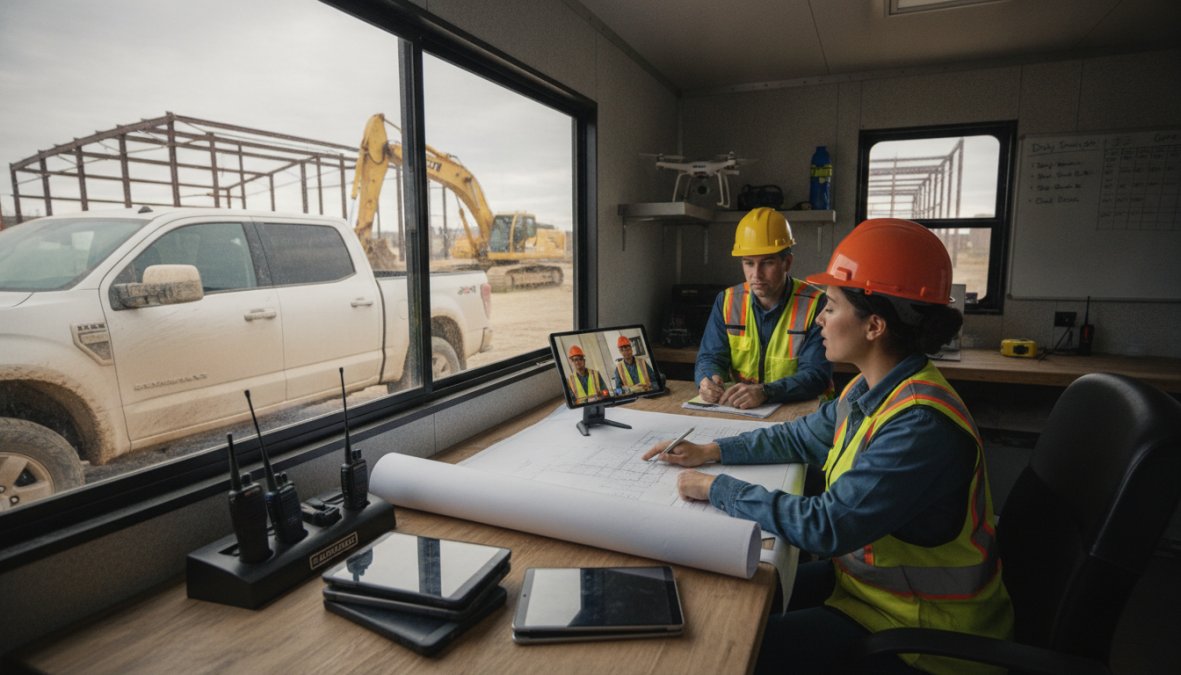
Video conferencing handles complex problem-solving, team alignment, and real-time site walkthroughs using mobile cameras. The most effective video cadence is daily 15-minute site check-ins during active construction, weekly full-team project reviews, and ad-hoc calls triggered by field exceptions or safety concerns.
Real-time reporting through construction software platforms gives project managers visibility into daily progress without micromanaging individual crew members.
Construction Project Management Software for Remote Operations
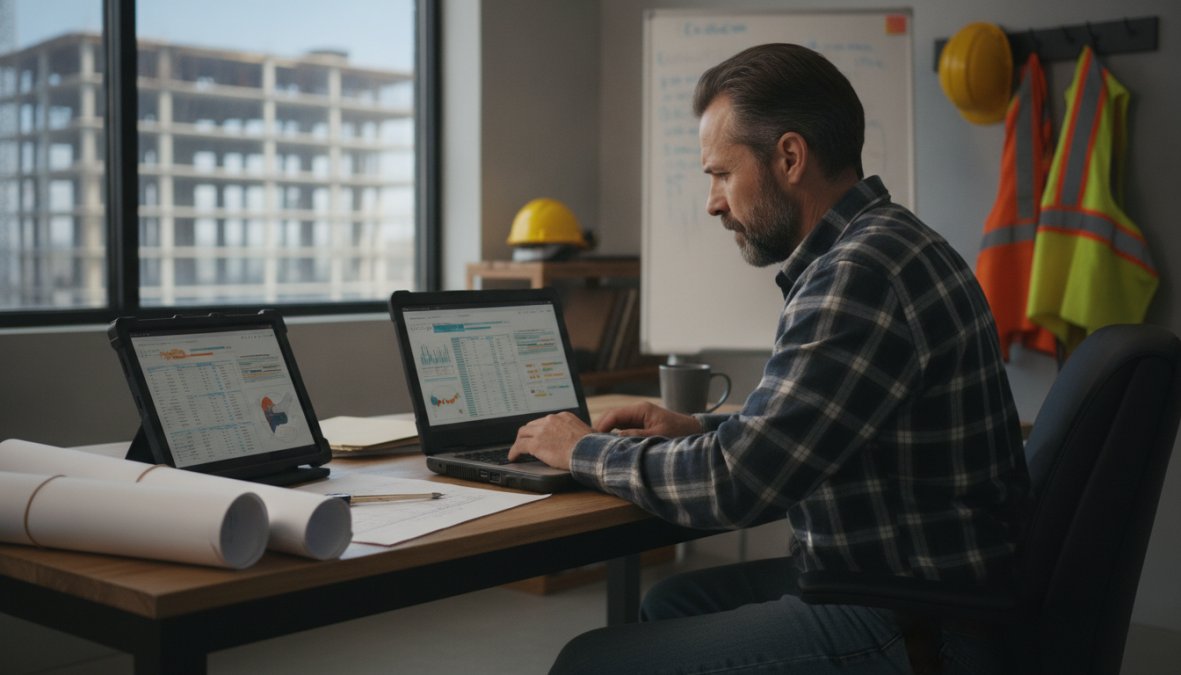
Construction project management software is the operational core of any remote construction workforce. The right platform centralizes document control, tracks task completion, enables real-time reporting, and connects field operations to office workflows. Platforms like Procore, Autodesk Construction Cloud, and Buildertrend are purpose-built for this. Generic project management tools lack the field-specific modules construction teams need.
Cloud-Based Collaboration and BIM Integration
Cloud-based collaboration gives every stakeholder access to the same project data regardless of location. BIM (Building Information Modeling) integration connects 3D design models to live project data, allowing remote managers to visualize site conditions without being physically present. According to Autodesk’s construction technology adoption report, BIM adoption reduces rework and improves coordination between design and field teams.
Cloud-based collaboration also enables document control at scale: version-controlled drawings, digital RFI workflows, and shared submittal logs that every team member accesses from a single source of truth.
Real-Time Site Documentation and Mobile-First Tools
A mobile-first approach means field staff can log progress, flag issues, and submit reports directly from the job site without returning to an office. Key capabilities include photo and video capture tied to specific tasks, digital daily reports submitted from the field, offline functionality for poor connectivity, and GPS-tagged documentation for inspections and safety compliance.
When field staff document in real time rather than reconstructing events at the end of a shift, data accuracy improves and project transparency increases.
Require field staff to submit photo documentation for every milestone completion. This creates a timestamped record that protects the business in disputes and gives remote managers genuine visibility into daily progress.
Tracking Remote Construction Employee Hours and Accountability
Tracking remote construction employee hours should focus on outputs, not inputs. Whether a remote estimator worked 8am to 5pm matters far less than whether the estimate was accurate, delivered on time, and within scope.
Productivity Monitoring Without Micromanagement
Effective output-based monitoring tracks task completion rates against project schedules, quality metrics like revision counts and error rates, response time to field queries, and milestone achievement. The difference between monitoring that builds accountability and monitoring that destroys morale comes down to transparency. When staff know what’s being tracked and why, they engage with it.
Setting Clear KPIs and Performance Expectations
KPIs for remote construction staff should be set at the project and individual level before work begins.
| Role | Key KPI | Measurement Frequency | Target |
|---|---|---|---|
| Remote Estimator | Estimate accuracy rate | Per project | Within 5% of final cost |
| Site Supervisor | Daily report submission | Daily | 100% on-time submission |
| Project Coordinator | RFI response time | Weekly average | Under 24 hours |
| Document Controller | Drawing version accuracy | Per revision cycle | Zero superseded drawings in circulation |
| Office Manager | Invoice processing time | Weekly | Within 48 hours of receipt |
KPIs only work when connected to real consequences and recognition.
Virtual Collaboration in Construction: Building Trust Across Distances
Trust in virtual construction teams doesn’t form automatically. It’s built through consistent behavior over time.
Overcoming Remote Work Challenges in Field Operations
The most persistent remote work challenges are connectivity gaps, time-zone friction, and loss of informal communication. Connectivity gaps are an infrastructure problem requiring hardware and data solutions, not better communication practices. Time-zone friction is manageable with clear async protocols and escalation paths. The loss of informal communication is hardest to solve, structured daily check-ins create space for incidental information-sharing that physical proximity enables.
Mental Health and Isolation in Remote Construction Roles
Remote construction roles carry specific isolation risks. According to OSHA’s guidance on worker mental health and wellbeing, isolation and stress are significant risk factors for construction workers, and remote work can amplify those risks when not actively managed.
Practical approaches include monthly team social sessions, peer-pairing systems connecting remote staff with on-site counterparts, access to employee assistance programs, and manager training to recognize behavioral signs of isolation and burnout.
The construction industry’s mental health challenge is real and underreported. Remote work doesn’t create the problem, but it removes the social scaffolding that normally buffers it. Building that scaffolding deliberately is a management responsibility.
Hardware, Infrastructure, and Legal Compliance for Remote Construction Staff
Remote construction staff need specific hardware to do their jobs effectively. A laptop and home Wi-Fi connection is insufficient for most construction roles.
Essential Equipment and Site Connectivity Requirements
Minimum hardware requirements by role: field supervisors need rugged tablets or laptops rated for outdoor use, mobile hotspots with construction-grade data plans, and high-resolution cameras. Estimators and coordinators need dual-monitor desktops or high-performance laptops with reliable broadband and backup connections. Document controllers need dedicated scanners and high-capacity cloud storage.
Construction site connectivity is a separate problem. Many active sites have poor or no cellular coverage. Solutions include portable LTE routers, satellite connectivity for remote sites, and mesh Wi-Fi networks for large sites.
Data Security and Legal Considerations for Remote Teams
Data security in remote construction operations is an underestimated risk. Construction projects involve sensitive client data, proprietary designs, and financial information. Minimum requirements include VPN access for all connections, multi-factor authentication on project management platforms, device management policies for personal devices, and clear data retention protocols.
Legal compliance for remote construction staff extends to employment law, state-specific labor regulations, and overtime rules. Workflow automation helps: automated compliance reminders, digital signature workflows, and audit-trail logging reduce legal exposure.
Best Practices for Managing Remote Staff in Construction Long-Term
Short-term fixes don’t build durable remote operations. Successful businesses treat remote management as an operational discipline.
Hybrid Work Models and Work-Life Balance
The hybrid work model for construction places field-facing staff on site during active construction phases and allows remote work during planning and administrative phases. This aligns physical presence with tasks that require it.
Work-life balance for remote construction staff requires clear policies: defined working hours, explicit expectations about after-hours availability, and management behavior that models the boundaries it sets.
Employee Engagement and Resource Allocation
Employee engagement in remote construction teams requires active investment in recognition, development, and inclusion. Remote staff are at higher risk of feeling disconnected from the broader organization.
Resource allocation for remote operations needs explicit planning. Remote staff require different tools, support structures, and onboarding timelines than in-person staff. Treating them as a cost-reduced version of in-person staff, rather than a distinct operational model with its own requirements, is the most common long-term failure mode.
Managing remote staff in construction at scale requires purpose-built systems, clear accountability structures, and ongoing investment in the people doing the work. Hard Hat Helpers provides virtual staffing solutions purpose-built for the home services and construction-adjacent space, with continuous performance monitoring, 24/7 availability, and overhead cost reductions of over 50% compared to traditional hiring. If your remote construction operation needs reliable, trained talent that integrates into your existing workflows without adding administrative burden, Book a Consultation with Hard Hat Helpers today.
Frequently Asked Questions
What are the biggest challenges of managing remote construction staff?
The primary challenges include maintaining real-time site-to-office communication, ensuring accountability without micromanagement, and managing field operations across distributed locations. Construction teams also struggle with data security, equipment access, and building trust when team members work in isolation. Implementing construction project management software and establishing clear communication protocols helps address these issues effectively.
How do you track remote construction employee hours accurately?
Use construction project management software with integrated time-tracking features that monitor productivity without being invasive. Cloud-based collaboration tools allow employees to log hours, report on task completion, and submit site documentation in real-time. Mobile-first applications enable field staff to clock in/out directly from job sites. Pair digital tracking with regular check-ins and KPI monitoring to ensure accountability while maintaining trust and work-life balance.
What remote team communication strategies work best in construction?
Combine asynchronous communication (email, project management platforms) with real-time reporting through video conferencing and instant messaging. Establish clear protocols for daily stand-ups, weekly project reviews, and emergency communications. Use cloud-based document control for site documentation and design changes. Regular video calls help build team culture and address complex issues quickly, while asynchronous channels reduce meeting fatigue and respect different time zones or field schedules.
Can virtual collaboration in construction maintain project quality and timeline?
Yes, with proper tools and processes. BIM (Building Information Modeling) and cloud-based collaboration platforms enable real-time coordination between remote office staff and field teams. Mobile-first documentation captures site progress instantly, reducing delays in decision-making. Clear task management, defined workflow automation, and regular stakeholder updates ensure operational efficiency. The key is establishing accountability through transparent project tracking and maintaining consistent communication about project lifecycle milestones and resource allocation.