

Table of Contents
- Why Hiring Remote Dispatchers for Home Services Is a Smart Move
- Remote Dispatcher Job Description: What the Role Actually Covers
- Outsourcing Dispatch Services vs. Hiring Directly: Which Is Right for You?
- Remote Dispatcher Interview Questions That Surface Real Competence
- Best Dispatch Software for Home Services Your Remote Team Needs
- What Hiring Remote Dispatchers for Home Services Actually Costs
- Managing Remote Dispatchers: Performance, Security, and Accountability
- Conclusion
Last Updated: June 11, 2026
Hiring remote dispatchers for home services is one of the highest-impact operational decisions a contractor can make in 2026. Hard Hat Helpers has helped dozens of HVAC, plumbing, and roofing companies offload dispatch to pre-qualified remote professionals, cutting overhead while improving response times. The challenge is not whether remote dispatch works, it is knowing how to hire right, set up the right tools, and keep performance accountable from a distance.
A remote dispatcher manages job scheduling, technician coordination, and customer communication from an off-site location using cloud-based dispatch software like ServiceTitan or Jobber, handling the same responsibilities as in-house staff without the physical office.
Why Hiring Remote Dispatchers for Home Services Is a Smart Move
Dispatch is the nerve center of any field service operation. A missed call, a double-booked technician, or a delayed follow-up costs real revenue, yet most contractors treat it as a back-office afterthought.
According to Bureau of Labor Statistics Occupational Employment data, administrative and dispatching roles represent one of the largest overhead costs for small service businesses. Moving that role remote changes the cost structure dramatically without sacrificing function.
The Real Cost of In-House Dispatching
Keeping a dispatcher in-house means paying salary, benefits, payroll taxes, office space, and equipment, well above the base wage alone. Add turnover, training time, and coverage gaps during illness or vacation, and the picture worsens. Remote dispatchers eliminate fixed overhead tied to physical presence, and many home service businesses find the switch reduces total dispatch-related costs by more than half.
How Remote Dispatchers Fit Into Your Existing Operations
A trained remote dispatcher integrates into your existing workflow through your dispatch software, phone system, and CRM, answering calls, scheduling jobs, updating technician status, and handling customer communication without ever entering your office. The key is a proper handoff protocol: access to your scheduling platform, a documented escalation process, and clarity on service area boundaries. Setup typically takes one to two weeks, not months.
Before your remote dispatcher’s first day, create a one-page escalation guide: which issues they resolve independently, which they escalate to a field supervisor, and which go directly to you. This single document prevents the majority of early miscommunications.
Remote Dispatcher Job Description: What the Role Actually Covers
A remote dispatcher job description for home services sits at the intersection of customer service, logistics, and trade knowledge. Posting a vague description is the fastest way to attract unqualified candidates.
Core Responsibilities Across HVAC, Plumbing, and Roofing
Core functions are consistent across trades: managing inbound service calls, assigning jobs based on technician location and skill set, confirming appointments, and communicating ETAs. In HVAC and plumbing, dispatchers also triage urgency, separating a no-heat emergency from routine maintenance. For roofing, dispatchers often coordinate with estimators and handle pre-construction scheduling.
Core responsibilities to include in your remote dispatcher job description:
- Inbound and outbound call handling for scheduling and customer follow-up
- Real-time technician tracking and job assignment through dispatch software
- Work order creation, updating, and closure in your field service management platform
- Customer communication including appointment reminders and on-the-way notifications
- Escalation management for urgent or after-hours service requests
- Coordination with field technicians on parts, access, and labor calculations
Must-Have Skills and Traits for Home Service Dispatchers
The best remote dispatchers combine fast decision-making with calm communication under pressure, a technician calling in with a parts issue while three customers wait for updates is a normal Tuesday. Non-negotiable skills include proficiency with at least one field service management platform, strong phone communication, and the ability to manage competing priorities without losing accuracy. Familiarity with HVAC, plumbing, or roofing terminology shortens the onboarding curve considerably.
Outsourcing Dispatch Services vs. Hiring Directly: Which Is Right for You?
Outsourcing dispatch services and hiring a dedicated remote dispatcher are not the same thing. Outsourcing gives you shared capacity across multiple clients; direct hiring gives you someone who knows your customers, technicians, and service area by name. For businesses with consistent job volume, dedicated hiring produces better customer experience. For seasonal or unpredictable volume, outsourcing offers flexibility a single hire cannot match.
| Option | Best For | Cost Structure | Customization | Ramp Time |
|---|---|---|---|---|
| Dedicated Remote Hire | Consistent daily volume | Fixed monthly | High | 1-2 weeks |
| Staffing Agency (specialized) | Growth-stage businesses | Variable | Medium-High | 3-5 days |
| BPO / Outsourced Dispatch | Seasonal or overflow coverage | Per-hour or shared | Low-Medium | Immediate |
| Freelance Platform | Trial or project-based | Hourly | Variable | 1-3 days |
DIY Hiring Through Freelance Platforms
Upwork and similar platforms offer direct access to a global talent pool with verified work history and ratings. The tradeoff is vetting time. Finding a dispatcher with genuine home services experience on a general marketplace requires reviewing dozens of profiles, running test calls, and building training materials from scratch, many businesses find the time cost exceeds the savings in the first three months.
Specialized Home Service Staffing Agencies
Specialized agencies like Hard Hat Helpers pre-screen candidates for trade-specific knowledge, handle onboarding and payroll, and provide performance monitoring from day one. You get a dispatcher who already understands field service workflows, plus a dedicated point of contact for performance issues, which matters when you are running a field operation and cannot manage an overseas contractor directly.
Avoid general-purpose BPO providers for home service dispatch unless they have documented experience in your specific trade. A dispatcher trained on retail customer service will struggle with HVAC triage calls and parts urgency. The wrong hire slows your project pipeline instead of accelerating it.
Remote Dispatcher Interview Questions That Surface Real Competence
Generic questions produce generic answers. Use scenario-based, trade-specific questions to separate candidates who understand home services from those who are guessing:
-
"A technician calls mid-job to say the repair requires a part not on the truck. The customer has already waited two hours. Walk me through exactly what you do." Tests prioritization, communication, and problem-solving simultaneously.
-
"How do you handle three inbound calls at once when you are the only dispatcher on shift?" Reveals whether the candidate has real dispatch experience or just call center experience.
-
"Describe how you have used [ServiceTitan / Jobber / Housecall Pro] to manage a full day’s dispatch board." If they cannot name specific features, they have not used the platform.
-
"A customer calls angry because their technician is two hours late. The technician is stuck on an emergency at another job. What do you say?" Tests de-escalation skills and honesty under pressure.
-
"How do you decide which technician to assign to a new job when two are available?" Reveals whether they understand skill matching, geographic routing, and labor calculations or just fill slots.
-
"What is your process for end-of-day job status updates?" Good dispatchers close the loop. Weak ones wait to be asked.
Always follow up with questions that require specifics. Vague answers to scenario questions are a reliable signal of inexperience.
Best Dispatch Software for Home Services Your Remote Team Needs
The right dispatch software is the shared workspace where your dispatcher, technicians, and office operate simultaneously. Without a real-time platform, remote dispatch falls apart within days.
ServiceTitan: Enterprise Power for Growing Contractors
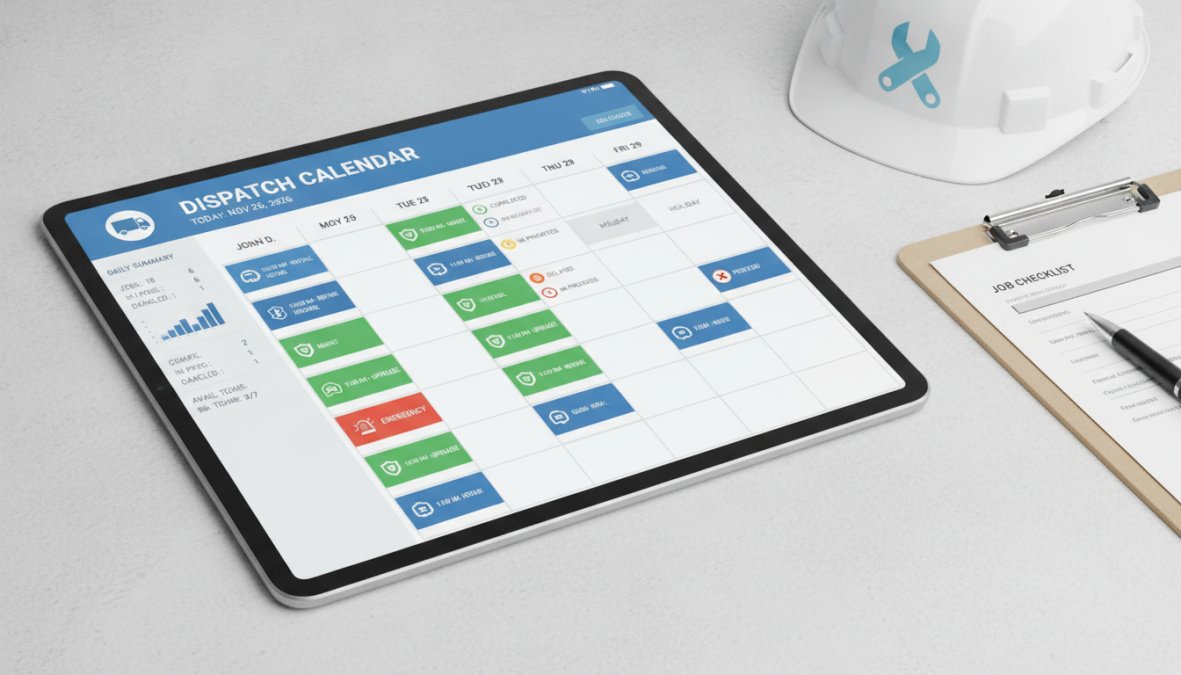
ServiceTitan is the platform of choice for medium to large home service businesses running HVAC, plumbing, electrical, or roofing operations. Its dispatch board provides real-time technician tracking, automated scheduling, and an integrated CRM with full customer history alongside open jobs. Remote dispatchers can manage work orders, process payments, and coordinate field execution without switching systems. The tradeoff is cost and complexity, ServiceTitan is a serious investment with a steep onboarding curve, but for businesses with a growing project pipeline and multiple technicians, it pays off quickly.
Best for: Mid-to-large contractors with 5+ technicians and complex scheduling needs.
Jobber: The Fast-Start Option for Small Teams
Jobber starts at $49 per month and gets a remote dispatcher operational within hours. The drag-and-drop dispatch calendar, automated appointment reminders, and "on my way" texts cover core functions without overwhelming a new hire. Its mobile app lets technicians update job status in real time, giving dispatchers accurate information without check-in calls, that two-way visibility is what makes remote dispatch work at the small team level.
Best for: Small to mid-sized home service businesses needing a user-friendly, fast-to-implement platform.
Housecall Pro and FieldCamp: Mobile-First and AI-Driven Alternatives
Housecall Pro is built for residential service companies with up to 15 technicians, with GPS tracking, online booking integration, and automated review requests making it strong for businesses prioritizing customer experience alongside dispatch efficiency.
FieldCamp takes a different approach as an AI-native platform, using autonomous agents for intelligent dispatching and lead triage to reduce manual workload. Its route optimization and AI-driven job assignment offer a genuine operational advantage for businesses scaling without proportionally increasing headcount. The ecosystem is smaller than ServiceTitan or Jobber, but the automation capabilities lead most competitors. According to Gartner’s field service management market analysis, AI-driven dispatching tools are among the fastest-growing segments in field service software.
What Hiring Remote Dispatchers for Home Services Actually Costs
Direct hires through freelance platforms run hourly, with rates varying by experience and location, home services experience commands a premium over general administrative rates. Staffing agencies charge a monthly rate covering compensation, benefits, payroll administration, and performance monitoring. Hard Hat Helpers includes continuous performance monitoring, a dedicated Client Success Manager, and tailored training on your specific tools, shifting the total cost comparison significantly in favor of the agency model once all overhead is factored in. BPO providers charge per hour of coverage, making them cost-effective for after-hours overflow but inefficient for full-time roles.
The honest framing: comparing remote dispatch costs only against base salary is the wrong calculation. The real comparison is total cost of employment, benefits, payroll taxes, office overhead, and management time. On that basis, many home service businesses find remote dispatch cuts total dispatch costs by more than half.
When calculating remote dispatcher costs, always compare against your total in-house cost, not just base salary. Benefits, payroll taxes, office space, equipment, and management time typically add 30-40% on top of base wages for in-house staff.
Managing Remote Dispatchers: Performance, Security, and Accountability
Hiring the right person is half the work. The other half is building a management structure that keeps performance high and customer data protected without micromanaging every call.
Data Privacy and the Security of Customer Information
Remote dispatchers handle customer names, addresses, phone numbers, and often payment information. Without proper security protocols, that data is exposed. At minimum, your remote dispatch setup should include:
- Role-based access controls in your dispatch software (dispatchers see what they need, nothing more)
- Mandatory use of a company-provisioned VPN for all work sessions
- No storage of customer data on personal devices
- A documented data handling policy signed before the first shift
- Regular access audits, especially when a dispatcher’s role changes
As noted in FTC guidance on small business data security, businesses that handle customer personal information are responsible for reasonable security measures regardless of whether staff are in-house or remote. Your terms of service should also clearly identify who is authorized to schedule, modify, or cancel service agreements on the company’s behalf.
Setting KPIs and Monitoring Attendance Remotely
Remote dispatchers without clear performance metrics drift. The KPIs that matter most are response time to inbound calls, booking conversion rate, technician utilization rate, and customer satisfaction scores on dispatched jobs. Set these benchmarks during onboarding, review them weekly for the first month, and monthly after that, most field service platforms generate these reports automatically.
Attendance monitoring works best through time-tracking integrations built into platforms like ServiceTitan or standalone tools. The goal is visibility, not surveillance. According to SHRM research on remote workforce management practices, businesses that establish clear remote performance standards from day one report significantly higher satisfaction with remote hires than those who adapt standards after problems emerge.
Managing a remote dispatch operation requires the right hire, the right tools, and a management framework built for visibility without micromanagement. Hard Hat Helpers provides pre-qualified dispatchers trained specifically for home services trades, with managed payroll, continuous performance monitoring, and a dedicated Client Success Manager included from day one. Book a consultation with Hard Hat Helpers and get a remote dispatcher who is ready to work inside your existing operations from week one.
Frequently Asked Questions
What are the core responsibilities of a remote dispatcher in home services?
A remote dispatcher in home services handles inbound and outbound customer calls, schedules and routes technicians for jobs in trades like HVAC, plumbing, and landscaping, manages work order updates in real time, and communicates delays or changes to both customers and field staff. They also support lead conversion by booking appointments quickly and following up on missed calls. The role is entirely office-based but requires deep familiarity with field execution workflows and dispatch software.
Is it better to hire a remote dispatcher directly or use outsourcing dispatch services?
It depends on your volume and management capacity. Outsourcing dispatch services through a specialized agency like Hard Hat Helpers gives you pre-trained talent, managed payroll, and faster onboarding, ideal if you want to reduce administrative burden. Hiring directly via platforms like Upwork offers more control and can be cheaper short-term, but requires you to vet candidates, handle onboarding, and manage performance independently. For most growing home service businesses, a specialized agency delivers faster ROI and lower risk.
What remote dispatcher interview questions should I ask when hiring for home services?
Focus on scenario-based questions that test real dispatching judgment. Ask how they would handle a technician running two hours late on a full schedule, how they prioritize emergency calls versus routine bookings, and what dispatch software they have used, such as ServiceTitan or Jobber. Also ask how they manage upset customers and what their process is for updating work orders in real time. These remote dispatcher interview questions reveal both technical competence and communication skills under pressure.
What is the best dispatch software for home services remote teams?
The best dispatch software for home services depends on business size. ServiceTitan is the most powerful option for medium to large contractors needing advanced reporting and SaaS integration. Jobber is ideal for small to mid-sized teams that need a fast, intuitive setup starting at $49/month. Housecall Pro suits mobile-first residential teams, while FieldCamp offers AI-driven dispatching for businesses focused on automation. Any remote dispatcher you hire should be trained on whichever platform your business uses before their first day.
How do I protect customer data when working with a remote dispatcher?
Establish clear data security protocols before onboarding any remote dispatcher. Use role-based access controls in your dispatch software so staff only see the data they need. Require a secure VPN connection, enforce strong password policies, and use platforms with built-in audit logs. If you outsource through an agency, confirm they have data handling agreements in place. Avoid sharing sensitive customer payment information verbally and ensure all communication happens through approved, encrypted channels.
How much does it cost to hire a remote dispatcher for a home service business?
Costs vary by hiring method. Freelancers on platforms like Upwork can range widely depending on experience and location. Specialized outsourcing agencies typically charge a monthly service fee that covers the dispatcher's salary, training, and management overhead. While exact pricing varies, agencies like Hard Hat Helpers position their service as saving businesses over 50% compared to hiring a full-time in-house dispatcher when you factor in salary, benefits, office space, and HR administration costs.