


Table of Contents
- What Happens When You Scale Your Business Too Fast
- Signs of Scaling Too Fast: Early Warning Signals
- Consequences of Rapid Business Growth: The Real Cost
- How to Avoid Over-Scaling a Business: Actionable Prevention
- Sustainable Business Growth Strategies: Scaling the Right Way
- Managing Growth Without Losing Control
- Conclusion
Last Updated: August 2, 2026
Understanding what happens if you scale your business too fast is critical for founders caught between ambition and operational reality. According to research from the National Federation of Independent Business, roughly 82% of businesses fail due to cash flow problems, many triggered by rapid, unmanaged growth. At Hard Hat Helpers, we’ve worked with hundreds of home service contractors who discovered that scaling faster meant chaos: missed appointments, burned-out teams, angry customers, and vanishing profit margins. Below, we’ll show you exactly what happens when growth outpaces infrastructure, and how to avoid becoming another cautionary tale.
What Happens When You Scale Your Business Too Fast
Scaling too fast doesn’t feel like failure at first. Revenue climbs, you hire aggressively, and new clients pour in. Then everything starts breaking: the dispatch system can’t handle volume, estimators work 60-hour weeks and make mistakes, customers wait days for callbacks, and your best technicians consider leaving.
Most founders miss the difference between growth and scaling. Growth is revenue increasing. Scaling is revenue increasing while operational costs stay proportional or decrease. When you scale too fast, you’re chasing growth without building the systems, people, and processes to support it. You’re trying to run a $2 million operation with $500,000 infrastructure.
The real damage shows up in customer churn, team turnover, and the realization that you’re working harder for less profit. You’ve created a trap: too big to ignore, too broken to fix quickly, too exhausted to think clearly.
Growth vs. Scaling: Why the Difference Matters
Growth is simple: more revenue. Scaling is complex: more revenue with controlled costs and sustainable operations.
A business that grows 50% in one year without scaling infrastructure experiences severe strain. Your dispatch team handling 20 jobs per day now handles 30. Your office manager managing 5 technicians now manages 12. Your customer service response time goes from 2 hours to 8 hours. Your systems weren’t designed for this volume.
Scaling means you’ve added infrastructure before demand hits. You’ve hired a second dispatcher before you needed one. You’ve implemented scheduling software before your spreadsheet became unmanageable.
The difference shows up in your margins. When you scale properly, profit margins stay stable or improve. When you grow too fast without scaling, margins compress because you’re paying overtime, missing billable hours, and losing customers to poor service.
Signs of Scaling Too Fast: Early Warning Signals
Recognizing warning signs early gives you a window to course-correct before damage becomes irreversible.
Cash Flow Red Flags
Cash flow is the first victim of rapid scaling. You’re spending money to support growth while waiting 30, 60, or 90 days for customers to pay. Watch for these signals:
- Payroll becomes unpredictable. Some weeks you have cash; others you’re sweating payroll.
- You’re taking on debt to fund operations. If you’re borrowing to cover regular expenses (not equipment), your growth is outpacing cash generation.
- Accounts receivable are aging. Jobs completed 45 days ago remain unpaid.
- You’re deferring vendor payments. Suppliers waiting 45 days instead of 15 signals cash stress.
The Small Business Administration’s guide to cash flow management emphasizes that cash flow problems are the leading cause of small business failure, often masked by growing revenue.
Operational Breakdown and Bottlenecks
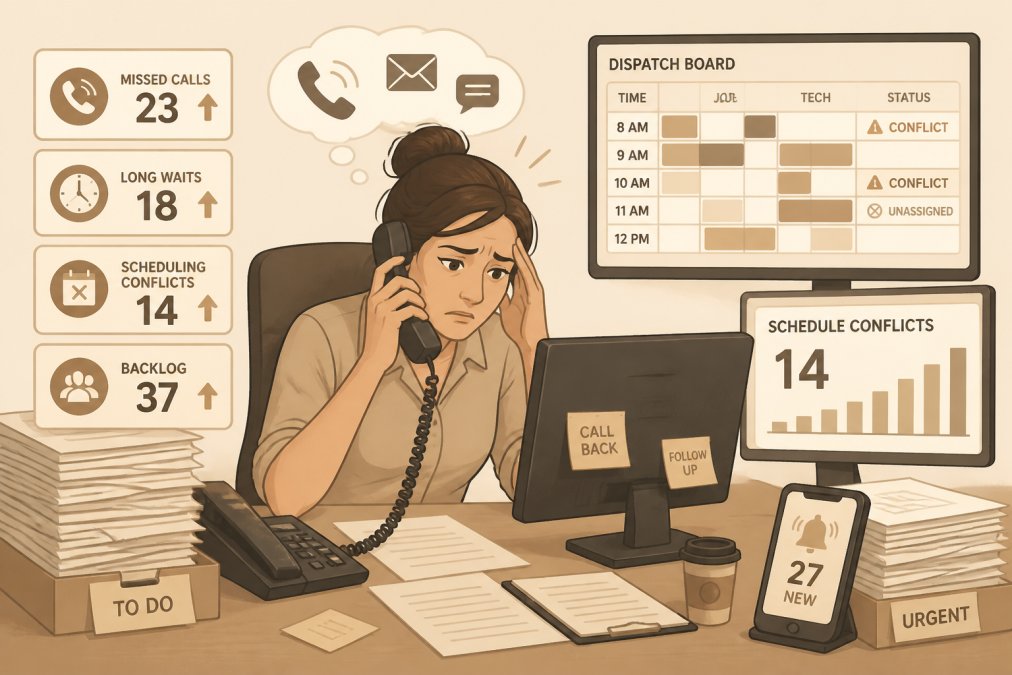
Operational bottlenecks appear suddenly and cascade through your entire business. Your dispatch system becomes the choke point, calls come in faster than dispatchers can assign jobs, technicians sit idle while customers wait, and you revert to phone calls and text messages, creating confusion and missed appointments.
Estimating becomes a bottleneck. With one estimator and 40% more jobs, estimates get delayed and customers go to competitors. Customer data management breaks down, with information scattered across CRM software, email, and notebooks.
Operational bottlenecks are self-reinforcing. A slow dispatch system means technicians aren’t productive. Unproductive technicians mean lower revenue per person. Lower revenue per person means you need more people. More people means more pressure on dispatch. The cycle accelerates until something breaks.
Team Burnout and Culture Collapse
Your team built your business. Scaling too fast destroys them. Rapid hiring without proper onboarding leaves new employees confused and underproductive. Existing employees spend time training newcomers instead of doing their jobs. Workload increases and morale drops.
Culture collapses when you can’t maintain the values that made your team special. You used to know every employee’s name. Now you’re hiring 5 people a month. Turnover accelerates as your best people leave because they’re exhausted. You replace them with less experienced people, service quality drops, and more customers leave.
Consequences of Rapid Business Growth: The Real Cost
The consequences of scaling too fast reshape your business in ways that take years to recover from.
Profit Margins Shrink While Revenue Climbs
This is the cruelest irony: your revenue is at an all-time high, but your profit is lower than when you were smaller. When you scale rapidly, you’re paying overtime wages, missing billable hours due to inefficiency, experiencing higher customer acquisition costs to replace lost customers, and carrying unused overhead. A home service company running at 35% net profit margins might drop to 12% during rapid scaling, even as revenue doubles.
You’re also losing high-margin work. Complex, profitable jobs get deprioritized in favor of quick, simple jobs that generate revenue but not profit.
Technology Debt and System Strain
When scaling too fast, you’re using tools designed for smaller volumes. Your CRM software crashes regularly. Your scheduling system is so slow that dispatchers use pen and paper as backup. Technology debt accumulates as you patch problems instead of fixing them.
This technical strain affects customer experience. Your online booking system is slow. Customers get error messages. Payment processing fails intermittently. These small failures compound into reputation damage.
Brand Dilution and Service Quality Decline
Your brand is built on consistent, quality service. Scaling too fast destroys that consistency. When your team is overwhelmed, service quality becomes inconsistent. Some customers get excellent service; others get mediocre. Customer reviews decline. You go from 4.8 stars to 3.9 stars in six months.
Quality control breaks down. Technicians cut corners to keep up with volume. Mistakes increase and rework eats into profit margins.
A brand built on quality service can’t survive rapid scaling without infrastructure. If you can’t maintain consistent quality, your growth becomes your liability.
Supply Chain and Vendor Pressure
Scaling too fast puts pressure on suppliers that damages relationships you’ve spent years building. Your parts supplier now requires cash on delivery instead of 30-day terms. Your equipment vendor is backlogged. Vendors start treating you differently and raise prices because they know you’re desperate.
Psychological Impact on Founders
The psychological toll of scaling too fast is real. You’re working 70-hour weeks, making decisions with incomplete information, and dealing with constant crises. Founder burnout is common. You’ve lost connection to what made you passionate about the business.
Many founders make poor decisions because they’re exhausted. They hire the wrong people, take on debt they shouldn’t, cut corners on quality, and make strategic decisions based on panic rather than analysis.
How to Avoid Over-Scaling a Business: Actionable Prevention
The good news: scaling too fast is preventable. It requires discipline, but it’s absolutely doable.
Build Infrastructure Before Revenue Demands It
The single best way to avoid scaling too fast is to build infrastructure before you need it. Implement your scheduling software when you have 15 technicians, not 30. Hire your second dispatcher when your first is at 70% capacity, not 100%. Build your CRM before you have 500 active customers.
Here’s the practical sequence:
- Identify your current bottlenecks. Where is your team struggling right now?
- Project growth 12 months ahead. What will break first?
- Build or hire to address that bottleneck before it becomes critical.
- Monitor use. You want to be at 60-70% capacity, not 100%.
- Repeat quarterly. Identify the next bottleneck and address it proactively.
This costs money upfront, but it prevents the far more expensive chaos of scaling too fast.
Hire Strategically: Avoid Hiring Velocity Traps
Rapid hiring is one of the biggest mistakes founders make when scaling. You need more people, so you hire aggressively. You bring on 5 people in a month without proper onboarding. They don’t understand your culture or processes and make mistakes. Existing employees fix those mistakes instead of doing their own work.
Strategic hiring means hiring in phases with proper onboarding between phases:
- Hire for roles that directly impact revenue first. Technicians and dispatchers.
- Hire for support roles only after revenue roles are stable. Administrative staff, accounting, HR.
- Onboard thoroughly. Spend 2-4 weeks training new hires on systems, processes, and culture.
- Monitor performance before hiring the next person. Give new hires 30-60 days to reach productivity.
- Adjust compensation as you grow. Your early employees took a risk. As revenue increases, their compensation should too.
Monitor KPIs and Set Growth Boundaries
You can’t manage what you don’t measure. Implement key performance indicators that tell you when you’re scaling too fast.
Critical KPIs for home service businesses:
| KPI | Healthy Range | Warning Sign |
|---|---|---|
| Revenue per technician per month | $8,000-$12,000 | Below $6,000 or above $15,000 |
| Customer acquisition cost | 10-15% of first job value | Above 20% |
| Customer retention rate | 60-75% year-over-year | Below 50% |
| Average response time to customer inquiry | 2-4 hours | Above 8 hours |
| Technician use rate | 65-75% | Below 50% or above 85% |
| Net profit margin | 15-25% | Below 10% |
| Employee turnover rate | Under 20% annually | Above 30% |
| Days sales outstanding | 15-30 days | Above 45 days |
Track these metrics weekly. When a metric moves into the warning zone, slow growth. Set a boundary: if customer acquisition cost exceeds 20%, pause new marketing until you’ve improved operational efficiency. If technician use exceeds 85%, stop taking new customers until you’ve hired more technicians.
Sustainable Business Growth Strategies: Scaling the Right Way
Sustainable scaling is methodical, disciplined, and sometimes slower than you’d like. But it’s the only way to build a business that lasts.
Phase Growth by Resource Availability
The right way to scale is to phase growth in stages, each aligned with resource availability.
Phase 1: Optimize your current operation. Before you scale, make sure your current operation is running efficiently. Are your technicians fully booked? Are your customers happy? Are your margins healthy?
Phase 2: Add capacity in one area. Pick one bottleneck: dispatch, estimating, or field technicians. Build infrastructure to remove that bottleneck.
Phase 3: Test the new capacity. Run at the new capacity level for 30-60 days. Monitor KPIs. Make sure your team can handle it without burning out.
Phase 4: Grow into the new capacity. Only after you’ve proven you can operate at the new level should you actively pursue growth to fill that capacity.
Phase 5: Repeat. Once you’ve filled the new capacity and KPIs are healthy, identify the next bottleneck and repeat.
This phased approach feels slow, but it’s far faster than explosive growth followed by a year of cleanup.
Outsource to Reduce Overhead and Operational Strain
One of the most effective ways to scale sustainably is to outsource non-core functions. Administrative tasks, dispatch, scheduling, estimating, customer service, and bookkeeping are essential but not your competitive advantage. By outsourcing these functions, you free up your team to focus on the actual service work.
At Hard Hat Helpers, we specialize in providing trained virtual staff for home service companies. Dispatchers, estimators, and office managers who understand your industry integrate into your existing systems and help you manage growth without chaos. Outsourcing also gives you flexibility to scale quickly without the hiring and onboarding process.
Prioritize Customer Retention Over New Acquisition
When scaling too fast, many founders focus on acquiring new customers while existing customers slip away. This is backwards. It costs 5-7 times more to acquire a new customer than to retain an existing one. If you’re losing customers due to poor service while chasing new ones, you’re running on a treadmill.
Prioritize retention. Make sure existing customers are happy. Respond to their calls quickly. Do quality work. Follow up after the job. A happy customer who refers you is worth far more than a new customer acquired through expensive marketing.
Managing Growth Without Losing Control
Working Capital and Liquidity Planning
Working capital, the cash you have available to run operations, is the constraint that stops most scaling efforts. You do a job on Monday. You don’t get paid until Friday. In the meantime, you’ve paid your technician, bought parts, and paid overhead. If you’re scaling fast, you need more working capital to cover this gap.
Calculate your cash conversion cycle: the number of days between when you pay for a job and when you get paid. If it’s 30 days and you’re doing $100,000 in monthly revenue, you need at least $100,000 in working capital available. As you scale, working capital requirements increase. Before you aggressively pursue growth, make sure you have the liquidity to support it.
The Federal Reserve’s guide to small business financing provides detailed guidance on working capital planning for growing businesses.
Exit Strategy Implications of Over-Scaling
If you’re building a business to eventually sell, over-scaling has serious implications for your exit value. Acquirers look at profitability, not just revenue. A business with $5 million in revenue and 20% net profit margins is worth far more than a business with $7 million in revenue and 8% margins.
Over-scaled businesses also have operational problems that scare away acquirers: high employee turnover, customer churn, technology debt, and strained vendor relationships. An acquirer will demand a price reduction to account for the work needed to fix these problems. If you want to build a valuable business, you need to scale sustainably.
Scaling your business is one of the most exciting and terrifying challenges you’ll face as a founder. The temptation to grow as fast as possible is powerful, but what happens if you scale your business too fast is a cautionary tale written in chaos, burned-out teams, and eroded profit margins. The companies that win aren’t the ones that grow fastest, they’re the ones that grow sustainably, building infrastructure before they need it, hiring strategically, and prioritizing profitability over revenue.
If you’re managing growth across multiple locations or struggling to maintain operational control, Hard Hat Helpers can help. Our virtual dispatchers, estimators, and office managers are trained specifically for the home services industry and integrate seamlessly into your existing operations. You reduce administrative overhead by over 50%, maintain consistent service quality as you scale, and free your team to focus on what they do best. With a dedicated Client Success Manager supporting your account and 24/7 availability, scaling becomes manageable instead of chaotic. Book a consultation to see how we’ve helped contractors scale without losing control.
Frequently Asked Questions
What are the main warning signs that your business is scaling too fast?
Key indicators include declining profit margins despite rising revenue, cash flow crunches, missed deadlines, increased customer complaints, and employee burnout. For home service businesses specifically, watch for dispatch errors, estimators missing details, and technicians getting lost on routes. If your team is working 60+ hour weeks consistently and you're still behind, scaling velocity has outpaced your operational capacity. Monitor these metrics monthly to catch problems early.
How does rapid business growth affect cash flow differently than sustainable scaling?
Rapid growth burns cash quickly because you're hiring, buying equipment, and expanding infrastructure before revenue stabilizes. You may show strong top-line numbers but have negative working capital. Sustainable scaling ties hiring and spending to actual cash inflow, not projected revenue. For a plumbing or HVAC business, this means hiring the dispatcher and estimator only after confirming you have the cash to cover their salary plus payroll taxes for 3-6 months, not betting on future jobs.
Can scaling too fast permanently damage my business reputation or brand?
Yes. When you scale faster than your team can handle, service quality drops. Missed appointments, poor estimates, and slow response times frustrate customers and generate negative reviews that persist online. Home service businesses depend on reputation and referrals. One season of poor service quality can cost you years of recovery. Sustainable scaling maintains service standards by ensuring your team has time to do work correctly and your systems keep up with demand.
What's the difference between growth and scaling, and why does it matter?
Growth means revenue increases, often through hard work and hiring. Scaling means revenue grows while your overhead stays relatively flat or grows slower. Growth alone can trap you: more revenue, same profit margins, more stress. Scaling requires systems, processes, and delegation. For home service companies, this means implementing dispatch software, training virtual office staff to handle estimates and scheduling, and documenting procedures so new hires can follow them. This reduces operational strain and lets you grow without proportional increases in management burden.