

Table of Contents
- Defining Technical Support and Customer Support
- Key Differences Between Technical Support and Customer Support
- Tier 1 IT Support and Escalation Workflows
- Core Responsibilities and Skill Sets
- Customer Support Best Practices for Home Services
- Outsourcing Customer Service for Efficiency
- Building Your Support Strategy
Last Updated: August 29, 2026
Defining Technical Support and Customer Support
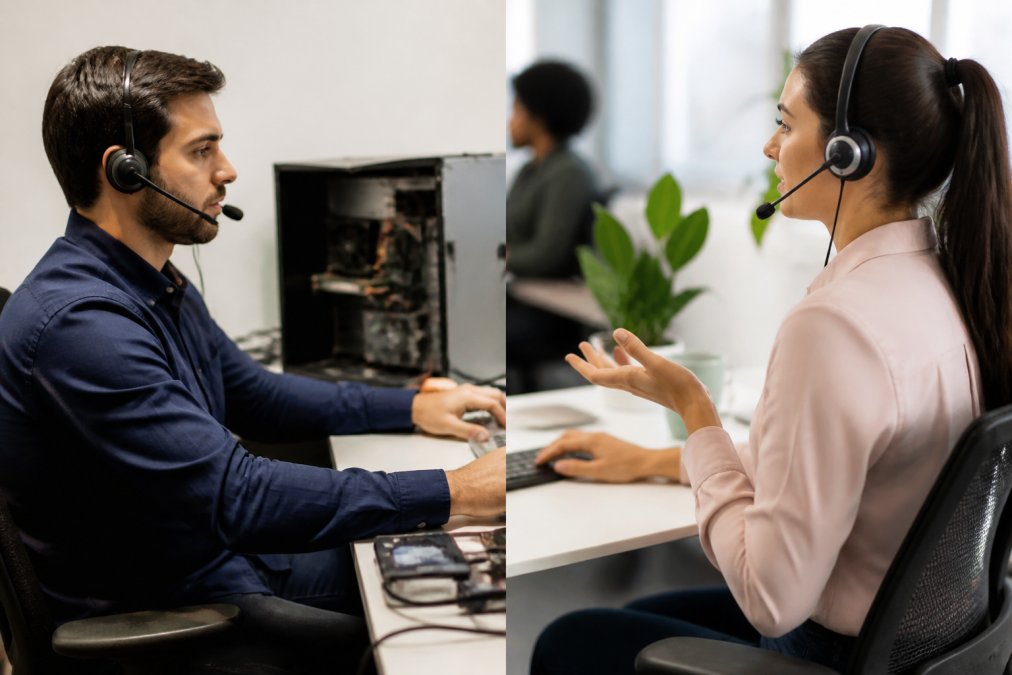
Technical support is specialized assistance for hardware, software, and system-related issues that prevent users from accessing a product or service. Customer support addresses general inquiries, account questions, billing issues, and product information to enhance the overall customer experience.
These functions require different skill sets, tools, and workflows. Technical support demands diagnostic expertise; customer support requires communication finesse and product knowledge. Conflating them creates bottlenecks and drops customer satisfaction.
For home services companies scaling from owner-operated to managed operations, this distinction is critical. You need dispatchers who handle customer communication and service scheduling alongside technical staff who troubleshoot software issues and manage platform integrations.
Hard Hat Helpers specializes in staffing these exact roles. Our virtual dispatchers handle customer inquiries, order tracking, and service coordination. The key insight: separating these functions eliminates bottlenecks and improves efficiency.
Key Differences Between Technical Support and Customer Support
Technical support focuses on diagnosing and resolving technical issues: troubleshooting hardware failures, debugging software problems, managing system configurations, and ensuring uptime. Technical support staff use diagnostic tools and remote access to identify root causes and implement fixes. Their primary metric is resolution time.
Customer support centers on the human experience: handling billing questions, order tracking, general product inquiries, and complaint management. Customer support representatives prioritize customer retention and satisfaction through relationship-building, not technical fixes.
| Aspect | Technical Support | Customer Support |
|---|---|---|
| Primary Focus | System functionality and uptime | Customer experience and satisfaction |
| Common Issues | Software bugs, hardware failures, configuration errors | Billing, shipping, account access, general questions |
| Required Skills | Troubleshooting, diagnostic tools, system knowledge | Communication, empathy, product knowledge |
| Typical Resolution Time | Minutes to hours (critical issues) | Hours to 24 hours |
| Escalation Path | Engineering team or vendor support | Supervisor or specialist department |
| Success Metric | System uptime and resolution speed | Customer satisfaction and retention |
For home services companies using Buildertrend or Procore, the distinction is practical. If a dispatcher can’t access the scheduling module, that’s a technical support issue requiring system troubleshooting. If a customer questions why their invoice shows two service visits instead of one, that’s customer support requiring account review and explanation.
Most small home services firms lack dedicated technical support staff. Hard Hat Helpers provides virtual staff trained on your business software and customer communication protocols, so you’re not asking dispatchers to debug systems or technicians to handle billing complaints.
Tier 1 IT Support and Escalation Workflows
Tier 1 IT support is the first line of defense in a multi-tier helpdesk structure. Tier 1 staff handle initial contact, gather information, attempt basic troubleshooting, and escalate when the problem exceeds their scope.
Tier 1 support is high-volume, lower-complexity work. The goal is resolving 60-80% of incoming tickets at this level, keeping costs down and resolution times fast (itil.org). Tier 1 staff use knowledge bases, run basic diagnostic scripts, and follow troubleshooting flowcharts. When they can’t resolve an issue, they escalate to Tier 2 with complete documentation. Tier 2 has deeper expertise and can dive into logs, test configurations, or contact vendors. Tier 3 might include engineering staff or vendor escalation.
For home services companies, clear escalation criteria prevent bottlenecks. A dispatcher (Tier 1 customer support) handles routine questions. Complex issues, billing disputes, or service complaints escalate to you or a manager. System problems go to technical staff or your software vendor. Simple issues resolve fast; complex issues get proper attention.
Hard Hat Helpers’ virtual dispatchers operate as your Tier 1 customer support layer, handling routine scheduling questions, service confirmations, and billing inquiries. When an issue requires your judgment, they escalate with complete context documented, keeping your inbox focused on decisions only you should make.
Core Responsibilities and Skill Sets
Technical support and customer support require different core competencies.

Technical support responsibilities include diagnosing system problems, running diagnostic tools, testing configurations, managing incident tickets, documenting solutions, and escalating complex issues. Technical support staff must understand how systems work, where failures typically occur, and how to troubleshoot systematically.
Technical support skill sets:
- Troubleshooting and diagnostic methodology
- Knowledge of relevant hardware and software systems
- Ability to use remote access and monitoring tools
- Technical writing and documentation
- Patience with non-technical users
- Ability to work under pressure when systems are down
Customer support responsibilities include answering inquiries, managing customer accounts, processing requests, handling complaints, and tracking orders or service appointments. Customer support staff are the voice of your company and must make customers feel heard and valued.
Customer support skill sets:
- Clear written and verbal communication
- Product and service knowledge
- Ability to manage multiple customer interactions simultaneously
- Problem-solving focused on customer outcomes
- Emotional intelligence and conflict de-escalation
- Attention to detail for account management
The skill overlap is minimal. A great technical troubleshooter might struggle with customer communication. A naturally empathetic customer service person might lack system architecture knowledge. Staffing them separately improves performance in both areas.
For home services companies, your dispatcher needs customer support skills for scheduling and customer communication. Your office manager needs to understand your business logic and customer relationships. Someone on your team needs technical proficiency with platforms like Procore or Buildertrend for configurations and user management.
Hard Hat Helpers provides virtual staff trained in these distinct roles. Our dispatchers are customer support specialists trained on your service offerings and communication style. Our office managers understand your business processes and can manage estimating, CRM functions, and basic system administration. managed services vs break-fix.
Customer Support Best Practices for Home Services
Home services customers often call with urgent problems and expect quick acknowledgment. Your support approach must reflect that reality.
Prioritize responsiveness. Confirm receipt immediately and provide a timeline. "We received your request at 2:15 PM. A technician will contact you by 4:00 PM today."
Know your service offerings deeply. Your support staff should explain what your technicians do, what problems they handle, and what’s outside scope. Pre-train staff on common scenarios so they answer confidently.
Document everything. Log every customer interaction in your system: what was reported, what was promised, what was scheduled. This ensures continuity and protects you if disputes arise.
Manage expectations about timelines. Communicate proactively about appointment status. "We’re on track for your 10 AM appointment Tuesday" is better than silence followed by last-minute rescheduling.
Handle complaints with authority to resolve. Give support staff authority to reschedule, offer partial refunds, or escalate to decision-makers. A support person who can only say "I’ll have the manager call you" creates frustration.
Use your software to your advantage. Platforms like Buildertrend and Procore include customer communication features, appointment reminders, photo updates, and invoicing. Automated confirmations reduce no-shows. Photo updates build customer confidence. Professional invoicing reduces billing disputes.
In home services, customer support is part of service delivery, not a cost center to minimize. Better support leads to fewer complaints, more referrals, and higher customer lifetime value.
Outsourcing Customer Service for Efficiency
Outsourcing customer service is practical for home services companies scaling beyond owner-operated.

When outsourcing makes sense: You’re spending 10+ hours per week on dispatch, scheduling, and customer calls (sba.gov). You’re missing calls because you’re in the field. Administrative overhead is pulling you away from revenue-generating work.
What to outsource first: Start with high-volume, repeatable tasks: appointment scheduling, service confirmations, basic billing questions. Leave complex decisions (pricing negotiations, service quality disputes, contract terms) with you initially.
The challenge with generic outsourcing: Many home services owners have tried cheaper global staffing platforms and been disappointed. Staff don’t understand your business model, service areas, pricing structure, or typical customer concerns. Specialized staffing makes the difference.
Hard Hat Helpers addresses this directly. Our virtual staff are trained specifically on the home services industry. A dispatcher understands why HVAC pricing varies by season, how plumbing service calls flow, and what remodeling customers worry about. We provide onboarding on your specific business, service offerings, pricing, and communication style.
The financial reality: Outsourcing customer service can significantly cut overhead costs. Hard Hat Helpers helps businesses save over 50% on overhead costs (bls.gov). Good hires, pre-trained and industry-specific, pay for themselves in the first month.
What to watch for: Choose a partner that provides continuous performance monitoring and assigns a dedicated account manager. You should have visibility into how your customers are being served.
The 24/7 angle: Outsourcing can provide evening and weekend coverage, allowing customers to reach someone during emergencies. A customer with a Sunday evening emergency can get help. That’s competitive advantage.
Outsourcing isn’t about cutting corners. It’s about accessing specialized expertise and capacity you can’t build in-house at small scale.
Building Your Support Strategy
A functional support strategy aligns your technical and customer support functions, defines clear workflows, and ensures neither becomes a bottleneck.
Start with a process map. How does a customer issue flow through your business? Define who handles what, what systems they use, and when escalation happens. This takes a few hours but saves months of confusion.
Define roles clearly. Your dispatcher is not your technician. Your office manager is not your field supervisor. Each role has distinct responsibilities. If you can’t afford separate people yet, define which responsibilities happen in which mode.
Choose tools that integrate. If your customer support team uses one system and your technical team uses another, information gets lost. Use platforms that share data. Your service management software should connect to your communication tools.
Train for your specific business. Generic customer service training teaches soft skills. You also need training on your specific products, services, and systems: how your pricing works, your service areas, typical job timelines, and common customer questions.
Measure what matters. For customer support: time to first response, customer satisfaction rating, repeat issues. For technical support: resolution time, first-contact resolution rate, escalation rate. Track whether issues are actually getting solved and customers are satisfied.
Plan for growth. Your support strategy should scale. Building systems incrementally is cheaper than scrambling when overwhelmed.
Hard Hat Helpers supports this strategy by providing pre-trained virtual staff integrated into your operations. Our dispatchers understand your business processes. Our office managers manage your CRM and estimating workflows. We handle payroll, benefits, and performance management, so you focus on growing your business. Your dedicated Client Success Manager ensures our team stays aligned with your needs as you scale.
Building separate technical support and customer support functions creates efficiency that compounds as you grow. The distinction becomes operational reality the moment you hire help. Dispatchers who excel at customer communication but aren’t trained on your software create frustration. Technical staff who understand your systems but can’t communicate clearly with customers create different problems.
The solution is defining what you need, staffing accordingly, and ensuring each function has the tools and training to succeed. Hard Hat Helpers provides virtual staff pre-trained for home services, integrated into your specific business, with continuous support and performance management. If administrative overhead is pulling you away from growth, Book Consultation to explore how specialized virtual staffing can reduce your overhead by over 50% while improving service quality.
Frequently Asked Questions
What is the difference between technical support and customer support?
Technical support diagnoses and resolves hardware, software, and system issues through troubleshooting and diagnostic tools. Customer support handles general inquiries, billing questions, order tracking, and complaint management. Technical support requires deeper technical proficiency and problem-solving skills, while customer support emphasizes empathy, service-oriented communication, and user experience. Both are essential but serve different functions in your business.
Does my home services business need both technical and customer support?
Most home services businesses benefit from both. Customer support manages client inquiries about scheduling, pricing, and service details. Technical support handles issues with your dispatch software, CRM configurations, estimating tools, and hardware problems. A small operation might combine these roles, but as you scale, separating them improves resolution time and client satisfaction. Outsourcing customer service allows your team to focus on field work while maintaining 24/7 availability.
What skills are required for effective technical support?
Technical support staff need strong problem-solving abilities, technical proficiency with hardware and software, and familiarity with diagnostic tools and remote access platforms. They must understand incident management, escalation procedures, and your specific systems. Equally important are soft skills: patience, clear communication, and the ability to explain technical concepts to non-technical users. For home services, knowledge of industry-specific software like Procore or Buildertrend is valuable.
How can outsourcing customer service improve operations for home services businesses?
Outsourcing customer service reduces administrative overhead, provides 24/7 availability for client inquiries, and ensures consistent response times. Virtual staff trained specifically for home services understand your pricing structures, service areas, and workflows without requiring extensive onboarding. This frees your team to focus on field work and business growth. Many businesses report over 50% reduction in overhead costs while improving client satisfaction and uptime.