




Last Updated: October 22, 2026
Quick Summary
Managing multiple locations in a home service business means running one company across several service areas without letting quality, scheduling, or cash flow slip at any branch. The fix is systems: written procedures, one communication rhythm, scheduling software that handles several branches, and numbers you review by location every week.
- Write one-page SOPs covering booking, job closeout, pricing, callbacks, and new-hire training.
- Hold a 30-minute weekly call with all branch leads using the same agenda every week.
- Route every cross-branch technician booking through one dispatcher to prevent double-bookings.
- Review the same location-level scorecard weekly, normalizing for branch age and service mix.
- Centralize dispatch, estimating, and admin to avoid duplicating overhead at every branch.
Table of Contents
- What Managing Multiple Locations Actually Requires
- Step 1: Write Standard Operating Procedures for Home Service Businesses
- Step 2: Build Multi-Location Business Communication That Works
- Step 3: Choose Home Service Scheduling Software That Scales
- Step 4: Track Home Service Business Performance Metrics by Location
- Step 5: Balance Local Autonomy With Company-Wide Standards
- Step 6: Protect Local Search Visibility in Every Service Area
- Step 7: Staff Each Location Without Duplicating Overhead
- Frequently Asked Questions
What Managing Multiple Locations Actually Requires
Managing multiple locations in a home service business means running one company across several service areas without letting quality, scheduling, or cash flow slip at any branch.
Most owners hit the same wall. The first location runs on your memory. The second runs on guesswork.
The fix isn’t more hours. It’s systems: written procedures, one communication rhythm, scheduling software that handles several branches, and numbers you review by location every week.
Step 1: Write Standard Operating Procedures for Home Service Businesses
Standard operating procedures for home service businesses are written, step-by-step instructions that tell any employee how to handle a recurring task the same way every time. They are the foundation of a multi-location business, because a branch manager can’t ask you how to do something at 7 a.m. on a Tuesday.
Start with the tasks that repeat most:
- How a call gets booked, from ring to confirmation
- How a tech closes out a job and collects payment
- How you price a standard repair versus a diagnostic visit
What Belongs in Every SOP
Each procedure should name the trigger, the exact steps, the person responsible, and what “done” looks like. Keep it to one page. Store every SOP in a shared platform so all locations open the same current version.
Write the SOP while you do the task, not afterward. Open a blank doc, narrate each click and call as you make it, then clean it up. You’ll capture the details you’d otherwise forget.
Step 2: Build Multi-Location Business Communication That Works
Multi-location business communication is a set schedule of check-ins between headquarters and each branch, plus one shared channel for daily updates. Without it, location managers make conflicting decisions and local teams stop hearing from leadership.
The Daily Huddle and the Weekly Branch Call
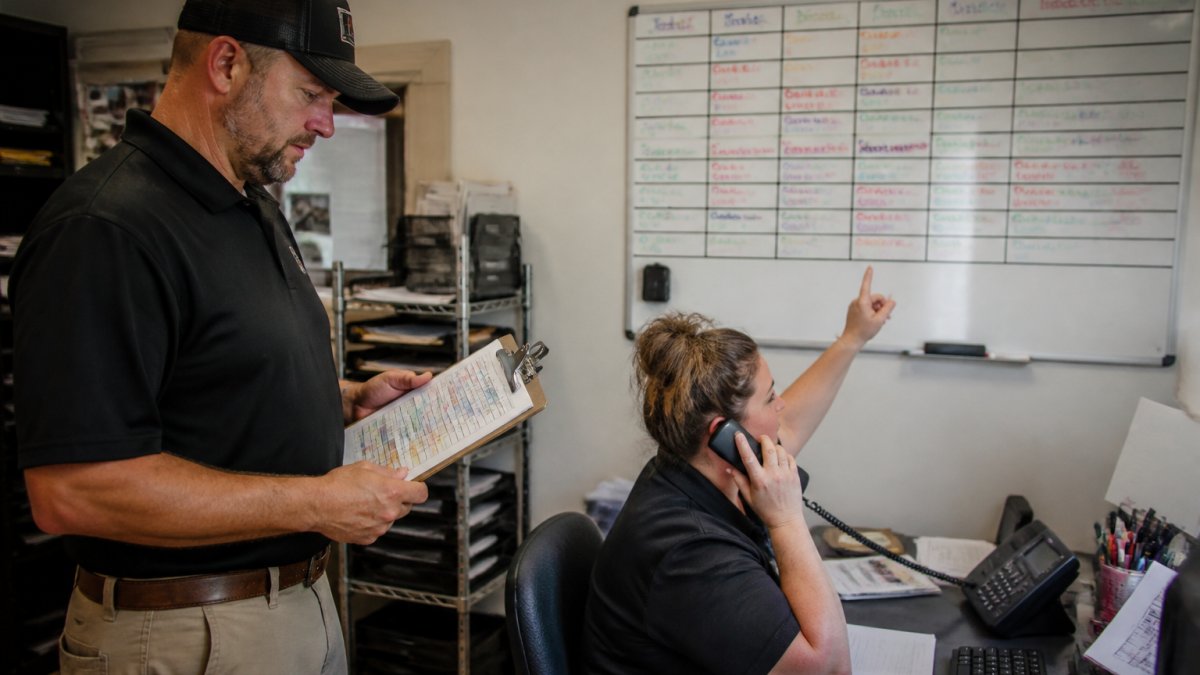
Run a short daily huddle at each location: who’s on the board, who’s out, what’s stuck. Then hold one weekly call with all branch leads. Same agenda every week:
- Jobs completed versus scheduled
- Open callbacks and complaints
- Staffing gaps for the coming week
- One thing each branch needs from headquarters
Keep the weekly call to 30 minutes. Long meetings get skipped.
Step 3: Choose Home Service Scheduling Software That Scales
Home service scheduling software should let you view every branch’s board in one screen and assign jobs by service area, not by location name. If your current tool forces you to open a separate calendar per branch, it will fail you at location three.
Look for these features before you commit:
- Shared technician pool across locations
- Service-area mapping so jobs route to the nearest tech
- Real-time job status visible to all dispatchers
Dispatching Across Branches Without Double-Booking Techs
Set one rule: a technician belongs to a primary branch but can be borrowed by a neighboring branch only through a dispatcher, never directly. That single rule prevents the most common multi-location mess, where two dispatchers promise the same tech to two customers.
If you let branch managers book each other’s techs informally, you’ll get double-bookings and angry customers within a month. Route every cross-branch booking through one dispatcher or a shared request form.
Step 4: Track Home Service Business Performance Metrics by Location
Home service business performance metrics are the numbers you review for each branch every week to spot problems before they spread. Track a small set consistently rather than a large set occasionally, and define each one the same way at every branch so the comparison is honest.
The Core Location-Level Scorecard
| Metric | How to Calculate It | What It Tells You | Cadence |
|---|---|---|---|
| Revenue per location | Total invoiced revenue for the branch in the period | Which branch earns its keep | Weekly |
| Revenue per technician | Branch revenue ÷ average active techs | Whether headcount is paying for itself | Weekly |
| Job completion rate | Jobs completed ÷ jobs scheduled | Dispatch and tech reliability | Weekly |
| Callback rate | Callbacks ÷ jobs completed | Service quality problems | Weekly |
| Technician utilization | Billable hours ÷ available hours | Whether you’re over- or under-staffed | Weekly |
| Average ticket | Revenue ÷ jobs completed | Pricing and upsell health | Monthly |
| Gross margin | (Revenue − direct labor and materials) ÷ revenue | Pricing and labor health | Monthly |
| Customer acquisition cost | Local marketing spend ÷ new customers | Local marketing efficiency | Monthly |
Comparing Branches Fairly
A new location will look weak next to an established one for a while, and a branch in a low-cost service area will post different margins than one in a dense metro. Compare each branch to its own trailing three-month average first, then to the company average, and only then to peer branches of similar age and service mix. Location-level reporting tells you whether a branch is improving, which matters more than its ranking against a branch that opened eight years earlier.
Two adjustments keep the comparison honest:
- Normalize for age. Exclude the first 90 days of a new branch from company-wide averages, or flag it separately.
- Normalize for service mix. A branch that runs mostly maintenance contracts will show lower average tickets and higher completion rates than one doing installs. Compare like with like, or weight the metrics.
The Weekly Review Rhythm
Hold one 30-minute review per week with branch leads using the same scorecard. Walk each branch through its four weekly metrics, flag any branch that moved more than a set threshold (for example, callback rate climbing two points week over week), and assign one owner and one deadline per flag. Monthly, roll the same numbers into a branch P&L review that adds gross margin and customer acquisition cost.
Pick your thresholds once and write them into the SOP. “Callback rate above X% triggers a quality review” removes the debate and makes the weekly call about action, not argument.
A metric you can’t define the same way at every branch isn’t a metric, it’s an opinion. Standardize the formula, normalize for age and service mix, and review the same scorecard every week.
Step 5: Balance Local Autonomy With Company-Wide Standards
Give branch managers control over scheduling and local customer relationships. Keep pricing, safety, and brand standards at headquarters. That split is the whole game.
What most guides miss is that autonomy is a retention tool. Good location managers stay because they can make decisions.
Write down which decisions are local and which are company-wide. Share the list with every manager.
Standardize what customers see and what keeps you legal. Let local teams decide how they hit those standards.
Step 6: Protect Local Search Visibility in Every Service Area
Each location needs its own business listing, its own location landing page, and its own reviews. Local search visibility is won one service area at a time, and a single homepage cannot rank for every town you serve. Maintaining consistency in your digital presence requires a systematic approach to managing local listings across franchises to ensure that each specific territory remains discoverable to nearby customers.
Build these assets for each branch:
- A verified business listing with the correct address and hours
- A location landing page with real photos and service details
- A store locator on your main site pointing to each page
- A process for asking happy customers for reviews by branch
Follow Google’s guidance on business listing best practices for accurate listing details.
Review Management by Service Area
Request at the point of service. The highest-converting moment is right after the tech closes the job, while the customer is still on site.
Route reviews to the right listing. Each branch should have its own verified listing, and review requests should point to that branch’s listing, not a single company-wide page.
Monitor by branch, not company-wide. Pull review volume, average rating, and response rate for each branch every month.
Respond with a recovery script. Negative reviews are a customer-recovery opportunity, not just a reputation problem.
Don’t let headquarters write every review response. A corporate-sounding reply on a local listing reads as fake to customers in that service area. Give branch managers a template and let them respond in their own voice.
Reviews are a per-service-area asset. Ask at the point of service, route to the branch listing, monitor by branch, and respond within two business days, that’s how one weak branch stops dragging down the whole brand.
Step 7: Staff Each Location Without Duplicating Overhead
The trap in adding locations is copying your office staff at every branch. Three branches with three full front offices can bury your margin.
This is where Hard Hat Helpers fits. We provide virtual dispatchers, estimators, and office managers trained for the home services industry, so each new branch gets support without a full local payroll.
We tailor training to your specific pricing, service areas, and tools, so a dispatcher understands your HVAC pricing structure or your remodeling quotes before they take a call.
Frequently Asked Questions
How do you keep service quality consistent across multiple locations?
Consistency comes from written systems, not personality. Put standard operating procedures for home service businesses in one shared platform so every branch follows the same steps for intake, dispatch, job closeout, and follow-up. Then audit a sample of jobs from each location every month against those steps. When one branch drifts, you catch it in the audit rather than in a customer complaint. Pair the audits with a short weekly call where location managers compare notes, and you get both a written standard and a human check on how well it is being followed.
What home service scheduling software features matter most when you run several branches?
Look for three things. First, a shared job board that shows every technician across every branch, so a dispatcher in one location can see who is free in another. Second, routing that respects each service area, since sending a tech across two territories burns labor hours. Third, location-level reporting built in, so you can pull job counts and completion rates per branch without exporting spreadsheets. Home service scheduling software that only works for a single office will force you into duplicate accounts and double data entry as you add locations.
Which performance metrics should I review for each location?
Start with revenue per location, gross margin, job completion rate, callback rate, and customer acquisition cost. Those five tell you whether a branch is profitable, whether the work is being done right the first time, and whether it is buying customers efficiently. Review them monthly side by side, not in isolation, because a branch can look healthy on revenue while a rising callback rate quietly eats the margin. Add customer review volume and rating per service area so you can see whether local reputation is keeping pace with the work you are selling.
When should a home service business open another location?
Open a new branch when your current one runs without you in the room daily, when demand in the new area already exists and is being served from too far away, and when you can name the manager who will run it. If you cannot point to written operating procedures and a shared scheduling system, adding a location multiplies chaos rather than revenue. A practical test: track how many jobs you turn down or lose to travel time in the target area over a quarter. If that number is steady and meaningful, the demand case is real.
Adding a second or third location tests every system you’ve built. If dispatch, communication, and reporting still depend on you personally, growth will stall. Hard Hat Helpers gives you trained virtual dispatchers, estimators, and office managers who plug into your existing operations, with managed payroll, continuous performance monitoring, and a dedicated Client Success Manager behind them. Book a consultation and see how one support team can carry every branch you add.