



Table of Contents
- Why Leadership Training Programs Matter for Home Services Businesses
- Hard Hat Helpers: Industry-Specific Virtual Leadership Support
- Leadership Development for Trade Businesses: What Sets Industry Training Apart
- How to Train Field Supervisors for Management Success
- Measuring Leadership Training ROI for Small Business Operations
- Key Program Formats and Delivery Options
- Choosing the Right Leadership Training Approach for Your Team
- Frequently Asked Questions
Last Updated: October 21, 2026
Why Leadership Training Programs Matter for Home Services Businesses
Leadership training programs home services differ from generic corporate development. Your field supervisors, dispatchers, and office managers face unique challenges: managing technicians across multiple job sites, handling customer relationships under pressure, and scaling operations without losing quality.
The home services industry moves fast. A supervisor who excels at hands-on work doesn’t automatically know how to delegate, manage scheduling conflicts, or handle difficult customer situations. This gap costs money. Poor field leadership leads to missed appointments, customer complaints, and high staff turnover.
Businesses that invest in leadership development for their team often see improvements in employee retention, customer satisfaction, and operational efficiency. The question isn’t whether to train your leaders, it’s which program fits your specific needs and budget.
Below, we’ll walk you through the best leadership training programs home services businesses need, what makes them different from generic corporate training, and how to measure whether the investment actually pays off.
Hard Hat Helpers: Industry-Specific Virtual Leadership Support
Hard Hat Helpers solves a core problem most home services businesses face: finding trained leadership talent without the overhead of hiring full-time staff.
Hard Hat Helpers provides virtual staffing solutions exclusively for the home services industry. We supply pre-qualified dispatchers, estimators, and office managers who already understand HVAC pricing structures, plumbing service areas, and the unique workflows of trade businesses. More importantly, our team is trained on your specific products, services, and tools before day one.
What sets this apart from generic virtual assistant services: our staff works 24/7, so you have coverage nights and weekends without paying for someone sitting idle during slow hours. We handle payroll, benefits, and performance monitoring. You get a dedicated Client Success Manager who stays accountable for results.
For leadership development specifically, this matters because your office and dispatch team doesn’t need to learn leadership theory, they need to learn your business. Hard Hat Helpers staff are trained on your processes, your customer base, and your operational challenges. They integrate seamlessly, which means less onboarding burden on your existing leaders and faster productivity.
The overhead savings are real. Businesses can significantly cut overhead costs by over 50% compared to hiring full-time staff. That’s money you can reinvest in field operations or growth.
If you’ve tried outsourcing before with cheaper global staffing companies and the quality was poor, the difference here is industry specificity. We’re not training generalists, we’re training people who understand home services operations from day one.
Leadership Development for Trade Businesses: What Sets Industry Training Apart
Generic leadership training teaches communication skills and decision-making frameworks that apply everywhere. Industry-specific training goes deeper: it teaches the actual problems your team will face.
A field supervisor in HVAC needs to know how to handle a technician who’s running late to a job, a customer who’s upset about pricing, and a scheduling conflict that affects three other appointments, all on the same day.
The best leadership training programs for home services address these realities:
Field team communication. Your supervisors manage technicians across multiple locations. They can’t walk over and tap someone on the shoulder. Training should cover how to use dispatch software, communicate expectations clearly through digital channels, and handle urgent changes when a technician is already at a job site.
Customer relationship management under pressure. A homeowner is upset because the service call is running late. The supervisor needs to de-escalate, explain the situation, and maintain the customer relationship while keeping the technician focused.
Scheduling and resource management. Home services operations are constrained by geography and time. Training should teach supervisors how to balance technician workload, account for travel time, and manage customer expectations when demand spikes.
Safety and compliance. HVAC, plumbing, and electrical work have safety requirements. Supervisors need to enforce these without slowing down operations. Leadership training should address how to build a safety culture that sticks.
Team retention in a high-turnover industry. The home services industry has higher turnover than most sectors. Training should teach supervisors how to motivate technicians, recognize good work, and create a workplace people actually want to stay in.
Generic programs skip these specifics. They teach principles. Industry-specific programs teach application.
How to Train Field Supervisors for Management Success
Field supervisors are your critical link between office operations and technicians in the field. Their effectiveness directly impacts customer satisfaction, technician retention, and profitability.
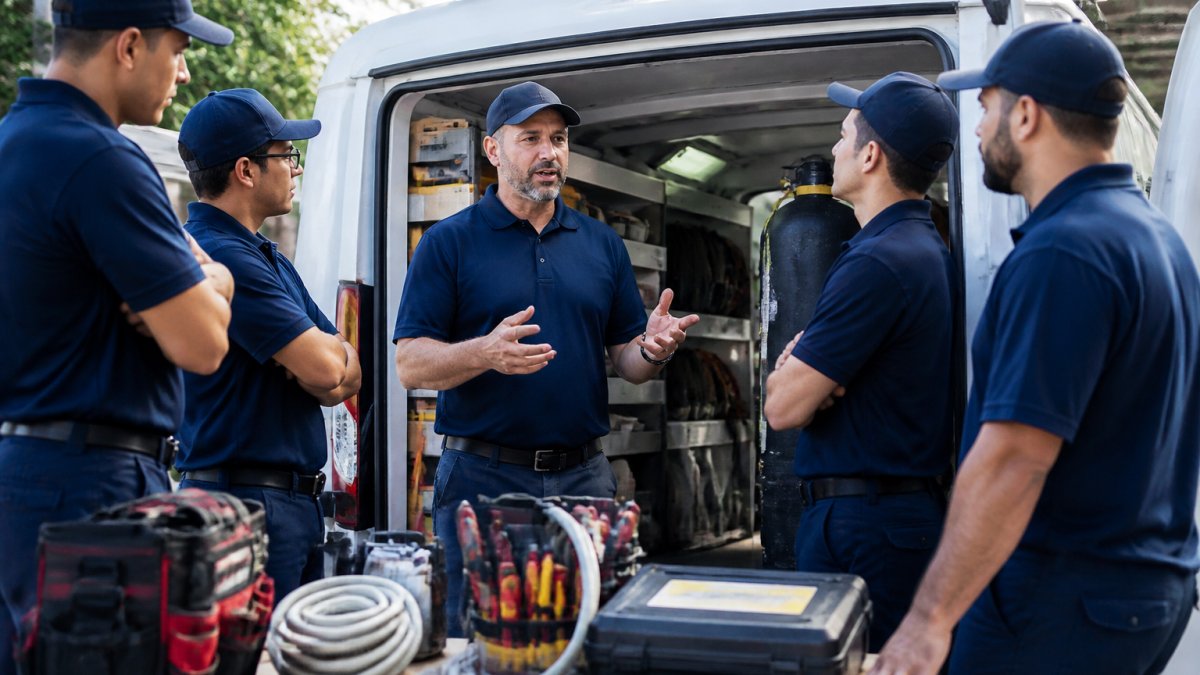
Training field supervisors for management success requires a structured approach:
1. Start with the fundamentals of your business. A new supervisor needs to understand your service offerings, pricing structure, profit margins, and customer base. They need to know which customers are high-value, which services are most profitable, and why certain decisions matter. This isn’t leadership theory, it’s operational context.
2. Teach delegation and accountability. Many field supervisors come from hands-on backgrounds. They’re comfortable doing the work themselves but uncomfortable asking others to do it.
3. Cover communication systems and tools. Your supervisors need to be proficient with dispatch software, mobile apps, and communication platforms. They should know how to send updates, handle urgent changes, and document decisions.
4. Address conflict resolution and difficult conversations. Supervisors will deal with technician conflicts, customer complaints, and scheduling problems. Training should give them frameworks for handling these situations calmly and professionally.
5. Teach performance management and feedback. Supervisors need to recognize good work, address underperformance, and give feedback that actually improves behavior. This is where many field leaders struggle because they lack experience in formal management.
6. Build a culture of safety and compliance. Supervisors enforce safety standards. Training should teach them how to prioritize safety without creating friction with technicians who want to work faster.
The timeline matters. Some supervisors need 30-60 days of structured training before they’re truly effective. Some of this is formal instruction. Much of it is on-the-job coaching with an experienced manager or mentor.
A common mistake: promoting a top technician to supervisor and expecting them to figure it out. Technical excellence doesn’t translate to management skill. The learning curve is steep, and without proper training, new supervisors often fail within the first year.
Measuring Leadership Training ROI for Small Business Operations
You need to know whether leadership training actually improves your bottom line. Without measurement, it’s just an expense.
Return on investment for leadership training in home services comes from four main areas:
Employee retention. When supervisors improve their management skills, technicians are more likely to stay. Calculate the cost of replacing a technician (recruitment, training, lost productivity) and compare it to training investment. A single technician retained often pays for supervisor training.
Customer satisfaction and repeat business. Better-trained supervisors handle customer interactions more professionally. This shows up in online reviews, referral rates, and repeat customer percentages. Track these metrics before and after training.
Operational efficiency. Improved scheduling, reduced overtime, fewer missed appointments, and better technician use all reduce costs. Monitor dispatch efficiency, average response times, and schedule adherence.
Revenue per technician. Well-managed teams close more jobs, upsell additional services, and work more efficiently. Track revenue per technician before and after training.
Set a baseline before training begins. Measure these four areas for 30-60 days, implement training, then measure again after 90 days. Most home services businesses see measurable improvement within three months.
| Metric | Baseline | Post-Training Target | ROI Calculation |
|---|---|---|---|
| Monthly technician turnover | % | % | Cost per replacement × reduction |
| Customer satisfaction score | Rating | Rating | Repeat business value × improvement |
| Schedule adherence | % on-time | % on-time | Cost of delays × improvement |
| Revenue per technician | $ | $ | Additional revenue × team size |
The investment in leadership training typically ranges based on program format and depth. Hard Hat Helpers eliminates the need to hire and train a new office manager or supervisor, we provide pre-trained staff who integrate immediately, which can deliver ROI within the first month through overhead savings alone.
Key Program Formats and Delivery Options
Leadership training programs come in different formats. The right choice depends on your schedule, budget, and learning preferences.
Instructor-led workshops. These are in-person or virtual sessions where a trainer leads a group through content. Workshops typically run 1-3 days and cover specific topics like communication skills, delegation, or decision-making. Cost varies widely.
Online self-paced courses. Participants work through video lessons, quizzes, and assignments on their own schedule. These are less expensive than instructor-led training but require self-discipline. Good for supervisors who can’t leave operations for multiple days.
Coaching and mentoring. One-on-one coaching from an experienced leader or external coach. This is highly personalized but also the most expensive option. Best for senior leaders or supervisors with specific challenges.
Modular programs. Training broken into smaller chunks, 30-minute lessons, weekly modules, or monthly topics. This fits better into operational schedules and allows time for practice between sessions.
Blended learning. Combines multiple formats: some instructor-led sessions, some self-paced learning, and some coaching. This approach often produces the best results because it accommodates different learning styles and allows for application between sessions.
For home services businesses specifically, blended programs work best.
Hard Hat Helpers offers a different approach: we provide trained staff who already have the skills your team needs.
Choosing the Right Leadership Training Approach for Your Team
The decision comes down to three factors: your current team’s readiness, your budget, and your timeline.
If you have supervisors in place but they need skill development, invest in training programs. Instructor-led workshops or blended learning programs work well. Budget 3-6 months for meaningful improvement. Cost depends on program depth, but expect several hundred to a few thousand dollars per supervisor.
If you lack experienced supervisors or office managers, hiring and training someone takes 6-12 months. Hard Hat Helpers offers a faster path: pre-trained virtual staff who integrate immediately and cost significantly less than a full-time hire when you factor in benefits, payroll taxes, and overhead.
If you have supervisors but lack bandwidth to manage them, a dedicated Client Success Manager (like you get with Hard Hat Helpers) ensures accountability and performance monitoring without adding to your workload.
The best leadership training programs for home services share common traits: they address field service realities, they’re structured but flexible, they measure results, and they’re delivered by people who understand the industry.
Scaling a home services business without strong leadership is nearly impossible. Your supervisors and office managers are the backbone of operations. Whether you develop your existing team through training or gain access to experienced professionals through virtual staffing, the investment in leadership capability pays dividends.
Hard Hat Helpers specializes in providing pre-trained virtual staff for the home services industry, dispatchers, estimators, and office managers who already understand your business and can lead effectively from day one. With 24/7 availability, managed payroll and benefits, continuous performance monitoring, and a dedicated Client Success Manager supporting every client, we handle the administrative burden so you can focus on growth. Book a consultation to see how industry-specific virtual staffing can transform your operations.
Frequently Asked Questions
What specific leadership skills are most critical for home services managers?
Home services managers need strong communication, delegation, and conflict resolution skills to manage field teams and office staff effectively. Decision-making under pressure, customer relationship management, and the ability to train technicians on both technical and customer service standards are equally important. Scheduling efficiency, safety accountability, and the ability to adapt to service disruptions separate successful managers from those who struggle. Leadership training programs that address these trade-specific challenges outperform generic management courses.
How can leadership development for trade businesses differ from general management training?
Trade-specific leadership training addresses the unique challenges of field operations: managing remote teams, coordinating complex schedules, handling emergency service calls, and maintaining quality control across multiple job sites. General programs often overlook the communication gaps between office and field staff, the technical knowledge required to manage skilled trades, and the safety and compliance pressures specific to HVAC, plumbing, and electrical work. Industry-focused programs include case studies from home services businesses and teach managers how to lead both office and field teams effectively.
What is the average ROI of leadership training programs for small home services businesses?
Businesses that invest in leadership training often see improvements in employee retention, reduced scheduling conflicts, faster decision-making, and better customer satisfaction. ROI depends on measuring baseline metrics before training (turnover rates, dispatch efficiency, customer complaints) and tracking the same metrics after implementation. The key is selecting training that addresses your specific operational pain points and reinforces learning through ongoing coaching or mentorship.
How long does it take for leadership training to show measurable business results?
Quick wins can appear as managers apply communication and delegation skills to daily operations. Significant improvements in team performance, retention, and customer satisfaction can emerge over time. Long-term cultural change and sustained productivity gains can develop. Businesses often see the fastest results when they combine formal training with ongoing support, peer accountability groups, and reinforcement from leadership. Without follow-up, training benefits can fade.