




Table of Contents
- Why Plumbing Businesses Need Virtual Assistant Solutions
- Human Virtual Assistants vs. AI-Powered Automation: Which ROI Makes Sense
- Plumbing Dispatch Software and Real-Time Scheduling
- Outsourced Dispatching for Plumbing Companies: When to Hire Human Support
- AI Customer Service for Plumbers: Intake, Estimates, and Lead Capture
- Key Features That Matter: Job Costing, Integration, and Data Security
- Hard Hat Helpers vs. Software-Only Platforms: Making Your Choice
- Conclusion
- Frequently Asked Questions
Last Updated: October 1, 2026
Why Plumbing Businesses Need Virtual Assistant Solutions
Plumbing businesses face a fundamental operational challenge: the more jobs your technicians complete, the more administrative work piles up. Scheduling, customer intake, estimates, invoicing, dispatch coordination, these tasks consume hours that could go toward growing your business. This is where virtual assistant software plumbing solutions become essential. The right solution handles the work that keeps you from scaling.
Plumbing shop owners face a false choice: hire full-time overhead or stretch your team thin. Virtual assistant solutions, whether AI automation or human staffing, break this by introducing flexibility without fixed costs.
The distinction matters. Some solutions are software platforms that automate workflows. Others are actual people, trained specifically for home services, who integrate into your operations. Hard Hat Helpers operates in the latter category: pre-qualified virtual staff who understand plumbing pricing structures, service areas, and customer communication standards. They handle dispatch coordination, estimates, customer intake, and job costing without requiring you to manage hiring, payroll, or benefits.
Industry-specific solutions eliminate the learning curve that kills productivity in the first 90 days. A general platform won’t understand your flat-rate pricing or dispatch protocols; specialized tools do.
Human Virtual Assistants vs. AI-Powered Automation: Which ROI Makes Sense
The choice between human virtual assistants and AI automation depends on whether the work requires judgment.
AI excels at high-volume, repetitive tasks: call routing, appointment reminders, intake forms, invoicing. Advantage: zero labor cost, instant scaling. Limitation: AI struggles with nuance, unusual issues get routed incorrectly or require human intervention anyway.
Human virtual assistants handle judgment-intensive work: dispatchers need to understand pricing and technician skill sets; estimators need to ask clarifying questions and defend pricing. AI alone falls short here.
The ROI question: how much work is rule-based versus judgment-based? If 70% of intake calls ask the same five questions, AI handles that efficiently. Complex calls and estimating still need a human.
Hard Hat Helpers provides human virtual assistants for judgment-intensive work. Their dispatchers optimize routes; estimators ask clarifying questions and defend pricing. This costs more than software but eliminates automation failures when they matter most.
Most plumbing businesses benefit from hybrid: AI for high-volume intake and scheduling, human support for dispatch and estimates.
Plumbing Dispatch Software and Real-Time Scheduling
Real-time dispatch coordination is your operational engine. You need to know which technician is closest and available. Delays cost jobs. Dispatch software provides live visibility into technician locations and job status.
Housecall Pro specializes in flat-rate pricing and dispatch; Jobber offers flexible scheduling and mobile integration. Both provide real-time visibility into technician location and job progress.
Mobile-first design is critical, technicians need job details and notes on their phone. Jobber excels at mobile design; Housecall Pro focuses on the coordinator’s interface.
Integration matters. Housecall Pro integrates with QuickBooks; Jobber offers broader third-party connections.
Dispatch software doesn’t replace human judgment. A complex installation needs your most experienced technician, not just whoever is closest. Human coordination adds value software alone cannot.
Outsourced Dispatching for Plumbing Companies: When to Hire Human Support
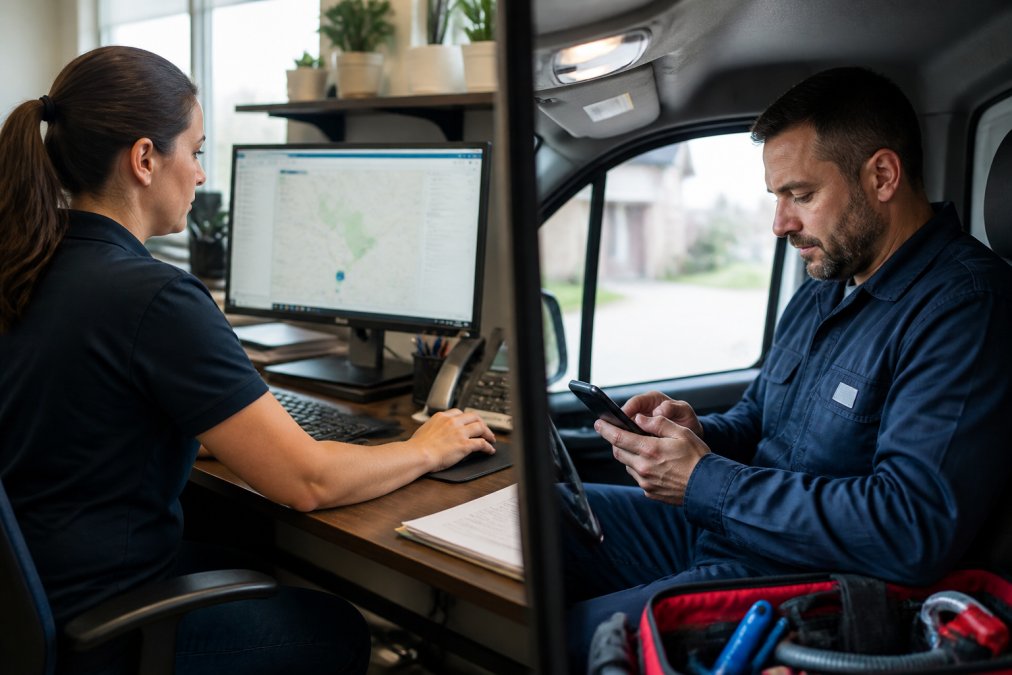
Dispatch coordination is high-stress: answering phones, managing schedules, handling complaints, coordinating technicians, tracking profitability. One person has limits before quality slips.
Outsourced dispatching becomes valuable when your team is overwhelmed. A specialist dispatcher means faster response times and fewer scheduling conflicts.
If you’re handling 15-20 jobs per day with one person managing dispatch, invoicing, and intake, you’re at capacity. Adding 10 more jobs without dispatch support breaks your system. Outsourced dispatching then makes financial sense.
Hard Hat Helpers provides trained dispatchers who learn your pricing structure, service areas, and communication standards before starting. This eliminates costly first-month mistakes from staff who don’t understand your business.
The honest limitation: outsourced dispatchers still need oversight. You can’t completely hand off the function and ignore it. Your dispatcher needs to know when to escalate issues, which customers have special requirements, and how to handle emergency situations. This is why the best implementations pair outsourced dispatch with your owner or office manager monitoring quality and handling exceptions.
AI Customer Service for Plumbers: Intake, Estimates, and Lead Capture
AI customer service tools have matured significantly. The appeal is obvious, 24/7 availability without paying for someone to sit at a desk overnight.
Here’s how it works in practice. A customer calls your number. The AI answers, asks what they need, captures their information, and either schedules them with available technicians or creates a draft estimate for your team to review. For routine service calls (clogged drain, leaky faucet), this process completes without human intervention. For complex jobs (whole-house replumbing, new construction), the AI flags the job for your team to review and refine the estimate.
The real value is lead capture. Many plumbing calls come during hours when your office is closed. Without AI answering, those calls go to voicemail. The customer either leaves a message (which you might not return quickly enough) or calls a competitor. Vellum ensures every call gets answered, the customer’s information gets captured, and they get scheduled or sent a preliminary estimate. This alone can increase job volume by 10-15% for many shops.
The limitation is accuracy. AI struggles with complex plumbing scenarios. A customer describing a persistent drainage issue might have a simple problem or a structural issue requiring inspection. AI might misclassify it, leading to a technician arriving unprepared. This is why the best implementations use AI for initial intake, then have a human review complex jobs before the technician is dispatched.
Integration with your CRM matters. The AI needs to feed customer information directly into your job management system. If data entry requires manual work, you lose the efficiency gain. Most modern platforms handle this, but verify before implementing.
The cost is typically subscription-based, which means it scales with usage. A slow month costs less than a busy month. Compare this to hiring a part-time office person, and the math often favors AI for businesses with variable call volume.
Key Features That Matter: Job Costing, Integration, and Data Security
When evaluating any virtual assistant solution, whether software or human staffing, three features separate adequate tools from systems that actually improve profitability.
Job costing is the first. You need to know whether each job is profitable. A flat-rate pricing system only works if you understand your actual costs. Knowify specializes in this, detailed job costing with real-time budget tracking. You estimate a job at 4 hours, your technician logs 5.5 hours, and you immediately see the variance. This data drives better estimating and helps you identify jobs that consistently run over.
Software-only platforms like Knowify and ServiceTitan excel at job costing because they can process data at scale. They track labor hours, material costs, and overhead allocation per job. Human virtual assistants won’t track this automatically, you still need the underlying software to capture the data. This is why the best implementations combine human dispatch coordination with software that tracks profitability.
Integration is the second critical feature. Your dispatch software needs to connect with your accounting system, CRM, and invoicing platform. ServiceTitan integrates deeply with industry-standard accounting software. Housecall Pro focuses on QuickBooks integration. Jobber offers broader third-party connections. If your software doesn’t integrate with your existing tools, you’re creating manual data entry work, which defeats the purpose.
Data security is the third, and it’s often overlooked until something goes wrong. Plumbing businesses handle customer addresses, phone numbers, and payment information. A breach exposes your customers and creates liability for you. Hard Hat Helpers emphasizes this in their positioning: they manage data security on behalf of your business.
Look for platforms that offer role-based access control (different staff see different data), audit logs (tracking who accessed what information), and encrypted data transmission.
Hard Hat Helpers vs. Software-Only Platforms: Making Your Choice
| Solution Type | Best For | Key Strength | Main Limitation |
|---|---|---|---|
| Software-Only (Jobber, Housecall Pro) | Efficiency and scalability | Real-time visibility, integrations | Requires human management of workflows |
| AI Automation (Vellum) | After-hours intake and lead capture | 24/7 availability, low cost | Struggles with complex scenarios |
| Human Virtual Assistants (Hard Hat Helpers) | Judgment-intensive work and customer relationships | Industry-specific training, quality | Higher cost than software alone |
| Hybrid Approach | Most plumbing businesses | Combines efficiency with quality | Requires coordinating multiple tools |
Conclusion
The best virtual assistant software plumbing option for your business depends on what’s actually holding you back. If you’re losing jobs because phones go unanswered and your team is drowning in scheduling, you need both the visibility that software provides and the human capacity that virtual assistants deliver.
Frequently Asked Questions
What’s the difference between virtual assistant software and hiring a human virtual assistant for plumbing dispatch?
Virtual assistant software automates tasks like scheduling, invoicing, and customer intake through AI and workflows. Human virtual assistants provide personalized customer interaction, complex problem-solving, and relationship management. Software scales instantly but lacks judgment; human assistants cost more but understand your specific pricing, service areas, and customer nuances. Many plumbing businesses use both: software for routine tasks and human support for estimating or high-value customer calls.
How does AI customer service for plumbers actually handle complex intake like service area restrictions or emergency calls?
AI systems handle routine intake by capturing basic information, scheduling appointments, and routing calls to the right technician or queue. However, complex scenarios like emergency dispatching or explaining your specific service areas typically require human intervention or hybrid workflows. AI excels at 24/7 responsiveness and initial lead capture; trained human dispatchers excel at judgment calls and customer relationship preservation.
Can outsourced dispatching for plumbing companies work if my business has unique pricing or service limitations?
Yes, but only if the outsourced team receives detailed training on your specific pricing structure, service areas, and customer preferences. Generic staffing services often fail because they lack this context. Specialized providers like Hard Hat Helpers invest in training virtual staff on your exact business model, reducing errors and rework. Budget 2-4 weeks for onboarding before they’re fully productive.
What plumbing dispatch software features are most important for reducing overhead costs?
Focus on automated scheduling, mobile dispatch coordination, and integrated invoicing. These three eliminate manual data entry, reduce back-and-forth communication, and speed up payment collection. Real-time technician tracking and route optimization also reduce travel time and fuel costs. Job costing features help identify which jobs are actually profitable, preventing underpricing. Pricing for most platforms depends on factors like team size and features.