

Table of Contents
- Can You Scale a Home Service Business Without More Staff?
- Build Systems and Processes to Automate Home Service Business Tasks
- Leverage Technology for Scaling Home Service Business Operations
- Outsourcing Home Service Business Tasks Without Losing Quality
- Improve Customer Retention Strategies for Home Service Growth
- Maintain Team Culture and Morale While Scaling Lean
- Real-World Case Studies: Home Service Businesses That Scaled Without Hiring
- Conclusion: Your Path to Scaling Without More Staff
Scale Your Home Service Business Without Hiring More Staff
Last Updated: July 28, 2026
Can you scale a home service business without more staff? Yes, but not by chasing revenue through headcount. The most successful home service companies scale by optimizing systems, automating administrative tasks, and using technology to replace work that once required multiple employees. According to research from the National Association of Home Builders, administrative overhead consumes 15-25% of operating costs in most service businesses, and much of that work can be eliminated or outsourced. The businesses winning today aren’t the ones with the biggest teams. They’re the ones with the smartest systems.
The Scaling Myth: Why Adding Headcount Isn’t the Answer
Most home service owners assume scaling means hiring. But the math doesn’t work. Each new hire adds fixed costs: payroll, taxes, benefits, training, and management overhead. A full-time office employee costs $50,000-$70,000 annually when you factor in taxes and benefits. By the time you’ve hired three people to support growth, you’ve added $120,000-$150,000 in annual overhead, a massive margin hit for businesses running 15-25% net profit.
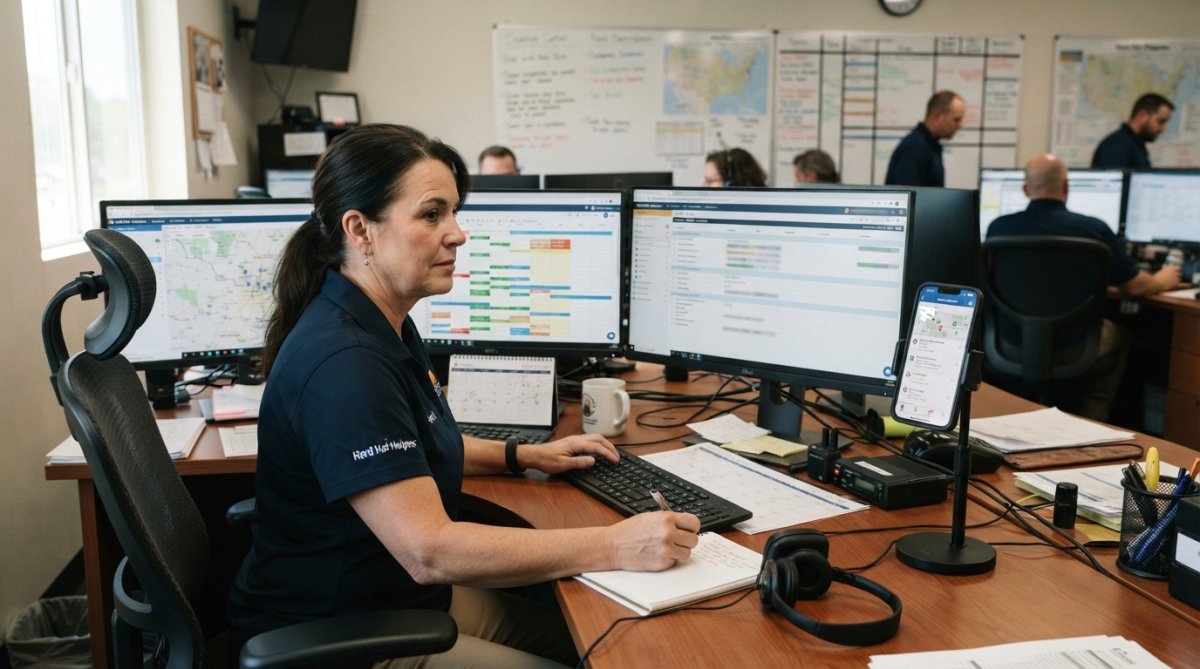
Profitable scaling requires a different approach: What work is essential, and what work can be eliminated, automated, or outsourced? A plumbing company using AI-powered lead capture doesn’t need a receptionist answering phones. An HVAC contractor with field service software doesn’t need a dispatcher manually calling technicians. Scaling without more staff requires a mindset shift. You’re not trying to do more with more people. You’re trying to do more with better systems, smarter technology, and strategic outsourcing of non-core tasks.
What Scaling Really Means Beyond Revenue Growth
Revenue growth is the easiest metric to chase and the least reliable indicator of business health. Real scaling means growing revenue while improving profitability, reducing owner workload, and building a business that runs without constant personal involvement.
For home service businesses, scaling metrics that actually matter include:
Revenue per technician: If your revenue per tech is $150,000 annually, your goal should be to increase that to $175,000 or $200,000, not hire more technicians at the current ratio.
Administrative cost as percentage of revenue: If admin costs are 20% of revenue and you can drop them to 12% through automation and outsourcing, you’ve created massive profit without touching service delivery.
Owner time required to run the business: If you’re working 60 hours a week to manage a $500K business, you haven’t scaled.
Profit margin: A $1M business at 20% margin ($200K profit) is better than a $1.5M business at 10% margin ($150K profit).
When you focus on these metrics instead of raw revenue, your scaling strategy shifts completely. You stop hiring and start systematizing.
Build Systems and Processes to Automate Home Service Business Tasks
Systems are the foundation of scaling without more staff. A system is a documented, repeatable process that anyone can execute. Without systems, every job depends on one person’s knowledge. With systems, the work gets done consistently regardless of who’s doing it.
Most home service businesses operate on tribal knowledge. When you try to scale by hiring, you’re constantly training new people on undocumented processes. They make mistakes. Customers get frustrated. You spend your time fixing problems instead of growing.
Documenting Standard Operating Procedures (SOPs)
An SOP is a clear, step-by-step guide that explains how the work gets done. Write it from the perspective of someone who’s never done the job before. Walk through every step, include decision points, templates, checklists, and quality standards. Once you have SOPs documented, you can train virtual staff, outsource tasks, or automate parts of the process.
| Process | Current Owner | Automation Opportunity | Estimated Time Savings |
|---|---|---|---|
| Lead capture | Phone/manual form | AI chatbot or online form | 5-8 hours/week |
| Estimating | Owner/senior tech | Estimation software with templates | 10-15 hours/week |
| Scheduling | Dispatcher | Automated scheduling software | 8-12 hours/week |
| Invoicing | Office staff | Automated invoicing from job data | 6-10 hours/week |
| Follow-up | Owner/office | Automated email sequences | 4-6 hours/week |
Identifying Your Biggest Bottlenecks
Scaling is impossible without identifying where your business is actually constrained. For most home service businesses, the bottleneck isn’t service delivery, it’s administrative overhead. Track your time and your team’s time for two weeks. Where is time being spent? What tasks are preventing you from taking on more work? Most home service owners find that eliminating one major bottleneck, usually administrative overhead, creates enough capacity to grow 30-50% without adding staff.
Track your team’s time in 30-minute increments for two weeks. You’ll immediately see where the bottlenecks are. Usually it’s phone calls, scheduling coordination, or quote preparation. Those are the processes to automate first.
Use Technology for Scaling Home Service Business Operations
Technology is the force multiplier that makes scaling without more staff possible. The right tools eliminate manual work, improve accuracy, and create capacity without adding headcount.
Field Service Software: Scheduling, Dispatching, and CRM
Field service software is the backbone of scaling. It handles scheduling, dispatching, customer information, and job tracking in one place. Instead of a dispatcher manually calling technicians and customers, the software automates appointment confirmation, sends arrival notifications, and provides real-time updates.
Housecall Pro is built specifically for home service businesses. It handles online booking, automated dispatching based on technician location and availability, integrated payments, and customer communication. Most home service businesses using Housecall Pro report that it eliminates 8-12 hours per week of administrative work. Jobber and ServiceTitan offer similar functionality.
The key benefit is that field service software eliminates the dispatcher role as currently structured. You don’t need someone sitting in an office managing schedules manually.
AI and Automation Tools for Lead Generation and Booking
Lead generation and booking are where AI is creating the biggest impact. Instead of a receptionist answering phones and scheduling appointments, AI agents handle inbound calls, texts, and chat inquiries 24/7.
Podium offers AI agents that answer calls, qualify leads, and book appointments automatically. A home service business that gets 20-30 inbound calls per day can eliminate the receptionist role entirely. The AI handles call answering and booking. A virtual assistant handles follow-up. Total cost: maybe $2,000-$3,000 per month instead of $4,000-$5,000 for a full-time receptionist.
Route Optimization and Efficiency Tools
Route optimization is a hidden profit lever. If your technicians spend 25% of their day driving between jobs, route optimization can cut that to 15%. That’s an extra 5-8 jobs per technician per week.
Optiway and MyRouteOnline both handle multi-stop route planning. Most home service businesses see 15-20% improvement in jobs completed per day after implementing route optimization. If a technician completes 5 jobs per day and route optimization gets them to 6 jobs per day, that’s a 20% capacity increase without hiring anyone.
Outsourcing Home Service Business Tasks Without Losing Quality
Outsourcing is the most direct way to scale without more staff. Instead of hiring employees, you contract with specialists who focus on specific tasks. The key is outsourcing administrative and support tasks, not core service delivery.
Virtual Assistants and Industry-Specific Staffing Solutions
Virtual assistants handle administrative work that doesn’t require a physical presence: scheduling, customer communication, invoicing follow-up, data entry, and quote preparation. A virtual assistant costs $15-$25 per hour, or $2,000-$4,000 per month for part-time work. Compare that to an office employee at $50,000+ annually.
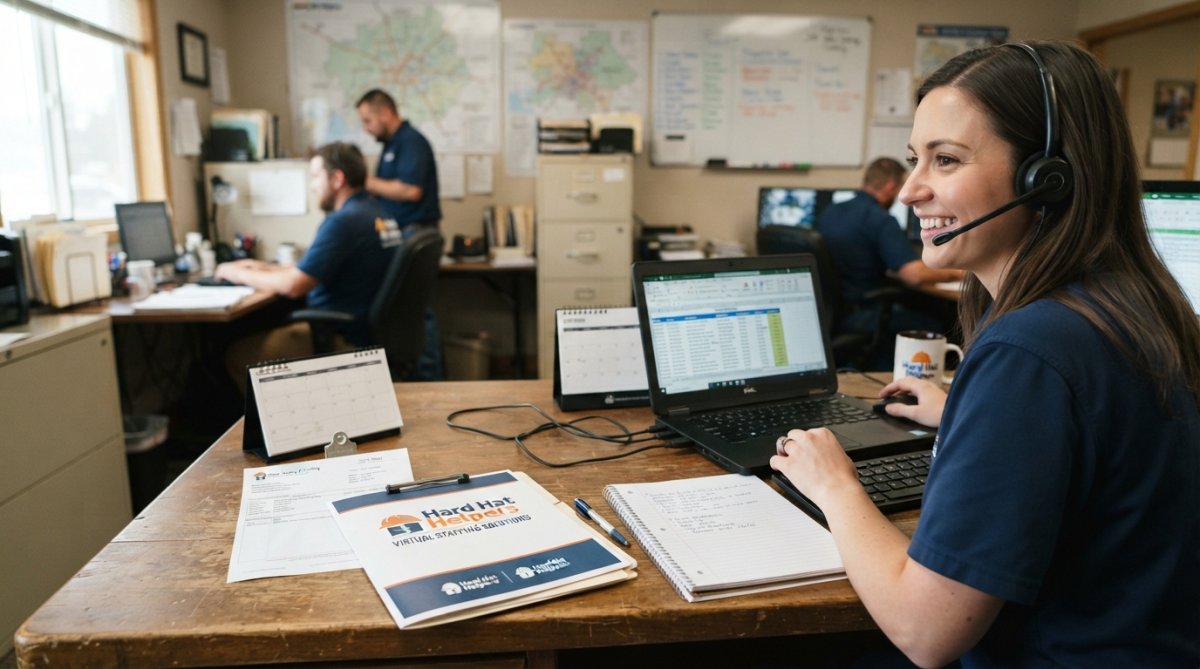
Industry-specific staffing solutions like Hard Hat Helpers specialize in virtual staffing for home service businesses. Their dispatchers, estimators, and office managers are pre-trained on home service workflows. They understand the unique demands of HVAC, plumbing, electrical, and other trades. They integrate into your existing tools and are available 24/7.
What Tasks to Outsource and What to Keep In-House
Core service delivery should stay in-house. Your technicians are your brand. Everything else is fair game:
Outsource: Dispatching and scheduling, estimating for standard jobs, customer communication, invoicing and payment follow-up, lead qualification.
Keep in-house: Service delivery, complex estimating, quality control, strategic decisions.
The general rule: outsource anything that’s repeatable and doesn’t require deep expertise.
Legal and HR Considerations for Outsourced Teams
When you outsource work, be clear about the relationship. Virtual assistants through services like Hard Hat Helpers are typically outsourced service providers, not your employees. The staffing company handles payroll, taxes, and employment compliance.
Misclassifying employees as contractors can result in significant back taxes, penalties, and legal liability. Using an established staffing company eliminates this risk.
Improve Customer Retention Strategies for Home Service Growth
Scaling isn’t just about adding new customers, it’s about keeping the ones you have. Retention is cheaper than acquisition, and retained customers spend more and refer more. Most home service businesses lose 30-50% of customers annually because they don’t follow up after the job or make it easy to book again.
Building Customer Experience and Loyalty Without Extra Staff
Customer experience comes down to a few key moments: initial contact, appointment confirmation, service delivery, and follow-up. Automate the non-critical moments and keep the human touch for the moments that matter.
Initial contact: Customers should be able to book online or reach someone quickly. Use AI or a virtual assistant to handle initial inquiries and scheduling.
Appointment confirmation: Send automated reminders 24 hours and 2 hours before the appointment. This reduces no-shows and improves customer experience.
Service delivery: Your technician builds the relationship here. They should be trained to explain the work and build confidence in your company.
Follow-up: Send an automated satisfaction survey immediately after the job. Follow up with customers who had issues. Send a thank-you message with an easy way to book again or refer friends.
Maintenance reminders: Send seasonal maintenance reminders or periodic check-in messages. These turn one-time customers into repeat customers.
Most of this can be automated with your field service software or a simple email automation tool.
Using Data and Metrics to Drive Retention
Track your retention metrics. How many customers from last year are still customers this year? What’s your repeat customer rate? If your retention rate is 40%, you’re losing 60% of customers annually. Improving retention to 50% or 60% can double your revenue without adding a single new customer.
Use your CRM data to identify which customers are at risk of churning. Reach out proactively. A simple email or text saying "We haven’t seen you in a while, is there anything we can help with?" often brings customers back.
Maintain Team Culture and Morale While Scaling Lean
Scaling without more staff puts pressure on your existing team. If you’re asking the same people to handle more work with better systems, you need to keep them engaged and motivated. The biggest mistake is treating scaling as a way to squeeze more productivity out of people. That leads to burnout, turnover, and quality issues. The right approach is to use systems and technology to eliminate drudgery, so your team can focus on high-value work.
Keeping Your Core Team Engaged and Motivated
Your core team, your technicians and key staff, are the foundation of your business. When you implement systems and technology, frame it as making their work easier. "We’re implementing new scheduling software so you don’t have to wait for dispatch calls." Communicate the scaling plan to your team. Explain why you’re doing it. Ask for their input on what’s working and what’s not. Pay attention to the people who make scaling possible. If a dispatcher is managing more jobs because of better systems, acknowledge that.
Managing Hybrid Teams of In-House and Virtual Staff
As you scale with virtual staff, you’ll have a hybrid team. Some people in your office or in the field, some remote. This requires clear communication and documented processes. The key is making sure everyone knows their role and how they fit into the workflow. Use your field service software and communication tools to keep everyone connected. Regular team meetings, even if some people are remote, help build culture and alignment.
When bringing on virtual staff, invest time in onboarding and training. The first month is critical. Spend the time to get them right.
Real-World Case Studies: Home Service Businesses That Scaled Without Hiring
HVAC and Plumbing Operations That Doubled Revenue with Lean Teams
An HVAC company with $800K annual revenue and 4 technicians was hitting a ceiling. The owner was doing all estimating, scheduling, and customer follow-up, working 60+ hours per week.
The company implemented three changes. First, they hired a virtual estimator through Hard Hat Helpers to handle routine jobs, freeing up 15 hours per week of the owner’s time. Second, they implemented Housecall Pro for scheduling and dispatching, eliminating the dispatcher role they were planning to hire. Third, they set up automated follow-up sequences with a virtual assistant handling exceptions.
Result: revenue grew from $800K to $1.6M in 18 months. The team went from 4 technicians to 5. The owner went from 60 hours per week to 35 hours per week. Profit margins improved from 18% to 24%.
A plumbing company with $1.2M revenue and 6 technicians had a different bottleneck: lead generation. They were getting 15-20 calls per day but converting only 30% to jobs. They implemented Podium AI for call answering and booking and route optimization software, reducing driving time from 30% to 18% of the technician’s day.
Result: revenue grew from $1.2M to $1.8M in 12 months. The team went from 6 technicians to 7. Administrative overhead decreased, and the receptionist role was eliminated.
Profitability Over Headcount: The Numbers That Matter
The common thread in successful scaling is that profitability improved even as revenue grew. A typical home service business at $500K revenue might have 15% profit. If they hire two office staff to scale to $750K revenue, profit margin might drop to 14% because of added overhead.
Compare that to scaling through systems and technology to $750K with the same team plus one virtual staff member: profit margin improves to 18.7%. Revenue grew 50%, profit grew 86%, and profit margin improved.
Your Path to Scaling Without More Staff
The question "can you scale a home service business without more staff" has a clear answer: yes, but only if you approach scaling strategically.
Start by identifying your biggest bottleneck. Track your time for two weeks. Where are you and your team spending hours that don’t generate revenue? Document your core processes. Create SOPs for estimating, scheduling, customer communication, and follow-up. Implement technology strategically. Field service software eliminates manual scheduling. AI-powered lead capture eliminates receptionist roles. Route optimization eliminates wasted driving time.
Outsource the right work. Use a specialized staffing company like Hard Hat Helpers to bring in virtual staff trained specifically for home service businesses. Focus on profitability, not just revenue. Track your profit margin, revenue per technician, and administrative cost as a percentage of revenue.
The businesses scaling most successfully today aren’t the ones with the biggest teams. They’re the ones with the best systems, the smartest technology, and the clearest focus on profitability. You can be one of them.
Hard Hat Helpers provides specialized virtual staffing solutions for home service businesses. Our dispatchers, estimators, and office managers are pre-trained on home service workflows and integrate seamlessly into your existing operations. We handle onboarding, payroll, and benefits management while providing 24/7 availability and continuous performance monitoring. Most clients report reducing administrative overhead by over 50% while gaining the flexibility to scale without the burden of hiring full-time staff. Book a consultation to see how we can help your business scale profitably.
Frequently Asked Questions
Can you really scale a home service business without hiring more staff?
Yes. Many home service businesses scale revenue and profitability without proportional headcount increases by implementing systems, automation, and outsourcing. The key is shifting from a labor-dependent model to a systems-dependent one. Rather than hiring another full-time employee, you can use field service software, virtual assistants, and AI tools to handle scheduling, dispatching, invoicing, and customer communication. This approach reduces overhead, improves efficiency, and allows your existing team to manage more work.
What's the difference between scaling and just working harder?
Scaling means growing revenue and capacity without proportional increases in costs or workload per employee. Working harder means you and your team are doing more of the same tasks. True scaling involves building systems, documenting processes, automating repetitive work, and leveraging technology. When you scale properly, your business can handle 50% more jobs without your team burning out, because the work is systematized, not just multiplied.
How can I automate home service business tasks without expensive software?
Start by identifying your biggest time-wasters: scheduling calls, manual invoicing, or repetitive customer follow-ups. Tools like Zapier can connect your existing software to automate workflows. Field service platforms like Jobber or Housecall Pro (starting at $19-$39/month) handle scheduling, dispatching, and invoicing. For lead capture and booking, AI tools like Podium or SimplyBook.me offer 24/7 automation. The goal is to reduce manual, repetitive tasks so your team focuses on revenue-generating work.
What outsourcing home service business tasks makes the most sense?
Outsource administrative and back-office work first: dispatching, scheduling, invoicing, customer follow-ups, and data entry. These tasks don't require your brand presence or technical expertise. Many home service businesses use virtual dispatchers and office managers to handle these functions. Avoid outsourcing customer-facing estimating or technical work unless the contractor is trained on your specific offerings. Industry-specific virtual staffing solutions ensure quality and reduce the learning curve compared to generic global outsourcing.
How do I maintain customer retention strategies while scaling with fewer people?
Automate routine touchpoints (appointment reminders, follow-up messages, invoice delivery) so your team can focus on high-value customer interactions. Use your CRM to track customer history and preferences, enabling personalized service without extra staff. Implement self-service options like online booking and status updates to improve experience without adding workload. Measure retention metrics (repeat rate, customer lifetime value) to identify which customers need personal attention and which are satisfied with automated service.