

Table of Contents
- What Is Overhead in a Service Business?
- Step-by-Step: How to Calculate Overhead for Your Service Business
- Overhead Rate Calculation Formula Explained
- Overhead Costs Service Business Examples
- How Overhead Impacts Profit Margins and Pricing Strategy
- Reducing Overhead Costs Service Business: Automation and Staffing
- Conclusion
Last Updated: July 27, 2026
What Is Overhead in a Service Business?
Overhead represents all indirect costs required to keep your business running, expenses that don’t directly tie to delivering a specific service. At Hard Hat Helpers, we’ve worked with hundreds of home service companies, and the ones that master overhead calculation consistently outprice their competition and maintain healthier margins.
Overhead includes office rent, utilities, insurance, vehicle maintenance, software subscriptions, and administrative salaries. Unlike direct costs (materials, labor for a specific job), overhead persists whether you’re executing one service call or fifty in a given month. This distinction determines how much you need to charge per billable hour just to break even.
Direct Costs vs. Indirect Costs
Direct costs are expenses tied directly to delivering a service. When an HVAC technician replaces a compressor, the compressor unit itself is a direct cost, as is the technician’s labor and materials like refrigerant or copper tubing.
Indirect costs, or overhead, don’t attach to any single job. Your dispatcher’s salary coordinates dozens of daily calls. Office rent doesn’t increase because you completed more jobs. Insurance premiums stay constant regardless of volume. You must account for the office staff supporting technicians, the dispatch system managing schedules, vehicles, and insurance covering the work.
Separate your expenses into two columns: one for costs directly tied to specific jobs (materials, direct labor), and one for everything else. This clarity makes overhead calculation far less confusing.
Fixed vs. Variable Overhead
Fixed overhead doesn’t change with business volume. Your office lease, insurance premiums, software subscriptions, and administrative salaries typically remain constant. These costs create your baseline: the minimum revenue required just to stay operational.
Variable overhead fluctuates with business activity. If you run more jobs, you use more fuel, generate more dispatch time, and potentially incur higher vehicle maintenance costs. Understanding this distinction helps you forecast accurately and calculate true cost per job.
Step-by-Step: How to Calculate Overhead for Your Service Business
Step 1: Identify All Indirect Costs
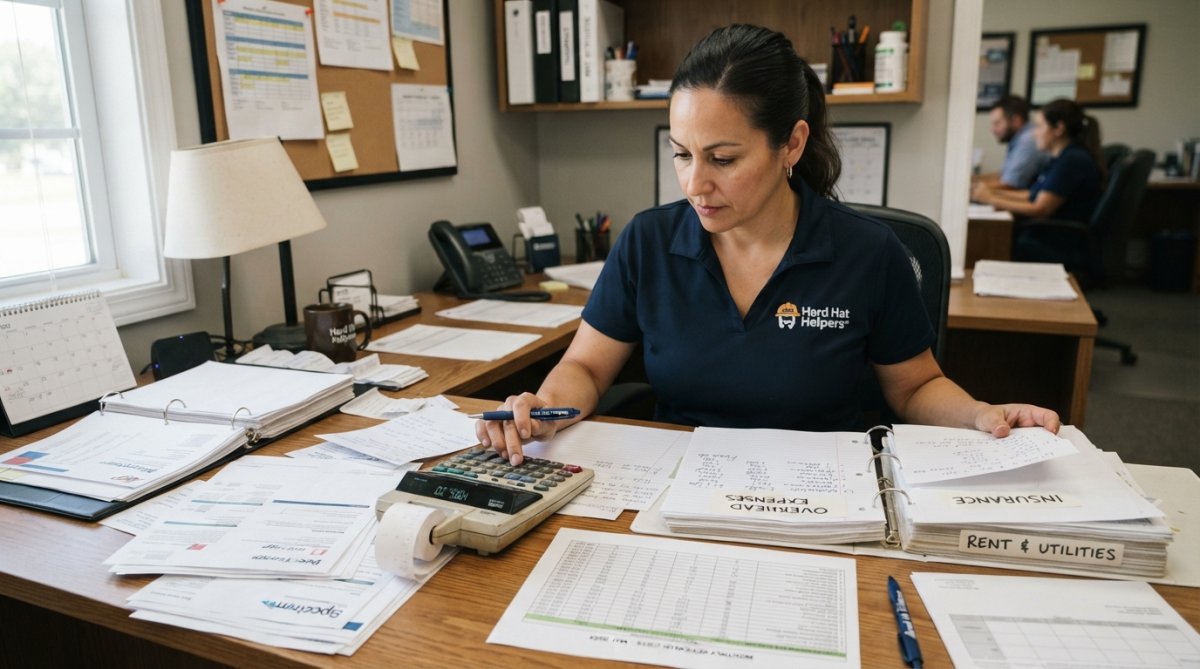
Start by listing every expense that doesn’t directly tie to a specific service delivery. Go through your bank and credit card statements for the last 12 months and highlight every transaction that doesn’t directly produce a service for a customer.
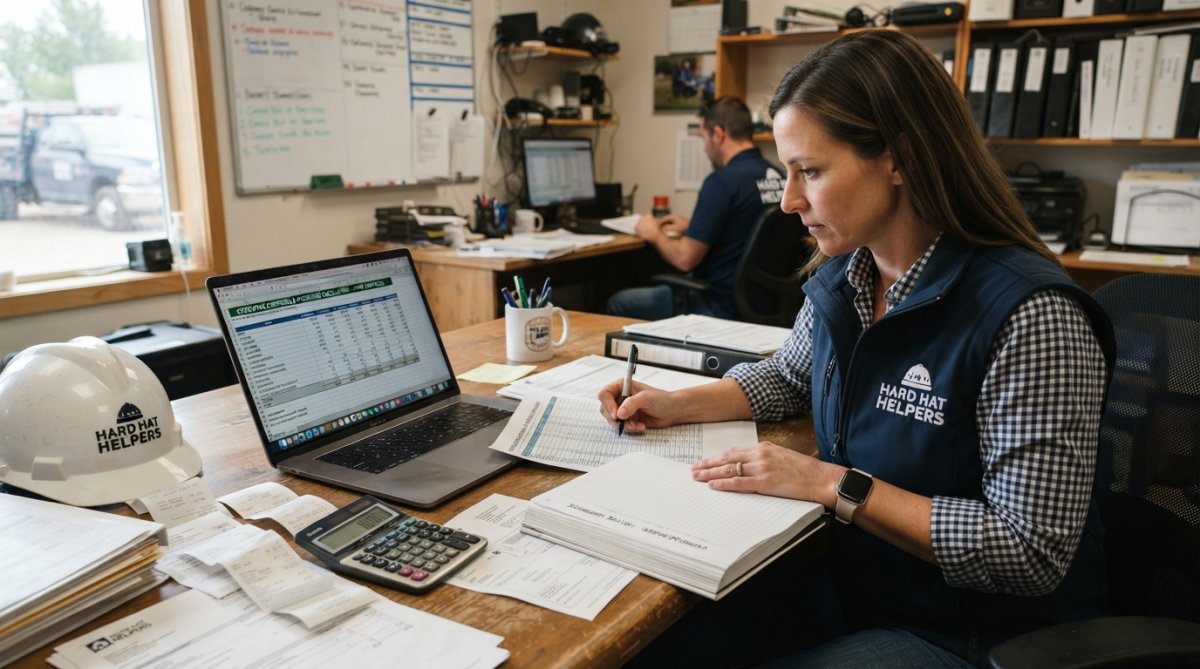
Common overhead categories include:
- Administrative salaries: dispatcher, office manager, estimator, bookkeeper
- Facilities: office rent, utilities, internet, phone
- Vehicles: lease or loan payments, fuel, maintenance, insurance, registration
- Insurance: general liability, workers’ compensation, vehicle coverage
- Software and technology: accounting software, dispatch systems, CRM, scheduling tools
- Marketing and advertising: website, Google Local Services ads, print materials
- Professional services: accounting, legal consultation, tax preparation
- Office supplies and equipment: computers, furniture, tools
- Licenses and permits: business license renewal, trade certifications
- Training and development: employee training programs, safety certifications
A common mistake is excluding owner salary from overhead. If you pay yourself a salary (not just profit distribution), that’s overhead. Many small business owners skip this and end up underpricing their services significantly.
Step 2: Determine Your Total Billable Hours
Billable hours represent actual time spent on customer work. This is NOT the same as hours worked.
Calculate this accurately:
-
Identify total annual hours available per employee. A full-time employee works roughly 2,080 hours annually (40 hours × 52 weeks). Subtract vacation days, sick days, holidays, and training time. Most service businesses see 1,800-1,900 available hours per technician annually.
-
Subtract unbillable time. Not every hour an employee works translates to billable time. Dispatch time between jobs, travel time, administrative tasks, equipment maintenance, and team meetings are unbillable. Estimate 15-25% of working time is unbillable on average.
-
Multiply by number of service personnel. If you have three technicians, each with 1,600 billable hours annually, your total is 4,800 billable hours.
-
Calculate average billable hours per month. Divide annual billable hours by 12.
Example: Three technicians × 1,600 billable hours each = 4,800 annual billable hours ÷ 12 months = 400 billable hours per month.
Step 3: Calculate Your Overhead Rate
Overhead Rate = Total Annual Overhead ÷ Total Billable Hours
Example: Annual overhead of $180,000 ÷ 4,800 hours = $37.50 per billable hour
This means every billable hour must contribute $37.50 just to cover overhead costs. This is separate from your actual labor cost, materials, or profit margin. Many service business owners are surprised by this number and discover they need to charge significantly more than they currently do just to break even on overhead alone.
Overhead Rate Calculation Formula Explained
Understanding the Formula Components
Total Annual Overhead includes every indirect expense summed across 12 months. Include annual expenses like insurance renewals, annual software licenses, or tax preparation fees that occur once yearly.
Total Billable Hours requires realistic estimation. Account for travel time between jobs, administrative tasks, equipment downtime, waiting time for customers, team meetings, and seasonal slowdowns.
The formula divides total overhead by total billable hours to determine cost per billable hour. This per-hour rate must be added to your labor cost and material cost to determine your true minimum charge per job.
Your overhead rate tells you the minimum hourly rate needed just to cover indirect costs. If your overhead rate is $37.50 per hour and your labor cost is $30 per hour, your minimum charge before profit is $67.50 per hour.
Machine Hours vs. Labor Hours Method
Some service businesses use machine hours instead of labor hours when equipment runtime drives overhead allocation. A print shop might allocate overhead based on press running time rather than employee hours.
Overhead Rate = Total Annual Overhead ÷ Total Machine Hours
However, most home service businesses, plumbing, HVAC, electrical, landscaping, use labor hours because technician time is the primary constraint.
Overhead Costs Service Business Examples
HVAC and Plumbing Service Overhead
An HVAC company with two technicians illustrates typical overhead costs:
- Office rent: $18,000
- Utilities and internet: $3,600
- Dispatcher salary: $35,000
- Office manager (part-time): $20,000
- Vehicle lease (two service vehicles): $24,000
- Vehicle fuel and maintenance: $8,000
- Insurance (liability, workers’ comp, vehicle): $15,000
- Software (dispatch, accounting, CRM): $3,600
- Marketing and Google Local Services ads: $6,000
- Licenses and certifications: $2,000
- Office supplies and equipment: $2,400
- Professional services: $3,000
- Training and continuing education: $1,200
Total annual overhead: $141,800
With two technicians working 1,600 billable hours each (3,200 total), the overhead rate is:
$141,800 ÷ 3,200 hours = $44.31 per billable hour
Every billable hour must cover $44.31 in overhead. If the technician’s loaded labor cost is $35 per hour, the true cost per billable hour is $79.31 before materials and profit margin.
Estimating and Dispatch Overhead
Many service business owners underestimate the overhead tied to estimating and dispatch functions. An estimator who generates quotes spends time on initial calls, site visits, proposal preparation, and follow-up. Dispatch overhead includes scheduling, customer communication, technician coordination, and administrative follow-up. These functions consume hours daily but don’t appear on customer invoices. Understanding this prevents the mistake of pricing based only on technician time while ignoring the infrastructure supporting that technician.
How Overhead Impacts Profit Margins and Pricing Strategy
Calculating Overhead Percentage for Pricing
Beyond per-hour overhead rates, many service businesses track overhead as a percentage of revenue.
Overhead Percentage = (Total Annual Overhead ÷ Total Annual Revenue) × 100
If your annual overhead is $141,800 and your total annual revenue is $380,000:
($141,800 ÷ $380,000) × 100 = 37.3%
This means 37.3 cents of every revenue dollar goes to overhead. If your industry standard is 20% profit margin, you need 37.3% for overhead, 40% for labor and materials, and 22.7% for profit. If you’re currently pricing at 15% profit margin, you’re leaving money on the table.
Calculate your overhead percentage quarterly. If it exceeds 40%, investigate whether you can reduce overhead or must increase pricing. If it falls below 25%, you have room to invest in growth.
Break-Even Analysis and Operating Margin
Understanding your break-even point depends entirely on accurate overhead calculation.
Break-Even Revenue = Total Annual Overhead ÷ (1 – (Labor + Material Cost as % of Revenue))
If overhead is $141,800 and labor plus materials average 45% of revenue:
$141,800 ÷ (1 – 0.45) = $141,800 ÷ 0.55 = $257,818
This business needs at least $257,818 in annual revenue just to break even.
Operating margin reveals business health:
Operating Margin = (Revenue – All Operating Expenses) ÷ Revenue × 100
If revenue is $380,000 and operating expenses total $320,000:
($380,000 – $320,000) ÷ $380,000 × 100 = 15.8% operating margin
Healthy service businesses typically maintain 10-20% operating margins. Below 10% indicates pricing is too low or costs are too high.
Common Calculation Pitfalls to Avoid
Pitfall 1: Excluding Owner Salary
Many owners calculate overhead without including their own salary, treating themselves as profit recipients rather than overhead costs. This creates artificially low overhead rates and unsustainably low pricing.
Pitfall 2: Underestimating Unbillable Time
Owners often assume technicians work productively 90-100% of their time. Reality is 70-80% billable hours at best. Underestimating unbillable time inflates billable hours, deflating overhead rate and pricing.
Pitfall 3: Forgetting Annual and Irregular Expenses
Monthly overhead tracking misses annual insurance renewals, tax preparation fees, or licensing renewals. These irregular expenses must be amortized across 12 months.
Pitfall 4: Confusing Overhead with Labor Cost
Some owners add their overhead rate directly to technician wages, creating double-counting. Overhead rate is separate from labor cost.
Pitfall 5: Static Overhead Rates
Business overhead changes with new software subscriptions, additional staff, vehicle purchases, or facility changes. Recalculate overhead rates quarterly or semi-annually.
Review your overhead calculation whenever you make significant changes: hiring new staff, moving offices, adding vehicles, or changing software systems. Failing to update pricing after overhead changes is a primary reason service businesses become unprofitable.
Software-Based Automation for Overhead Tracking
Modern accounting and dispatch software dramatically simplifies overhead tracking and calculation.
QuickBooks Online (starting at $38/month) provides comprehensive expense tracking with transaction categorization. Reports generate overhead summaries and overhead percentages with a few clicks.
FreshBooks (starting at $23/month) specializes in service business accounting. It tracks time entries, expenses, and project profitability. The platform automatically calculates billable vs. unbillable time.
Toggl Track (free plan available) focuses specifically on time tracking. Service teams log time to projects and tasks, automatically categorizing billable and unbillable hours.
At Hard Hat Helpers, we’ve observed that businesses using integrated accounting and dispatch software reduce overhead calculation errors by 40% compared to manual tracking.
| Calculation Step | Time Required | Frequency | Tools |
|---|---|---|---|
| Identify overhead categories | 2-3 hours | Quarterly review | Spreadsheet or accounting software |
| Sum annual overhead expenses | 1-2 hours | Monthly | Accounting software (automated) |
| Calculate billable hours | 1-2 hours | Quarterly | Dispatch software or time tracking |
| Compute overhead rate | 15 minutes | Monthly | Calculator or accounting software |
| Calculate overhead percentage | 15 minutes | Monthly | Accounting software (automated) |
| Adjust pricing based on rate | 30 minutes | Quarterly | Spreadsheet or pricing software |
Conclusion
Calculating overhead for service business accurately is non-negotiable for sustainable profitability. Most service business owners underestimate overhead by 20-30%, leading to dangerously low pricing that erodes margins over time. The calculation itself is straightforward, total annual overhead divided by total billable hours, but accuracy requires honest assessment of every indirect cost and realistic billable hour estimation.
Overhead calculation becomes significantly easier when you have reliable support managing administrative functions that generate overhead costs. Hard Hat Helpers provides specialized virtual staffing for home service businesses, offering pre-qualified dispatchers, estimators, and office managers trained specifically on your operations. By outsourcing administrative overhead to experienced professionals, businesses reduce salary and benefits costs while improving efficiency. Our clients report overhead reductions exceeding 50% through optimized staffing. Book a consultation to explore how virtual staffing adjusts your overhead structure and improves profitability.
EXTERNAL SOURCES:
According to QuickBooks small business accounting guide, accurate expense categorization is the foundation of overhead tracking for service businesses.
Research from FreshBooks service business benchmarks shows that service companies using integrated accounting software adjust pricing 40% more frequently based on accurate overhead data.
The U.S. Small Business Administration guide to business costs emphasizes that overhead underestimation is among the leading causes of service business failure in the first five years.
Frequently Asked Questions
What is considered overhead in a service business?
Overhead in a service business includes all indirect costs required to operate but not directly tied to specific jobs. This includes administrative expenses like office salaries, rent, utilities, insurance, accounting software subscriptions, and equipment maintenance. Unlike direct labor (billable technician time) or direct materials, overhead supports your entire operation. Understanding which costs are overhead versus direct is essential for accurate overhead calculation and pricing strategy.
How do you calculate overhead rate per hour for a service business?
To calculate overhead rate per hour, divide total annual overhead costs by total billable hours worked annually. For example, if your overhead costs $120,000 per year and your team logs 4,000 billable hours, your overhead rate is $30 per billable hour. This rate helps you set pricing that covers both direct labor and overhead, ensuring profitability. Many service businesses use this formula to allocate overhead across jobs and understand their true cost per labor hour.
How can reducing overhead costs impact my service business profit margins?
Lower overhead directly improves your operating margin and net profit. If overhead represents 40% of revenue, reducing it by 20% through automation, virtual staffing, or process improvements can increase profit margins by 8-10 percentage points. This is especially impactful for service businesses with thin margins. Many home services companies (HVAC, plumbing) find that outsourcing administrative functions like dispatch and estimating through virtual staffing reduces overhead by over 50%, freeing capital for growth and improving overall profitability.
What's a good overhead percentage for a service business?
A healthy overhead percentage for service businesses typically ranges from 25-35% of gross revenue, though this varies by industry. HVAC and plumbing services often target 30-35%, while consulting may run 40-50%. Calculate your overhead percentage by dividing total overhead costs by total revenue. If your overhead exceeds 40% of revenue, it's time to review cost allocation, pricing strategy, or consider process automation and staffing solutions to improve efficiency and protect your operating margin.