

Table of Contents
- Why Businesses Are Reconsidering In-House Dispatching
- Top Alternatives to Hiring In-House Dispatchers
- Cost-Benefit Analysis: Outsource Dispatch Services vs. In-House
- How to Choose a Dispatch Service for Your Business
- Comparison Table: Key Features & Pricing Models
- Risk Management & Compliance Considerations
- Common Mistakes When Switching from In-House Dispatching
- Conclusion: Finding Your Best Dispatching Solution
Alternatives to Hiring In-House Dispatchers: 2026 Guide
Last Updated: July 20, 2026
When evaluating alternatives to hiring in-house dispatchers, you’re examining fundamental changes to how your operations run. Hard Hat Helpers specializes in helping home services companies find staffing solutions that work for their dispatch needs. Below, we’ll walk through the major alternatives, what each costs, and how to pick the right one for your operation.
Why Businesses Are Reconsidering In-House Dispatching
The traditional model of hiring full-time in-house dispatchers no longer fits modern operations. Many business owners discover that their dispatch department operates at partial capacity during slow seasons while struggling during peak demand. The real problem isn’t dispatching itself, it’s that in-house teams create fixed costs regardless of volume. A dispatcher earning $35,000-$45,000 annually costs the same whether you dispatch 20 jobs per day or 50.
Remote dispatching and outsourced services flip this model. You pay for capacity when you need it. When volume drops, your costs drop proportionally. This is why an increasing number of home services companies, plumbing, HVAC, electrical, landscaping, are moving away from dedicated in-house dispatch staff.
Top Alternatives to Hiring In-House Dispatchers
1. Outsourced Dispatch Services (Full-Service Model)
Outsourced dispatch services handle the entire operation: answering phones, scheduling appointments, managing emergency calls, rerouting jobs, and communicating with customers. A dedicated dispatch team works for you, but they’re employed by the service provider. You get 24/7 coverage without the payroll burden.
The appeal is straightforward: someone else manages hiring, training, payroll, and benefits. You get professional dispatchers trained on your specific pricing structure, service areas, and customer protocols. Octopus Tech operates this model for trucking companies and owner-operators, handling appointment scheduling, urgent call dispatching, and message management while reducing operational costs.
Best for: Companies with consistent call volume that need full-time coverage across all hours, especially those with complex service areas or multiple locations.
Pros:
- Eliminates payroll, benefits, and HR administration
- Provides professional, trained dispatchers
- Offers 24/7 coverage without hiring night-shift staff
- Reduces operational costs compared to in-house teams
- Handles peak volume without hiring temporary staff
Cons:
- Less direct control over daily dispatch decisions
- Pricing varies and often requires negotiation
- Integration with your systems takes setup time
- Potential communication lag between your office and dispatch team
2. Virtual Dispatchers & Remote Staffing Solutions
Virtual dispatchers work from remote locations but function as members of your team. They integrate into your existing workflows, use your tools, and operate according to your processes. You have more direct control than with outsourced services while reducing administrative overhead.
Hard Hat Helpers provides virtual dispatchers specifically trained for the home services industry. They’re pre-qualified professionals who integrate seamlessly into your operations. You manage payroll and benefits, but Hard Hat Helpers handles onboarding, continuous performance monitoring, and 24/7 availability. The overhead reduction typically exceeds 50% compared to traditional in-house hiring because you eliminate recruiting, training, and HR infrastructure costs.
Best for: Companies wanting direct control over dispatch operations while reducing administrative burden, especially those seeking 24/7 availability without hiring multiple shifts.
Pros:
- Seamless integration into existing operations
- Pre-qualified and trained professionals
- 24/7 availability with dedicated support
- Significant overhead cost reduction (50%+ savings vs. in-house)
- Continuous performance monitoring built in
- Faster onboarding than traditional hiring
Cons:
- Still requires you to manage the dispatcher’s work
- Timezone differences may affect real-time communication
- Requires systems and processes already documented
3. AI Dispatch Software & Automation Tools
Artificial intelligence is reshaping dispatch operations. AI dispatch software automates load assignment, optimizes routes, handles routine customer communications, and operates 24/7 without human intervention.
DispatchMVP uses an AI Voice Dispatcher called "Otto" that automates load management for owner-operators, integrating with major load boards (DAT, Truckstop) and assigning loads based on location and availability. The basic plan starts at $49/month. WAQ Technologies offers Dispatch Intelligence, an AI platform that optimizes load-to-driver assignments while considering Hours of Service regulations and geographic positioning, starting at $149/month with a 14-day free trial.
These tools don’t replace dispatchers entirely, they augment them. AI handles repetitive decisions while your dispatcher focuses on complex scenarios and customer relationships.
Best for: Companies with high transaction volume where automation ROI is clear, or owner-operators wanting to reduce manual dispatch work.
Pros:
- Dramatically reduces time spent on routine dispatch tasks
- Operates 24/7 without human fatigue
- Improves decision consistency through algorithmic optimization
- Integrates with load boards and TMS systems
- Scales without proportional cost increases
Cons:
- Requires learning curve for new users
- AI may lack nuance in complex negotiations
- Dependent on data quality and system integrations
4. Hybrid Model: In-House + Outsourced Support
Some operations run best with a hybrid approach: keep your core dispatcher in-house for relationship management and complex decisions, but outsource overflow and after-hours coverage to a service provider.
This model works when you have enough volume to justify one full-time dispatcher but not enough to support multiple staff. During peak seasons, overflow goes to the outsourced provider. At night, the service provider handles emergency calls. Your in-house dispatcher focuses on high-value work: customer relationships, complex scheduling, and vendor negotiations.
Best for: Mid-sized operations with variable volume, companies transitioning from in-house to outsourced, or businesses wanting to test outsourcing without full commitment.
Pros:
- Maintains direct control over core dispatch operations
- Reduces in-house staffing costs through partial outsourcing
- Provides flexibility to scale up or down with volume
- Covers after-hours and peak demand without hiring additional staff
Cons:
- More complex to manage than single-model approach
- Requires clear handoff protocols between teams
- Pricing is higher per unit than pure outsourcing or pure in-house
5. Self-Dispatching & Load Board Platforms
Owner-operators and small carriers can bypass dispatchers entirely by self-dispatching through load boards. DAT Load Board gives you direct access to shippers and brokers. You search for loads, negotiate rates, and book directly, keeping 100% of revenue instead of paying a dispatcher percentage or salary.
This approach works when you have the time and negotiation skills. It fails when you’re too busy operating to manage the business side.
Best for: Owner-operators with time availability, experienced carriers managing their own fleets, or businesses testing the market before hiring dedicated dispatch staff.
Pros:
- Gives full control over load selection and negotiation
- Potentially cheaper than hiring a dispatcher
- Maximizes profit margins on each load
- Access to largest network of trucking professionals
Cons:
- Requires significant time from owner-operator
- Lacks professional back-end support
- Difficult to scale beyond one or two trucks
Cost-Benefit Analysis: Outsource Dispatch Services vs. In-House
An in-house dispatcher in most markets earns $35,000-$50,000 annually in salary. Add payroll taxes (15%), benefits (health insurance, workers’ comp, unemployment insurance), and administrative overhead (recruiting, training, management time), and your true cost reaches $55,000-$75,000 per year.
A full-service outsourced dispatch provider typically charges between $2,000-$5,000 monthly depending on call volume, complexity, and service hours. That’s $24,000-$60,000 annually. The key advantage: your costs flex with business volume. Slow season? Your dispatch costs drop. Peak season? You pay more, but you’re also generating more revenue to cover it.
For most home services companies with 2-4 full-time technicians, outsourcing saves $15,000-$30,000 annually while improving service quality. For larger operations with 10+ technicians, the savings are smaller percentage-wise but still significant in absolute dollars.
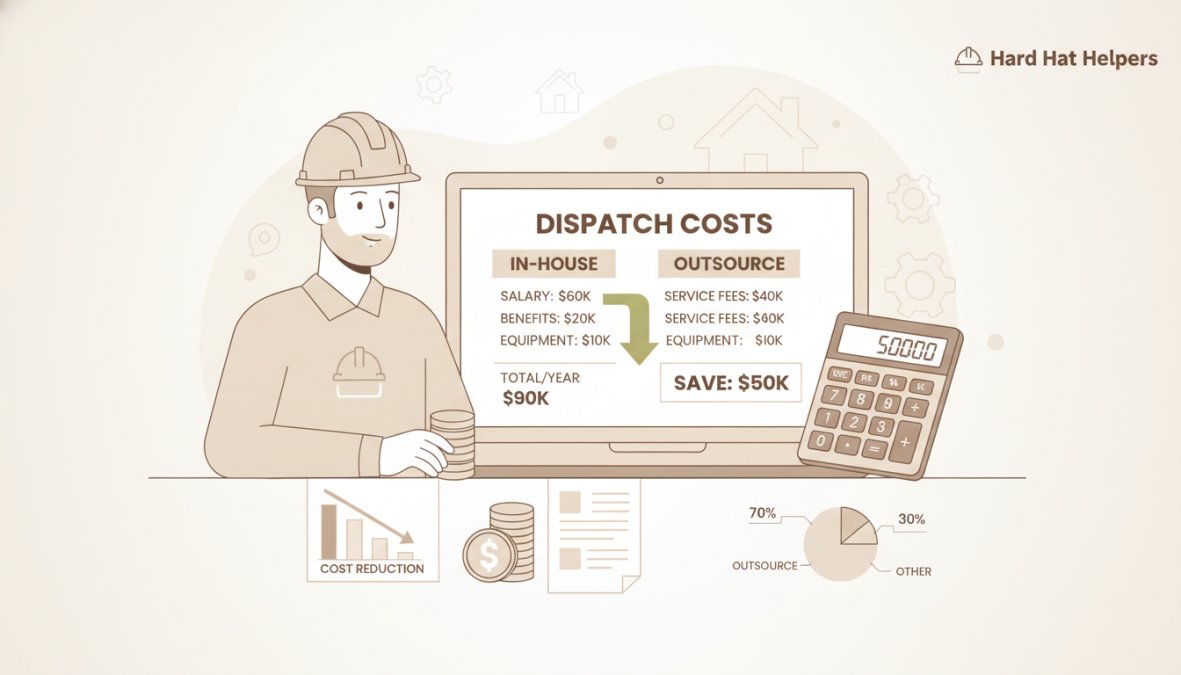
The financial decision hinges on one question: Is your dispatch volume stable enough to justify a full-time salary, or does it fluctuate with seasons? If it fluctuates, outsourcing almost always wins financially.
How to Choose a Dispatch Service for Your Business
Choosing a dispatch provider isn’t about finding the cheapest option. It’s about matching the service model to your actual needs.
Industry-Specific Requirements
Home services dispatching is fundamentally different from logistics or emergency services dispatching. A good provider understands your industry’s specific challenges. For HVAC companies, dispatchers need to understand that a furnace repair can’t be scheduled like a plumbing job. For plumbing companies, dispatchers need to handle emergency calls differently than scheduled service calls.
Ask any potential provider: Have you worked with [your industry]? Can you name three companies similar to ours that you dispatch for? If they can’t answer specifically, they’re not specialized enough.
Integration & Technology Compatibility
Your dispatch service must integrate with your existing tools. If you use ServiceTitan, Housecall Pro, or another field service software, the provider needs API integration or at minimum a documented process for syncing data.
Before signing a contract, ask for a technical integration walkthrough. How does their system connect to yours? What happens when a job is booked? Is there a backup if the integration fails?
Request a one-week trial integration before committing to a long-term contract. This reveals integration problems before they become expensive operational issues.
Support & Scalability
You need a provider that scales with your growth. Ask about their capacity. What’s the maximum number of concurrent dispatches they can handle? What happens if you suddenly double your volume? Do you get a dedicated account manager, or are you a ticket number in a queue?
| Evaluation Criteria | What to Look For | Red Flags |
|---|---|---|
| Industry expertise | Named clients in your industry, specific terminology | Generic answers, no industry references |
| Integration capability | API documentation, trial period offered | Manual data entry required, no technical support |
| Scalability | Clear capacity limits stated, growth plan | Vague about capacity, no scaling process |
| Support model | Dedicated account manager, response SLA | Ticket-based support only, no named contact |
| Pricing transparency | Clear per-unit or tiered pricing | Hidden fees, pricing "depends on negotiation" |
| Contract flexibility | Month-to-month or short-term options | Long-term lock-in, early termination penalties |
Risk Management & Compliance Considerations
When you outsource dispatch, you’re trusting another company with customer data, scheduling information, and potentially payment details. Ask about data security. Where is customer data stored? Is it encrypted? Who has access? What’s their backup and disaster recovery process?
Also clarify liability. If the dispatch service makes an error that costs you money, who pays? Get this in writing before signing. For compliance-heavy industries, verify that the provider meets relevant regulations. HIPAA for health-related services. SOC 2 compliance for sensitive data.
Finally, understand the termination process. If the relationship isn’t working, how quickly can you exit? Know the terms before you’re locked in.
Common Mistakes When Switching from In-House Dispatching
Mistake 1: Expecting identical service immediately. An outsourced dispatcher won’t know your business on day one. They need 2-4 weeks to understand your pricing, service areas, and customer preferences.
Mistake 2: Keeping your in-house dispatcher "just in case." This creates confusion. Make a clean transition or define a hybrid model clearly upfront.
Mistake 3: Underestimating the importance of documentation. Document everything: how you schedule jobs, how you handle emergencies, what information customers need. Spend a week writing this down before you hand off dispatch.
Mistake 4: Choosing based on price alone. The cheapest provider isn’t always the best value. Choose based on fit: industry expertise, integration capability, and support quality.
Mistake 5: Not monitoring performance. Track key metrics: call answer time, job scheduling accuracy, customer complaints. Review these monthly.
The biggest mistake is assuming outsourced dispatch requires zero management from you. You still need to [monitor performance](/how-to-manage-remote-dispatchers-effectively/), provide feedback, and ensure the provider understands your business.
Conclusion: Finding Your Best Dispatching Solution
The choice between in-house dispatching, outsourced services, virtual staff, and automation tools depends on your specific situation: volume, complexity, budget, and growth plans. There’s no universal answer.
What’s consistent across successful transitions: companies that reduce their dispatch overhead while maintaining service quality do so by matching the solution to their actual needs. For home services companies seeking a proven alternative that combines professional expertise with significant cost reduction, Hard Hat Helpers offers virtual dispatchers specifically trained for your industry. Our team handles onboarding, payroll, benefits, and continuous performance monitoring, delivering 24/7 availability with dedicated support while reducing overhead by over 50% compared to traditional in-house hiring.
Field service management industry benchmarks on dispatch staffing
Home services labor market analysis and staffing trends
Best practices for outsourcing operations in service industries
Frequently Asked Questions
What's the difference between outsourced dispatch services and virtual dispatchers?
Outsourced dispatch services typically handle your entire dispatch operation as a third-party vendor, managing calls, scheduling, and customer communication. Virtual dispatchers are remote employees or contractors integrated into your team who perform the same duties from a distance. Virtual staffing solutions often provide pre-qualified, industry-trained professionals with dedicated support, while traditional outsourcing may offer less customization. For home services businesses, virtual dispatchers trained specifically on your products and pricing structures often deliver better results than generic outsourced providers.
How much does it cost to outsource dispatching compared to hiring in-house?
Cost savings depend on your current staffing model. In-house dispatchers require salary, benefits, payroll taxes, training, and office overhead, often totaling $50,000+ annually per employee. Outsourced dispatch services and virtual staffing alternatives typically operate on subscription or per-service models with lower overhead. Many businesses report reducing administrative costs by over 50% when switching to specialized virtual staff. However, pricing varies significantly based on hours needed, industry complexity, and service level. Request custom quotes from providers to compare against your current in-house expenses.
Can AI dispatch software replace human dispatchers entirely?
AI dispatch software excels at automation, load optimization, and routine task handling, reducing the workload on human dispatchers significantly. However, most businesses benefit from a hybrid approach. AI handles load matching, scheduling optimization, and administrative tasks, while human dispatchers manage complex negotiations, customer relationship issues, and exceptions. For home services businesses with custom pricing and service areas, human judgment remains valuable. AI tools work best when paired with experienced dispatchers or virtual staff who understand your specific operations.
How do I know if a dispatch service understands my industry's specific needs?
Look for providers with direct experience in your industry, whether trucking, home services, delivery, or emergency services. Ask for case studies or references from similar-sized businesses in your field. Virtual staffing providers should offer tailored training on your specific pricing structures, service areas, and operational workflows. Request a trial period or pilot program before committing long-term. The best alternatives to hiring in-house dispatchers are those that invest time understanding your unique business model rather than applying generic solutions.
What happens if an outsourced dispatcher or virtual staff member isn't working out?
Reputable dispatch services and virtual staffing providers offer replacement guarantees and performance monitoring. Before signing, clarify the replacement process, notice period, and transition support. Dedicated service providers typically manage onboarding and training, reducing downtime when changes occur. Unlike in-house hiring, where termination and recruitment take weeks, outsourced alternatives often provide quick replacement options. Ensure your contract specifies performance metrics, quality standards, and your right to request a replacement if service doesn't meet expectations.