


Table of Contents
- Why Outsource Scheduling for Your Plumbing Business
- Plumbing Dispatch Software: Automation vs. Human Oversight
- Plumbing Answering Service: 24/7 Coverage Without Full-Time Staff
- Virtual Assistant for Plumbing Company: Hybrid Scheduling Models
- Benefits of Outsourcing Dispatch for Plumbing Operations
- Outsource Scheduling for Plumbing: Software, Service, or Hybrid?
- Common Mistakes When Outsourcing Plumbing Scheduling
- Getting Started: Implementation and Onboarding
Outsource Scheduling for Plumbing: A 2026 Guide
Last Updated: July 19, 2026
Why Outsource Scheduling for Your Plumbing Business
Dispatching and scheduling consume roughly 15-20% of a plumbing business owner’s weekly workload. The challenge isn’t finding a scheduling solution, it’s finding one that works with your existing operations without requiring months of training. You need someone (or something) that understands plumbing-specific pricing structures, service areas, emergency call protocols, and technician scheduling nuances.
Below, we’ll walk you through three core approaches: automation-first software solutions, 24/7 answering services that handle bookings for you, and hybrid models that combine human intelligence with software efficiency.
The real cost of poor scheduling isn’t just missed bookings, it’s technicians sitting idle between jobs, emergency calls going to voicemail, and customers booking competitors instead. Outsourcing this function typically pays for itself within 60-90 days.
Plumbing Dispatch Software: Automation vs. Human Oversight
Dispatch software automates the mechanics of scheduling: customers book online, the system assigns jobs to available technicians based on location and skill, and routes are optimized in real time. However, software alone doesn’t solve the scheduling problem for plumbing businesses. A booking system can’t negotiate emergency pricing with a midnight customer or recognize that your best technician is already overbooked.
The most successful plumbing operations use software as a tool, not a replacement for human decision-making. You’re automating routine bookings while maintaining oversight for complex situations.
How Dispatch Fit and Routing Optimization Work
Dispatch fit refers to the algorithm’s ability to match a job to the right technician based on location, availability, skills, and current workload. Routing optimization then sequences multiple jobs to minimize travel time and fuel costs. A good routing engine can reduce drive time by 15-25% compared to manual dispatch.
However, the software can’t account for customer relationships, technician fatigue, or service quality preferences. These gaps require human oversight.
Set up your dispatch software with manual override capabilities. Your dispatchers should be able to reassign jobs with one click when the algorithm gets it wrong.
Handling Emergency vs. Routine Scheduling Logic
Emergency calls require different logic than routine maintenance. An emergency plumbing call at 2 AM can’t wait for the next available slot; you need someone to commit to a response time (typically 30-60 minutes) and be willing to pay premium pricing.
Most scheduling software treats all bookings the same way. You need software that separates emergency intake from routine booking, assigns emergency calls to on-call technicians specifically, and flags them for immediate dispatch.
Plumbing Answering Service: 24/7 Coverage Without Full-Time Staff
A plumbing answering service is a team of live agents who answer your phone, book appointments, qualify leads, and handle customer questions, without you hiring full-time office staff. Unlike software, these services provide human judgment that reduces no-shows, improves booking accuracy, and handles edge cases gracefully.
The service operates 24/7, which means emergency calls at midnight don’t go to voicemail. For plumbing businesses, this is critical, a customer with a burst pipe won’t wait for you to call back in the morning.
Real-Time Booking Accuracy and Handoff Quality
The quality of an answering service depends entirely on handoff quality, how accurately the agent captures job details and communicates them to your dispatch team. Real-time booking accuracy means the agent inputs information directly into your dispatch system as the customer speaks, with all details correct.
When evaluating a plumbing answering service, ask specifically how they handle real-time booking integration. Can they access your system directly? Do they confirm details with customers before hanging up? What’s their accuracy rate on captured information?
Virtual Assistant for Plumbing Company: Hybrid Scheduling Models
A virtual assistant for plumbing company operations sits between pure software and pure answering service. The VA handles scheduling, customer communication, and administrative tasks, but they’re trained specifically for your business and have deeper context than a generic answering service agent.
Virtual assistants work best in a hybrid model where they manage routine scheduling and customer communication while you or your dispatcher handle complex decisions and emergency calls. This gives you 24/7 coverage without the cost of a full-time on-site employee.
Training, Implementation, and Ramp-Up Timeline
The critical difference between a virtual assistant and an answering service is training depth and duration. A generic answering service agent might receive 2-3 hours of training on your business. A virtual assistant trained for your specific operation receives 2-3 weeks of structured onboarding.
During onboarding, the VA learns your pricing structure, service areas and travel times, technician capabilities, customer communication standards, and emergency protocols. Implementation typically follows this timeline:
- Week 1: Initial training on your systems, pricing, and service offerings. The VA observes calls and dispatch operations.
- Week 2: The VA handles routine bookings with real-time supervision. You review every interaction and provide feedback.
- Week 3: The VA manages most routine calls independently. You spot-check interactions and handle complex edge cases.
- Week 4+: The VA operates independently for routine work. You remain available for complex decisions and emergency escalations.
Most virtual assistants reach full productivity by week 3-4, though they continue improving over the first 60-90 days.
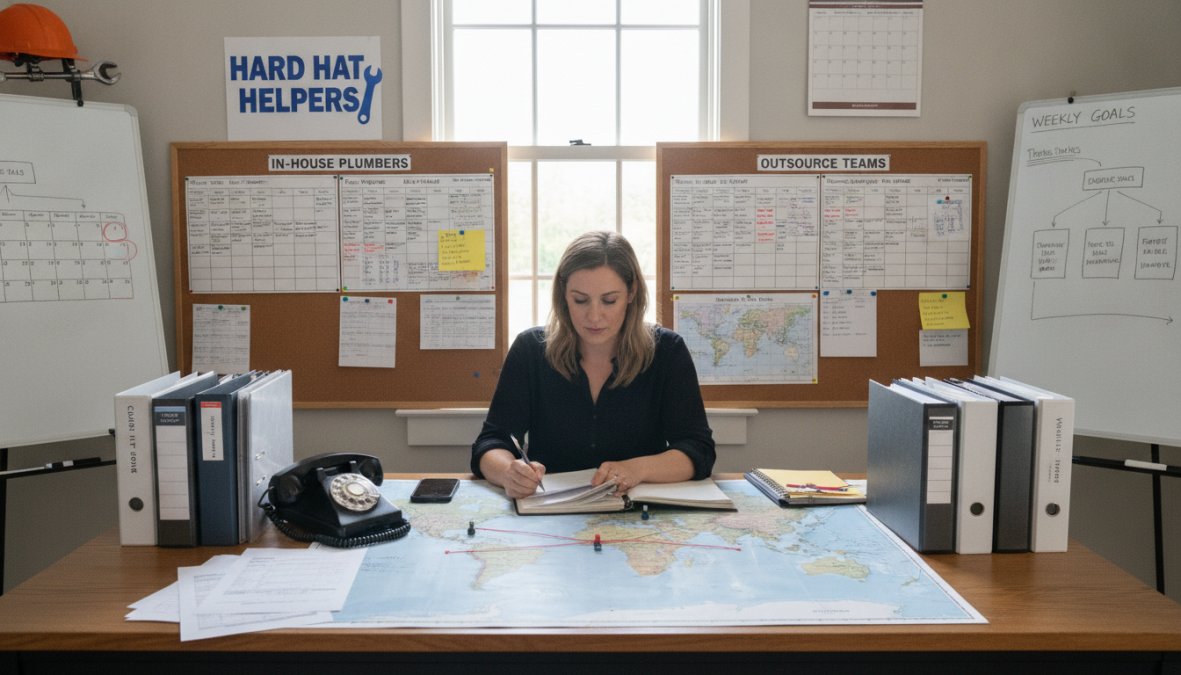
The most common mistake is expecting a virtual assistant to be productive immediately. If you don’t invest in proper training and supervision during weeks 1-3, the VA will develop bad habits and create more work than they save.
Benefits of Outsourcing Dispatch for Plumbing Operations
Outsourcing scheduling removes the bottleneck that prevents many plumbing businesses from scaling. When you’re personally handling dispatch, you can only grow as fast as you can work. A dedicated dispatcher makes fewer mistakes than an overwhelmed owner managing calls between customer meetings. Customers get faster response times because the phone is always answered. Research from the home services industry shows that businesses implementing dedicated dispatch see 20-30% improvement in technician use rates and 15-25% reduction in customer response times.
Cost-Benefit Analysis: Small vs. Enterprise Operations
The economics of outsourcing differ significantly based on operation size.
For a small operation with 2-3 technicians and 5-10 jobs per day, a full-time dispatcher is often overkill. A small business typically benefits more from a hybrid approach: simple scheduling software for routine bookings plus a part-time answering service for after-hours calls.
For a mid-size operation with 8-15 technicians and 25-50 jobs per day, dedicated dispatch becomes essential. A full-time virtual assistant or hybrid service typically pays for itself within 60-90 days through improved technician use and reduced missed bookings.
For enterprise operations with 30+ technicians, dedicated dispatch is non-negotiable. These businesses typically use advanced dispatch software with dedicated dispatch staff, sometimes hybrid with answering service support for overflow.
| Operation Size | Recommended Approach | Cost Range | Payback Period |
|---|---|---|---|
| 2-3 technicians | Software + part-time answering | Minimal | Not applicable |
| 8-15 technicians | Virtual assistant + software | Moderate | 60-90 days |
| 30+ technicians | Dedicated dispatch team + software | Higher | 30-60 days |
Outsource Scheduling for Plumbing: Software, Service, or Hybrid?
The choice between pure software automation, pure answering service, and hybrid models depends on your operation’s complexity and your tolerance for customer service variability.
Pure software works best for high-volume, standardized services. A full-service plumbing company with emergency calls, complex repairs, and variable pricing needs human judgment.
Pure answering service works best when customer interaction quality is your highest priority and you have the internal capacity to manage dispatch.
Hybrid models, software handling routine bookings plus a virtual assistant or answering service for complex calls and after-hours coverage, work best for most growing plumbing businesses.
Comparison: DIY Software vs. Managed Answering Services vs. Virtual Staff
| Approach | Answering Capability | Scheduling Automation | Training Requirements | Cost | Best For |
|---|---|---|---|---|---|
| DIY Software | Phone integration only | Full | Minimal | Low | High-volume routine work |
| Answering Service | 24/7 live agents | Manual + software | Moderate | Moderate | Customer service priority |
| Virtual Assistant | 24/7 with deeper context | Full + judgment | Extensive | Moderate | Growing businesses needing scale |
| Hybrid (Software + Service) | 24/7 live agents + automation | Full automation | Moderate | Moderate | Most plumbing businesses |
What to Look for in a Scheduling Partner
When evaluating any outsourced scheduling solution, assess these criteria:
Integration capability. The solution must integrate directly with your existing dispatch software. If it requires manual data entry or email handoffs, it’s creating work, not saving it.
Plumbing-specific training. Generic answering services won’t understand your pricing structure or service complexity. Look for partners who specialize in home services.
Real-time availability. Can the service answer at 2 AM? Can they dispatch immediately or do they just take a message?
Accuracy metrics. Ask for booking accuracy rates and no-show percentages. A service should provide specific performance data.
Scalability. As you grow, can the service handle increased volume without renegotiating contracts?
Common Mistakes When Outsourcing Plumbing Scheduling
The biggest mistake is outsourcing without clear processes and expectations. You need documented procedures for how bookings are captured, how emergency calls are handled, how pricing is quoted, and how exceptions are escalated.
A second common mistake is choosing based on cost alone. The cheapest answering service often delivers the poorest quality. Another frequent error is inadequate training, virtual assistants need deep knowledge of your specific operation.
Many businesses also fail to measure results. Track metrics before and after implementing outsourced scheduling: booking accuracy, response time to calls, technician use rates, no-show percentages, and customer satisfaction scores.
Finally, some businesses try to use answering services for dispatch decisions. An answering service agent can book an appointment, but they shouldn’t be deciding which technician gets which job.
Getting Started: Implementation and Onboarding
Implementation starts with a clear assessment of your current scheduling pain points. How many calls do you miss? How long does it take to book a customer? How many no-shows do you have? These metrics become your baseline for measuring improvement.
Next, document your scheduling processes. Write down how you currently handle routine bookings, emergency calls, pricing quotes, service area assignments, and technician dispatch. This documentation becomes the training material for your outsourced partner.
Choose your partner based on plumbing-specific expertise, integration capability, and proven performance metrics. Ask for references from other plumbing businesses and speak directly with them about real-world performance.
Plan for a 4-week ramp-up period where you actively supervise the outsourced dispatcher or VA. During ramp-up, you’re teaching your partner how your business works and they’re learning your standards for customer service and dispatch quality.
After go-live, monitor metrics weekly for the first month, then monthly thereafter. Are booking accuracy rates improving? Is response time to calls faster? Are technicians spending less time idle between jobs?
Create a simple dashboard tracking 3-5 key metrics: booking accuracy, call answer time, technician use, no-show rate, and customer satisfaction. Review it weekly during ramp-up and monthly after go-live.
Outsourcing scheduling for plumbing business operations removes the management bottleneck that prevents most companies from scaling beyond 15-20 technicians. The choice between software automation, answering services, and virtual staff depends on your operation’s complexity, but most growing plumbing businesses benefit from a hybrid approach. Book a consultation to discuss how we can optimize your dispatch operations.
Frequently Asked Questions
What are the benefits of outsourcing scheduling for a plumbing business?
Outsourcing scheduling reduces administrative overhead, enables 24/7 customer availability, and improves response times for emergency calls. It frees your team to focus on revenue-generating work like installations and repairs. With a dedicated answering service or virtual assistant, you gain access to trained professionals who understand plumbing workflows, dispatch optimization, and customer communication, often at a fraction of the cost of hiring full-time office staff. Many plumbing businesses report faster job completion and higher customer satisfaction when scheduling is handled by specialists.
How long does it take for a virtual assistant to become productive with plumbing dispatch?
Implementation and training timelines vary based on your operation's complexity. Most virtual assistants trained specifically for the home services industry can handle basic scheduling within 1-2 weeks, but full productivity, understanding your service areas, pricing structures, and customer preferences, typically takes 4-6 weeks. Businesses with detailed training documentation and clear dispatch protocols see faster ramp-up. A dedicated Client Success Manager can accelerate this process by providing tailored onboarding on your specific plumbing services, tools, and operational requirements.
Is outsourcing plumbing scheduling cost-effective for small businesses?
Yes, for most small plumbing operations. Outsourcing eliminates the cost of hiring, training, and managing a full-time dispatcher or office manager, overhead that can exceed 50% of payroll when you factor in benefits, taxes, and turnover. A virtual assistant or answering service scales with your business: you pay only for the hours or calls you need. This model works especially well for small shops with 2-3 existing office staff, where outsourcing one role can significantly reduce fixed costs while maintaining or improving service quality and response times.
What's the difference between plumbing dispatch software and a professional answering service?
Plumbing dispatch software automates scheduling, routing, and job tracking through a mobile app and customer portal, requiring your team to manage the system. A professional answering service handles incoming calls, books appointments, and may integrate with your dispatch software or CRM. A hybrid approach combines both: software handles automation and field technician routing, while a 24/7 answering service or virtual assistant manages customer booking and emergency calls. The best choice depends on your team's capacity, budget, and whether you want human oversight for customer interactions and complex scheduling logic.