




Table of Contents
- What Are Virtual Assistant Services for HVAC?
- Core Responsibilities: What HVAC Virtual Assistants Actually Do
- HVAC Dispatch Virtual Assistant: Scheduling and Coordination
- Outsourced HVAC Customer Support: Inbound and Lead Management
- Virtual Assistant Training for HVAC: Onboarding and SOP Creation
- HVAC Virtual Assistant Pricing: Cost Savings vs. In-House Staff
- Security and Data Privacy for Construction Firms
- How to Implement Virtual Assistant Services for HVAC: Getting Started
Last Updated: June 30, 2026
What Are Virtual Assistant Services for HVAC?
Virtual assistant services for HVAC connect your business with trained remote professionals who manage dispatch, customer communication, billing, and administrative workflows. A single virtual assistant can handle what previously required two full-time office staff, eliminating payroll taxes, benefits, workspace costs, and training overhead while providing someone already familiar with HVAC software platforms like ServiceTitan and Procore.
How VAs Integrate Into Your HVAC Operations
Integration begins by identifying your bottlenecks. Most HVAC companies operate with one person managing phones, scheduling, invoicing, dispatch, and follow-ups. A virtual assistant steps into one or more roles, freeing your team for revenue-generating activities.
The integration process unfolds in phases: the VA learns your systems and pricing structure, shadows your processes for 5-10 days, then assumes responsibility for assigned tasks while your team monitors quality. This phased approach reduces disruption and builds confidence.
The most successful HVAC companies assign their VA a single primary responsibility first (usually dispatch or customer service), then gradually expand scope after 30 days.
Core Responsibilities: What HVAC Virtual Assistants Actually Do
HVAC virtual assistants handle administrative and operational tasks across three categories: customer-facing communication, operational coordination, and financial management. Most contractors report that managing inbound calls and scheduling is their biggest time drain. A virtual assistant can handle 100+ customer inquiries weekly, qualify leads, and schedule appointments, freeing 8-12 hours per week for strategic work.
Dispatching and Field Coordination
Dispatching creates immediate, measurable impact on HVAC operations. A skilled dispatcher understands technician capabilities, current workload, travel time, and customer preferences. They coordinate real-time scheduling adjustments when emergencies arise and communicate changes instantly to technicians and customers.
Effective dispatching involves route optimization to reduce travel time, load balancing across your team, and proactive communication about delays. The dispatcher also ensures technicians have complete job information before arriving on-site, reducing callbacks and improving first-time fix rates.
Accounts Payable and Receivable Management
HVAC businesses often struggle with cash flow because invoices sit unpaid. A virtual assistant trained in accounts receivable sends invoices promptly, follows up on past-due accounts, and processes payments. This responsibility alone can improve cash flow by 10-15 days on average.
Accounts payable management involves processing vendor invoices, scheduling payments, tracking warranty claims, and managing rebate submissions. Many contractors leave money on the table by missing manufacturer rebates or warranty reimbursements.
Payroll Processing and HR Support
Payroll for field service teams involves overtime calculations, mileage reimbursement, and bonus structures. A virtual assistant manages timesheet collection, verifies hours against dispatch records, and coordinates with your payroll processor. They also handle HR tasks: onboarding, maintaining employee files, tracking certifications, and scheduling training.
Many HVAC companies face compliance issues because payroll and HR documentation is disorganized. A virtual assistant ensures timesheets match actual work performed and certifications are current, preventing liability and penalties.
HVAC Dispatch Virtual Assistant: Scheduling and Coordination
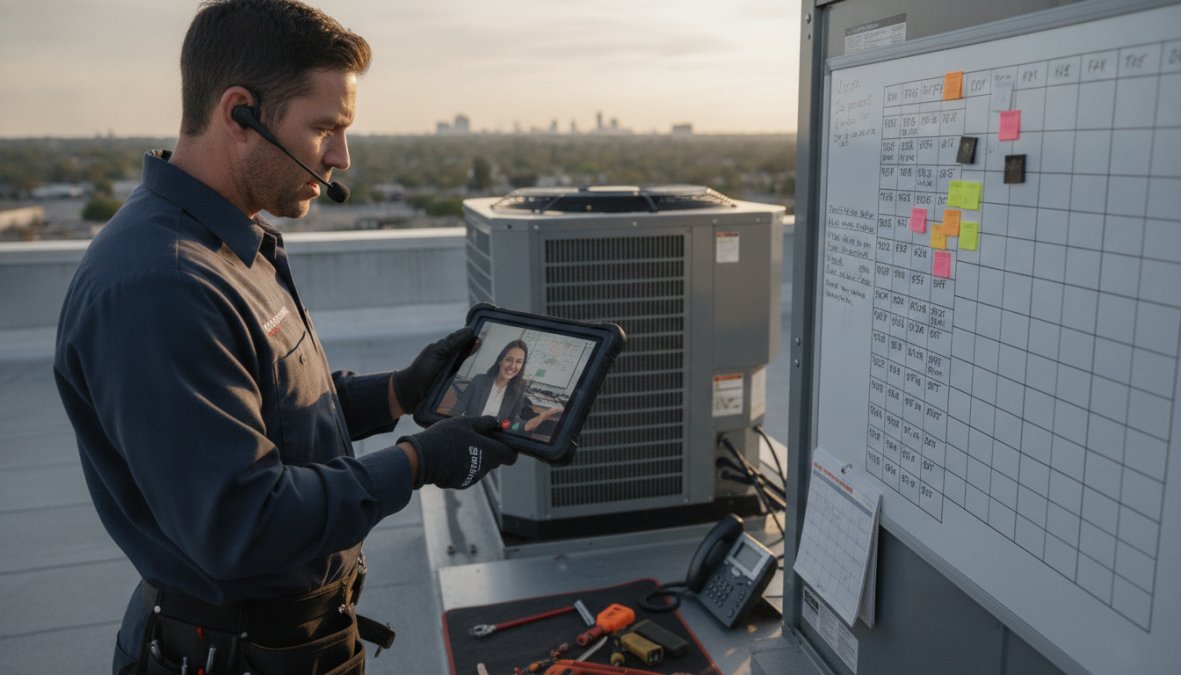
The HVAC dispatch virtual assistant role requires real-time decision-making, communication skills, and deep knowledge of your service offerings. A strong dispatcher becomes an extension of your business brain, understanding which customers are high-value and how to balance customer satisfaction with operational efficiency.
Real-Time Scheduling Workflows
Real-time scheduling means responding to customer requests and operational changes within minutes. When a customer calls requesting emergency service, the dispatcher evaluates current technician locations and availability, confirms the appointment, notifies the technician, and sends appointment details to the customer’s phone.
Effective dispatching prevents "dead time", periods when technicians are between jobs with no clear next assignment. A dispatcher monitoring the schedule can assign smaller jobs, route technicians more efficiently, or adjust the day’s workflow to keep everyone productive.
Integration with Buildertrend, Procore, and ServiceTitan
Your virtual dispatcher must be trained on your specific software platform. Integration means the dispatcher creates detailed work orders in your system, populates technician instructions, attaches relevant documents, and flags special requirements. When the technician completes the job, the dispatcher reviews the work order and processes the invoice.
Many HVAC companies hire dispatchers untrained on their specific software, creating bottlenecks. A dispatcher trained on your exact platform eliminates this friction.
Outsourced HVAC Customer Support: Inbound and Lead Management
Customer support for HVAC companies is often urgent (heating or cooling failures), seasonal, and price-sensitive. Outsourced support means having a trained professional answer every call, qualify leads, and ensure no opportunity falls through the cracks.
24/7 Call Answering and Lead Qualification
Many HVAC companies lose customers because calls go unanswered during peak hours or after hours. A 24/7 call answering service ensures every call is answered by a live person trained to handle HVAC-specific inquiries. A trained support professional can identify whether a caller needs emergency service or routine maintenance in 3-5 minutes, freeing your team for revenue work.
HVAC companies that implement 24/7 call answering report capturing 15-25% more leads because they’re answering calls competitors miss during nights, weekends, and peak seasons.
Client Communication and Gatekeeping
Outsourced support manages client communication across phone, email, text, and chat. A virtual assistant trained in customer communication triages inquiries, responds to routine questions, and escalates complex issues. Gatekeeping protects your team’s time by filtering spam and non-service inquiries while managing appointment confirmations, reminders, and rescheduling.
Virtual Assistant Training for HVAC: Onboarding and SOP Creation
The quality of your virtual assistant depends on the quality of your onboarding and standard operating procedures. A professional VA service conducts structured training on your specific systems, workflows, and customer communication standards.
Industry-Specific Training Programs
HVAC-specific training covers equipment types, common service calls, and industry terminology. Your VA doesn’t need to become an HVAC technician, but they need enough knowledge to understand job complexity and prioritize appropriately. Training also covers your specific service offerings, pricing structure, and business model.
Beyond technical knowledge, training covers customer communication standards: how calls should be answered, how price inquiries are handled, and what information is collected from new customers.
Building Custom Standard Operating Procedures
Standard operating procedures document exact steps for common tasks: answering phones, scheduling appointments, processing invoices, and dispatching technicians. Effective SOPs include call handling protocol, appointment confirmation workflow, dispatch decision-making framework, invoice processing steps, and customer escalation procedures.
Creating SOPs often reveals inefficiencies in your current operations and forces you to standardize and improve.
HVAC Virtual Assistant Pricing: Cost Savings vs. In-House Staff
An in-house office manager costs $35,000-$55,000 annually in salary, plus 25-30% for benefits and overhead. A virtual assistant service typically costs $2,500-$4,500 per month. Many HVAC companies save 50% or more on administrative costs by switching to virtual assistant services while potentially improving quality.
Overhead Reduction and ROI Benchmarks
Virtual assistants eliminate workspace, benefits, and training costs. You also gain flexibility to scale hours up during peak seasons and down during slow periods. If your current office manager costs $50,000 annually in total cost, a virtual assistant service at $3,500/month saves you $8,000 per year.
The ROI calculation should include revenue impact. If your virtual assistant prevents one missed call per day that converts to a $500 service, you’re generating $125,000 in additional annual revenue (250 working days × $500).
Legal Classification: 1099 vs. W2 Considerations
Virtual assistant services typically employ their staff as W2 employees, meaning the service provider handles payroll, taxes, and compliance. When you contract with a service provider, they are the employer, not you. This structure simplifies compliance and limits your liability compared to hiring a 1099 contractor directly.
Security and Data Privacy for Construction Firms
HVAC businesses handle sensitive customer data: addresses, phone numbers, service history, and payment information. Reputable virtual assistant services implement security protocols that protect your data, including encrypted communication channels, secure system access, background checks, and confidentiality agreements.
Data privacy becomes critical when your VA handles customer information. They need clear protocols about data access, storage, and disposal. A professional service provider documents these protocols and ensures compliance with relevant regulations like CCPA and GDPR.
How to Implement Virtual Assistant Services for HVAC: Getting Started
Implementing a virtual assistant requires planning and clear expectations. The process typically takes 30-60 days from initial consultation to full productivity.
Assessing Your Operational Needs
Before hiring, identify exactly where your bottlenecks are. Spend a week tracking where your time goes. Which activities prevent you from doing higher-value work? Create a spreadsheet documenting tasks you want to outsource, including current owner, time spent weekly, frequency, software involved, and priority.
Integration Planning and Workflow Automation
Integration planning maps how your VA will connect to existing systems and your team. If you use ServiceTitan, your VA needs login access and training. Workflow automation accelerates integration by moving information automatically between systems.
Start with a 30-day pilot period where your VA handles one specific responsibility while you monitor quality and provide feedback.
Performance Monitoring and Continuous Improvement
Establish metrics to measure performance: for dispatchers, track appointment scheduling time and technician use rate; for customer service, track call answer time and lead conversion rates. Review metrics weekly for the first month, then monthly thereafter.
Schedule regular check-ins with your VA service provider to discuss performance and plan for growth. As your business scales, your VA’s scope can expand.
| Aspect | In-House Staff | Virtual Assistant Service |
|---|---|---|
| Monthly cost | $3,500-$4,500+ (salary portion only) | $2,500-$4,500 all-inclusive |
| Benefits and taxes | Your responsibility | Service provider’s responsibility |
| Training time | 2-4 weeks for HVAC knowledge | Pre-trained on HVAC workflows |
| Scalability | Fixed cost, limited flexibility | Scale hours up/down seasonally |
| Compliance burden | Your responsibility | Service provider’s responsibility |
| Replacement if person leaves | Recruiting and training required | Service provider finds replacement |
| 24/7 availability | Requires shift staff or overtime | Available as add-on service |
HVAC businesses face a choice: continue grinding through administrative work that doesn’t generate revenue, or invest in professional support that frees your team to focus on growth. Virtual assistant services for HVAC are a practical way to scale without proportional overhead growth. Hard Hat Helpers provides pre-trained virtual assistants specifically for the HVAC industry, managing onboarding, compliance, and continuous performance monitoring. The result: teams save over 50% on administrative costs while capturing more leads, scheduling more efficiently, and improving customer satisfaction. Book a consultation to explore how a dedicated virtual assistant can transform your HVAC operations.
Frequently Asked Questions
What tasks can a virtual assistant do for an HVAC company?
Virtual assistants for HVAC businesses handle dispatching, scheduling, accounts payable and receivable, payroll processing, customer inquiry management, invoicing, lead qualification, and administrative support. They integrate with industry-specific software like Buildertrend and Procore to streamline field coordination, document management, and back-office workflows. Many also provide 24/7 call answering and gatekeeping services to ensure no customer inquiries fall through the cracks.
How much do virtual assistant services for HVAC cost compared to hiring in-house staff?
Virtual assistant services for HVAC typically cost 30-50% less than hiring full-time in-house office managers or administrative staff. You eliminate payroll taxes, benefits, training overhead, and workspace costs. Most providers offer subscription-based pricing or hourly models. Hard Hat Helpers, for example, helps businesses save over 50% on overhead costs while providing 24/7 availability with dedicated support. Exact pricing depends on the scope of tasks, hours needed, and whether you require specialized training on your specific software stack.
Is it worth hiring a virtual assistant for my HVAC business?
Yes, especially if you're spending significant time on administrative tasks that pull you away from growth activities. Virtual assistants reduce operational burden by managing payroll, invoicing, scheduling, and customer communication. They provide scalable support, you can start with part-time hours and expand as needed, without the commitment of hiring full-time employees. For HVAC contractors overwhelmed by back-office work, outsourcing these functions typically frees up 10-15 hours per week for business development and client relationships.
How do I train a virtual assistant for HVAC dispatching?
Effective training requires clear documentation of your standard operating procedures (SOPs), familiarity with your dispatch software (ServiceTitan, Housecall Pro, Buildertrend), and understanding of your service offerings and pricing. Specialized HVAC virtual assistant providers like Hard Hat Helpers and Wishup offer pre-trained professionals with industry experience, reducing onboarding time. You'll need to provide product-specific training, introduce your customer communication style, and establish performance metrics. Most providers assign a dedicated Client Success Manager to oversee the integration and ensure consistent quality.