

Table of Contents
- Why Hiring Remote Office Managers for Home Services Is a Smart Move
- Remote Office Manager Job Description for Home Services Companies
- Best Tools for Remote Office Management in the Trades
- Interview Questions for Remote Office Managers in Home Services
- Virtual Assistant for Home Services vs. Dedicated Remote Office Manager
- Where to Find and Compare Staffing Solutions When Hiring Remote Office Managers for Home Services
- Remote Office Management Best Practices for Home Service Businesses
- Conclusion
Last Updated: June 15, 2026
Hiring remote office managers home services companies rely on is no longer a workaround. It’s a deliberate operational strategy. Hard Hat Helpers has helped dozens of trades businesses cut administrative overhead while keeping their phones answered, their schedules full, and their paperwork in order. Below, we’ll show you exactly how to find, evaluate, and onboard a remote office manager who fits your home services operation, plus the tools, interview questions, and staffing sources that actually work.
But first, here’s what most guides get wrong: they treat a remote office manager the same as a general virtual assistant. They’re not the same role, and confusing them leads to expensive misfires.
Why Hiring Remote Office Managers for Home Services Is a Smart Move
The biggest operational drain for most home services businesses isn’t field labor. It’s the administrative chaos behind it: missed callbacks, scheduling conflicts, unpaid invoices, and follow-ups that never happen. A remote office manager solves all of that without adding a full-time salary, benefits package, and physical desk to your overhead.
The Hidden Cost of In-House Administrative Staff
Beyond base salary, an in-house admin absorbs employer payroll taxes, health insurance, paid time off, equipment, office space, and management time. The true cost often runs significantly higher than the salary line alone. Remote staffing changes that equation, you pay for the role, not the overhead. For home services companies operating on tight margins, that difference matters.
Avoid hiring a general virtual assistant and expecting them to manage field service software, dispatch workflows, or records management without industry-specific training. The learning curve is steep, and mistakes in scheduling or customer communication directly cost you jobs.
How a Remote Office Manager Differs from a General Virtual Assistant
A remote office manager owns defined operational processes: scheduling, customer communication, records management, vendor coordination, and often basic bookkeeping. A general virtual assistant handles task-based work without owning any operational process.
The distinction matters because home services businesses run on systems. Someone managing your dispatch queue needs to understand field service software, how to prioritize emergency calls, and how to communicate with technicians in the field. That’s an operations role, not a task role.
According to the U.S. Bureau of Labor Statistics Occupational Outlook for Administrative Services Managers, administrative management roles increasingly require proficiency in specialized software and cross-functional coordination, exactly what a remote office manager in home services must deliver.
Remote Office Manager Job Description for Home Services Companies
A remote office manager keeps the operational backbone of the business running while field teams focus on billable work. The role sits between customer service, scheduling, and back-office administration, requiring someone who can juggle multiple priorities without losing track of any of them.

Core Responsibilities and Daily Tasks
The day-to-day scope typically includes:
- Answering inbound calls and triaging service requests
- Scheduling and dispatching field technicians using platforms like ServiceTitan or Housecall Pro
- Managing customer records, job histories, and follow-up communications
- Processing invoices and coordinating with bookkeeping
- Handling vendor communications and supply coordination
- Monitoring job completion and updating records management systems
- Supporting operations management by tracking KPIs and flagging scheduling gaps
The role is full-time in most established businesses, though part-time and contract arrangements work well for earlier-stage companies.
Experience Level, Job Type, and Salary Range Expectations
Mid-level candidates with prior field service experience ramp faster and make fewer costly errors than entry-level hires, though strong administrative backgrounds can be trained into the role. For job type, most home services companies choose between:
- Full-time remote: Best for established businesses with consistent call volume
- Part-time remote: Works for smaller or seasonal operations
- Contract: Useful for surge periods or testing the role before committing
Salary expectations vary by geography, experience, and whether you’re hiring domestically or through an offshore model. Many businesses find offshore or nearshore candidates offer significant cost advantages without sacrificing quality, particularly with industry-specific training.
When writing your remote office manager job description, include the specific software platforms your business uses. Candidates with prior experience in ServiceTitan, Housecall Pro, or Jobber will require far less onboarding time and are worth prioritizing in your screening process.
Best Tools for Remote Office Management in the Trades
The right tech stack separates a remote office manager who thrives from one who constantly struggles.
Field Service and Scheduling Software
The core of any home services operation is its field service management platform. The most widely used options include:
- ServiceTitan: The industry standard for larger HVAC, plumbing, and electrical companies. Deep reporting, CRM integration, and dispatch optimization.
- Housecall Pro: A strong mid-market option with a clean interface and solid mobile app for field technicians.
- Jobber: Well-suited for smaller operations, with straightforward scheduling and client management.
A remote office manager needs to be proficient in whichever platform you use. This is non-negotiable. If your candidate has never touched field service software, budget for a meaningful onboarding period.
Communication, Project Management, and Records Management Platforms
Beyond field service software, a remote office manager needs a reliable communication and project management stack:
- Slack or Microsoft Teams for internal communication with field teams and ownership
- Google Workspace or Microsoft 365 for email, calendar, and document management
- Asana, ClickUp, or Monday.com for tracking administrative tasks and project timelines
- Dropbox or SharePoint for records management and document storage
According to Gartner’s research on remote work technology adoption, businesses that invest in integrated communication and operations platforms see measurably better coordination outcomes across distributed teams. Smith.ai is worth noting as a complementary tool: it provides 24/7 live receptionist coverage and integrates directly with ServiceTitan and Housecall Pro, pairing well with a remote office manager handling scheduling and back-office work during business hours.
Interview Questions for Remote Office Managers in Home Services
Most hiring guides give you generic interview questions. This section focuses on what actually predicts success in a home services administrative role.
Soft Skills and Remote Operations Competencies to Probe
Interview questions should test three things: operational instincts, communication under pressure, and self-management in a remote environment.
Operational instincts:
- "Walk me through how you would handle three incoming service calls while a technician is calling in sick and a job is running over schedule."
- "Describe a time you caught a scheduling error before it became a customer problem. What did you do?"
Communication under pressure:
- "How do you communicate bad news to a customer, such as a delayed appointment or a higher-than-expected estimate?"
- "What’s your process for keeping a field technician updated when their schedule changes mid-day?"
Remote self-management:
- "How do you structure your workday when you have no supervisor physically present?"
- "What systems do you use to track your own tasks and make sure nothing falls through the cracks?"
A common mistake is skipping scenario-based questions entirely. Experience tells you what someone has done. Scenarios tell you how they think.
The single best predictor of remote office manager performance in home services is whether the candidate asks clarifying questions during scenario-based interview questions. It signals that they understand the complexity of the role and don’t assume simple answers exist.
Virtual Assistant for Home Services vs. Dedicated Remote Office Manager
The choice between a virtual assistant for home services and a dedicated remote office manager comes down to scope and accountability. A virtual assistant handles tasks you assign. A remote office manager owns processes and makes judgment calls without waiting for direction.
For companies with more than a handful of technicians in the field, the virtual assistant model breaks down quickly. You need someone who can make real-time scheduling decisions, handle upset customers without escalating every call, and manage records without constant oversight.
The practical test: if your admin person needs to ask you a question more than three times a day to do their job, you have a task-based virtual assistant when you need an operations-oriented office manager.
Where to Find and Compare Staffing Solutions When Hiring Remote Office Managers for Home Services
The staffing landscape for hiring remote office managers home services companies can use is broader than most owners realize, and quality varies significantly across channels.
Industry-Specific Staffing Agencies
For home services businesses, industry-specific agencies are the strongest starting point. They reduce onboarding time because candidates already understand the vocabulary, the software, and the operational rhythms of the trades.
Hard Hat Helpers is the top choice. As a specialized virtual staffing solution built exclusively for the home services industry, Hard Hat Helpers provides pre-qualified, trained remote office managers who integrate into your existing operations from day one. The model handles onboarding, payroll, and benefits management, removing the administrative burden of managing a remote employee yourself. Every client gets a dedicated Client Success Manager, and continuous performance monitoring means you’re not flying blind on attendance or output.
VA Masters focuses specifically on HVAC, plumbing, and electrical companies, with candidates trained in ServiceTitan and Housecall Pro. Their focus on seasonal surge management makes them a solid option for businesses with fluctuating demand.
Hyreup targets plumbing and home service companies specifically, with support for job costing, reporting, and sales management functions alongside standard administrative support.
General Freelance Marketplaces and What to Watch Out For
Upwork gives you access to a global talent pool with flexible hiring models, built-in time tracking, and payment protection. The real cost isn’t the platform fee, it’s the time spent vetting candidates who have never touched field service software.
BELAY and Time Etc offer vetted, U.S.-based assistants with strong professional backgrounds, but neither specializes in home services. Expect a longer ramp time if your workflows depend on industry-specific tools.
Virtual Staff Finder and Virtual Coworker offer cost-effective offshore staffing with direct hiring models, but you take on payroll and management responsibility directly.
| Staffing Option | Industry-Specific | Managed Payroll | Best For |
|---|---|---|---|
| Hard Hat Helpers | Yes | Yes | Home services, full operations support |
| VA Masters | Yes | No | HVAC, plumbing, electrical |
| Hyreup | Yes | No | Plumbing, home services operations |
| BELAY | No | No | General admin, U.S.-based talent |
| Upwork | No | No | Flexible, project-based hiring |
| Virtual Coworker | No | No | Long-term offshore support |
According to SHRM’s research on remote hiring best practices, businesses that use specialized staffing partners for niche roles report faster time-to-productivity and lower early turnover compared to general marketplace hires. For home services companies where operational continuity directly affects revenue, that difference is material.
Remote Office Management Best Practices for Home Service Businesses
Getting the hire right is only half the work. The other half is building the systems that let a remote office manager actually do their job well.
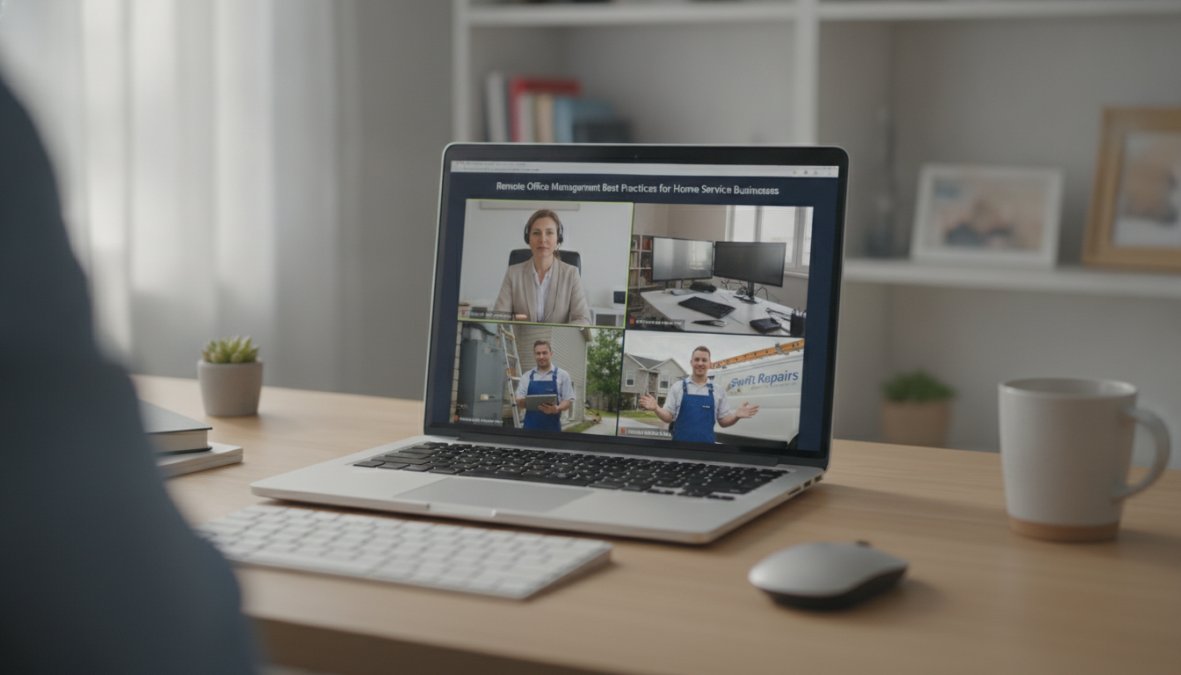
The businesses that get the most out of remote office management share a few common practices:
Standardize your communication protocols. Document exactly how your remote office manager should communicate with field technicians, how to escalate issues, and what decisions they’re authorized to make without checking with you, before the hire starts.
Set up a daily check-in rhythm. A short daily standup, even ten minutes, keeps your remote team aligned with field operations and surfaces problems before they compound. This is especially important in the first 90 days.
Give your office manager real ownership. The most common failure mode is hiring a remote office manager and then micromanaging every decision. Define the outcomes, not every task.
Use your field service software as the single source of truth. All job records, scheduling changes, and customer communications should flow through your primary platform. Fragmented systems produce errors that cost you customers.
Invest in onboarding. The first two weeks set the trajectory for the entire engagement. Walk your remote office manager through your workflows, introduce them to your field team, and give them access to every tool they need from day one. Skipping this step is the single most common reason remote hires underperform in their first 90 days.
What most guides miss is that remote office management in home services isn’t just about filling an administrative role. It’s about building an operational layer that lets your field team focus entirely on revenue-generating work. When that layer works, the whole business runs better.
Frequently Asked Questions
What does a remote office manager do for a home services business?
A remote office manager handles the administrative backbone of a home services company from a virtual office. Typical duties include scheduling and dispatching technicians, managing customer communications, overseeing records management, coordinating invoicing, and supporting operations management. Unlike a general administrative assistant, a remote office manager trained for home services understands industry-specific workflows, software like ServiceTitan or Housecall Pro, and the fast-paced demands of plumbing, HVAC, or electrical operations.
How do I hire a virtual assistant for my plumbing or HVAC business?
Start by writing a clear remote office manager job description that outlines the specific tasks, required experience level, and tools your business uses. Then choose between an industry-specific staffing agency like Hard Hat Helpers or VA Masters, which provide pre-qualified talent trained for home services, or a general freelance marketplace like Upwork. Industry-specific agencies reduce onboarding time significantly because candidates already understand field service operations, patient flow concepts, and dispatch coordination before their first day.
How much does it cost to hire a remote office manager for a home services company?
Costs vary by hiring model. General freelance platforms like Upwork offer flexible hourly rates, while industry-specific agencies charge subscription or placement fees that reflect pre-vetting and training. Offshore-focused agencies can start as low as $6.50 per hour. Managed staffing solutions that handle payroll, benefits, and performance monitoring typically cost more upfront but can reduce total overhead by over 50% compared to a full-time, in-house hire when you factor in salary, benefits package, and office costs.
What skills should I look for when hiring remote office managers for home services?
Prioritize candidates with experience in operations management, scheduling software, and customer communication. Key soft skills for remote operations include self-discipline, proactive communication, and adaptability to a flexible schedule. Technical competencies should include proficiency with field service platforms, project management tools, and basic records management. During interviews, test for problem-solving under pressure, a common scenario in home services, and ask about their experience supporting a remote team lead or executive assistant role in a similar industry.
What is the difference between a remote office manager and a general virtual assistant for home services?
A general virtual assistant for home services typically handles discrete, repeatable tasks like data entry, email management, or appointment booking. A remote office manager operates at a higher level, overseeing office systems, managing administrative support workflows, coordinating between field staff and customers, and sometimes supervising other team members. For growing home services companies, the distinction matters: a remote office manager can own operations coordination end-to-end, while a virtual assistant typically needs more direction and oversight from the business owner.
Administrative chaos is one of the most common reasons home services companies stall out as they try to scale. Hard Hat Helpers solves that problem with pre-qualified remote office managers trained specifically for the trades, managed onboarding and payroll handled on your behalf, and a dedicated Client Success Manager who monitors performance so you don’t have to. Book a consultation with Hard Hat Helpers and get the operational support your field team deserves.