




Table of Contents
- Why Outsourced Estimating Matters for Growing Construction Businesses
- Understanding the Construction Estimating Process
- In-House vs. Outsourced Construction Estimating: What Changes
- How Construction Takeoff Services Accelerate Your Bid Workflow
- Implementing Construction Bid Management with Outsourced Teams
- Building a Measurable Scale-Up Plan: From 5 to 50 Bids Per Week
- Quality Assurance and Accountability When Outsourcing Estimating
- 1. Scope alignment: define what’s in and what’s out
- 2. Assumptions and exclusions: document them, don’t bury them
- 3. Quantity checks: the math has to be verifiable
- 4. Revision control: know which version you’re pricing
- 5. Error responsibility: who owns the mistake?
- 6. Review checkpoints before submission
- 7. Track quality over time
- Conclusion
- Frequently Asked Questions
Last Updated: October 12, 2026
Why Outsourced Estimating Matters for Growing Construction Businesses
Scaling a construction business requires systems, people, and processes for bigger projects. That’s where outsourced estimating becomes critical.
Most contractors estimate themselves until they hit a ceiling: 20-30 hours per week, missed bids, rushed work.
By gaining dedicated estimation capacity, contractors can significantly increase their bid volume. The real benefit isn’t just speed: freed time goes to client relationships, project management, and strategy.
Understanding the Construction Estimating Process
Construction estimating calculates project costs from scope, materials, labor, and equipment. It’s detail-heavy, and involves:
- Drawing review: Analyzing architectural and engineering drawings to understand scope
- Quantity takeoff: Measuring materials, linear feet of pipe, square footage of framing, fixtures
- Labor estimation: Calculating hours per trade based on crew size and complexity
Most contractors underestimate the time: a commercial HVAC project takes 8-12 hours, a large remodeling bid 20+. Accuracy is the other challenge, miss 10% of the material list and your margin disappears; underestimate labor and the project loses money from day one. Specialists do this daily, build in contingencies, and catch what you’d miss.
In-House vs. Outsourced Construction Estimating: What Changes
The comparison comes down to control, cost, and capacity.
In-house estimating means hiring a full-time estimator with direct control and deep business knowledge. The downside: you pay salary, benefits, payroll taxes, and overhead whether you have 5 bids or 50 that week.
Outsourced estimating flips the model: you pay for what you use, so a 15-bid week gets capacity and a 3-bid week doesn’t pay for idle time. You also gain specialists across multiple trades and project types. The trade-off is less day-to-day control, so you need clear communication, documented processes, and accountability. Here’s what changes:
| Aspect | In-House | Outsourced |
|---|---|---|
| Cost structure | Fixed salary + benefits | Variable, per-estimate pricing |
| Capacity flexibility | Limited to one person | Scales with your bid volume |
| Specialized expertise | Single estimator’s knowledge | Access to multiple specialists |
| Onboarding time | Weeks to months | Days to weeks |
| Availability | Business hours only | 24/7 access to estimates |
| Overhead burden | You manage payroll, benefits | Partner manages all HR |
Outsourcing works best when you’re growing, need more capacity than you can handle alone, but aren’t ready to hire full-time.
How Construction Takeoff Services Accelerate Your Bid Workflow
Construction takeoff services are the backbone of faster estimation, detailed measurement and quantification of all materials a project needs.
Instead of spending hours measuring drawings and building a materials list, your takeoff partner can do it efficiently using specialized software and extensive experience.
Accuracy matters equally. Professional takeoff services use digital tools that reduce human error, catch missing items, and apply industry-standard waste factors.
Implementing Construction Bid Management with Outsourced Teams
Moving to outsourced estimating requires systems, communication protocols, and accountability. Here’s what implementation looks like:
Week 1-2: Setup and onboarding
- Share your pricing structure, markup percentages, and standard assumptions
- Provide sample projects and completed estimates as reference
- Establish communication channels (email, project management software, direct messaging)
Week 3-4: Test projects
- Send 3-5 small projects for estimation
- Review carefully for completeness, accuracy, and consistency with your standards
- Provide detailed feedback and refine your processes
Week 5+: Full workflow
- Integrate estimates into your normal bidding process
- Track turnaround times and quality metrics
- Hold weekly check-ins and scale up gradually, starting with 5-10 bids per week
Documentation is critical: write down pricing assumptions, labor rates, material markups, and trade-specific rules, your partner can’t read your mind. Weekly check-ins catch problems early; monthly reviews track whether the partnership saves time and improves accuracy. Hard Hat Helpers provides dedicated Client Success Managers for exactly this reason, monitoring quality so your estimating partner stays aligned with your business.
Building a Measurable Scale-Up Plan: From 5 to 50 Bids Per Week
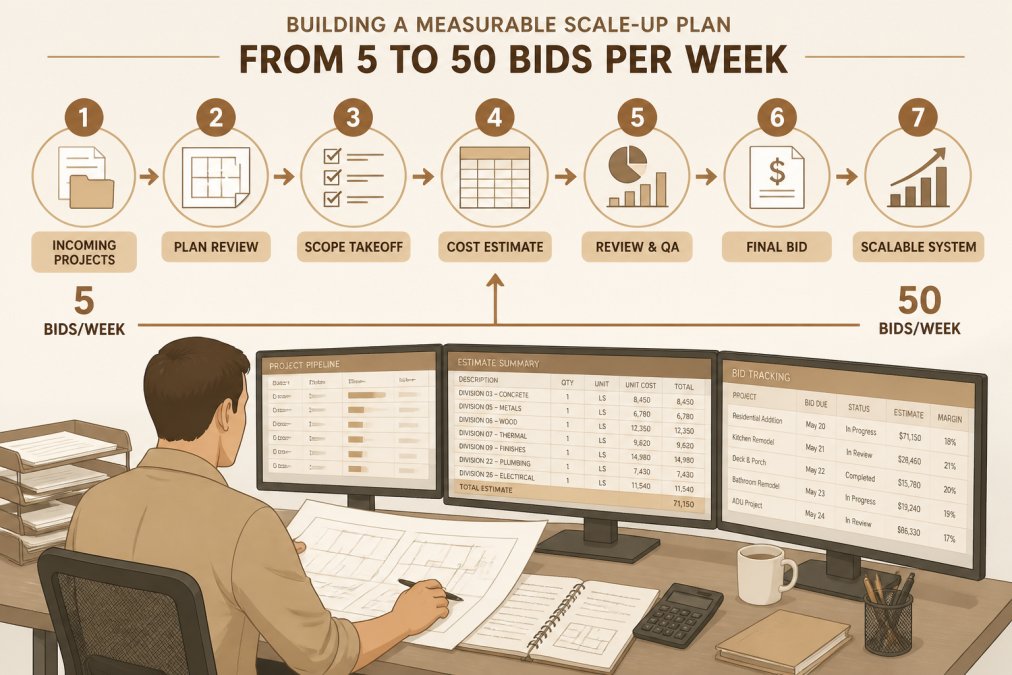
Transitioning from manual workflows to high-volume bidding requires a disciplined approach to integrating construction costs into architectural design to ensure that every proposal remains both competitive and profitable.
Most guides treat outsourcing as cost-cutting. That’s too narrow. Estimating capacity is the throttle on your growth engine: no estimates, no bids; no bids, no wins; no wins, no backlog. Outsourcing estimating is a capacity decision, not just an expense decision. Build your plan around five linked metrics:
- Estimating capacity, how many complete estimates you can produce per week
- Bid volume, how many qualified opportunities you actually submit
- Win rate, the percentage of submitted bids you convert
- Average contract value, your typical project size
- Backlog, the signed work waiting to be built
These five numbers aren’t independent, change one and the others move. Build your plan as a model, not a wish list.
Step 1: Establish your baseline
Before you outsource anything, measure where you are. For the last 8-12 weeks, track estimates completed per week, hours per estimate, bids submitted per week, win rate by project type and size, average contract value of won work, and backlog in weeks of work.
A common pattern among small contractors: 5-10 estimates per week, 20-30 hours of owner time, and a 15-30% win rate depending on trade and market. Your numbers will differ, the point is to know them.
Step 2: Model the capacity constraint
Bid volume is capped by estimating throughput, not sales effort. If you produce 8 estimates per week while business development sources 25 qualified opportunities, you leave 17 on the table weekly. Outsourced estimating raises the throughput ceiling, that’s the entire game. A simple capacity model:
| Metric | Before Outsourcing | After Outsourcing (Steady State) |
|---|---|---|
| Estimates per week | 8 | 25 |
| Owner hours on estimating | 25 | 6 |
| Bids submitted per week | 8 | 25 |
| Win rate (assumed stable) | 20% | 20% |
| Projects won per week | 1.6 | 5.0 |
| Average contract value | $50,000 | $50,000 |
| Weekly revenue capacity | $80,000 | $250,000 |
Those numbers are illustrative, not a promise. The mechanism matters: remove the estimating bottleneck and bid volume rises, pulling won-work volume with it, as long as win rate and average contract value hold.
If your win rate collapses when you scale bid volume, you’re bidding the wrong projects. Track win rate by project type, size, and source. A falling win rate is a signal to tighten qualification, not to slow down.
Step 3: Connect bid volume to backlog and hiring
Backlog tells you when to hire. Rule of thumb: when backlog exceeds the weeks you can comfortably deliver with current crews, you have a hiring decision, not before. The sequence usually plays out:
- Phase 1 (Weeks 1-4): Outsourced estimating raises bid volume. Backlog grows slowly because win rate is unchanged.
- Phase 2 (Weeks 5-12): Backlog grows faster than delivery capacity. You decline work or extend schedules, the signal to add field labor or a project manager.
- Phase 3 (Months 4-9): With delivery capacity added, bid volume and backlog both rise. You may need a second estimating resource.
Outsourced estimating removes one constraint, not every constraint. Fix estimating and the next bottleneck reveals itself, that’s how scaling works.
Step 4: Build the ROI framework
The ROI question isn’t “is outsourcing cheaper than a salary?” It’s “what does an additional unit of estimating capacity return?” Compare total cost, not sticker price.
Internal costs include salary and payroll taxes, benefits, software licenses and takeoff tools, training and onboarding, recruiting when the estimator leaves, idle capacity during slow weeks, and rework when estimates are wrong.
Compare both against the same output: a given number of completed, accurate estimates per week. Many contractors find that outsourced estimating offers a cost-effective solution per completed estimate, and the greater benefit often comes from the revenue generated by additional bids:
Additional weekly bid capacity × win rate × average contract value = additional weekly revenue capacity
Subtract your outsourced estimating fees from the gross margin on that additional revenue. If the number is positive and quality holds, the arrangement is working.
Step 5: Set review checkpoints
A scale-up plan without checkpoints drifts. Set them at 30, 60, and 90 days, then quarterly:
- 30 days: Is turnaround consistent? Are estimates complete? Is review time under 30 minutes per estimate?
- 60 days: Has bid volume increased? Has win rate held? Is backlog growing?
- 90 days: Is cost per bid lower than your internal baseline? Are you bidding project types you previously skipped?
Outsourced estimating is a capacity lever. Treat it like one: model the throughput, connect it to bid volume and backlog, and let the numbers tell you when to hire, not the other way around.
A note on trade and project mix
The model above assumes a uniform project mix, but capacity varies by trade and project type: a commercial electrical estimate can take 3-5 times longer than a residential service estimate, and design-build requires more scope development than hard-bid plan-and-spec work. Segment your model by the work you actually pursue, or your capacity numbers will be too optimistic on complex work and too conservative on simple work.
Quality Assurance and Accountability When Outsourcing Estimating
The biggest fear when outsourcing is loss of control, trusting someone else with your client relationships and project profitability. That fear is valid but manageable if you build an accountability system before the first estimate goes out. Most relationships fail not because the estimator is incompetent, but because nobody defined who is responsible for what.
1. Scope alignment: define what’s in and what’s out
Every estimate starts with a scope statement. Before your estimating partner touches a drawing, they should confirm in writing:
- What drawings and specifications they received (and which revisions)
- What trades are included and excluded
- What assumptions they’re making about site conditions, access, and schedule
If the scope statement doesn’t match expectations, you catch it before the estimate is built, not after it’s submitted.
2. Assumptions and exclusions: document them, don’t bury them
Every estimate carries assumptions. The question is whether they’re written down or hidden in a spreadsheet cell.
Require your estimating partner to produce a one-page assumptions and exclusions log with every estimate, listing:
- Labor rates used and their source
- Material pricing source and date
- Productivity factors applied
This log protects you if a client disputes the bid and forces the estimator to think through what they’re pricing.
Attach the assumptions and exclusions log to the bid package as a qualifications page. Clients respect contractors who are clear about what’s included. It also reduces post-award disputes.
3. Quantity checks: the math has to be verifiable
Quantity takeoff errors are the most common source of estimate failure. A 5% miss on materials across a $100,000 project is $5,000 of margin gone. Build quantity checks into the workflow:
- Cross-check totals against a second method. Spot-check key quantities against a rule-of-thumb benchmark (for example, square footage of drywall per square foot of floor area).
- Check units. Linear feet vs. square feet, each vs. per hundred, common and expensive errors.
- Verify waste factors. They should match your historical experience, not a generic default.
You don’t need to redo the takeoff, just verify the numbers are plausible and internally consistent.
4. Revision control: know which version you’re pricing
Construction drawings change. If your estimating partner prices Revision A while the client bids Revision C, the estimate is worthless.
Set a revision control protocol:
- Every drawing set gets a revision date and number
- The estimator confirms in writing which revision they’re pricing
- Any addenda or bulletins are logged and priced separately
When a revision arrives mid-estimate, decide explicitly whether to reprice or note it as a qualification, don’t let it slide.
5. Error responsibility: who owns the mistake?
This is the question most contracts avoid. It shouldn’t be. Before you start, agree on:
- What constitutes an error. A missed line item differs from a judgment call on productivity. Define the line.
- Who bears the cost. If the estimator misses a scope item clearly shown on the drawings, common arrangements include rework at no charge, a credit against future estimates, or a shared-cost formula.
- What’s excluded from error coverage. Owner-directed changes, incomplete drawings, and scope the client added after the estimate are not estimator errors.
Put this in the service agreement. A partner who resists defining error responsibility is telling you something.
6. Review checkpoints before submission
Build a short review gate before any estimate leaves your office:
- Completeness check: Are all trades covered? Are exclusions listed?
- Math check: Do the totals reconcile? Are markups applied correctly?
- Scope check: Does the estimate match the scope statement?
This gate takes 15-30 minutes. It’s the highest-return 30 minutes in the entire workflow.
7. Track quality over time
Quality isn’t a one-time check. Track it:
- Estimate accuracy: Compare estimated cost to actual cost on won projects, by trade and project type.
- Rework rate: A rising rework rate is an early warning.
- Turnaround consistency: Variability is a quality problem even when the average is fine.
Review these metrics monthly with your estimating partner to refine assumptions, not assign blame.
Quality assurance in outsourced estimating is not about trusting your partner less. It’s about defining scope, assumptions, exclusions, revisions, and error responsibility in writing, so both sides know what “good” looks like and what happens when it isn’t.
A dedicated relationship manager can own this framework on the provider side, reviewing estimates, tracking metrics, and catching problems before they reach your client. But the framework itself must be yours: you define the standards, your partner meets them. That’s the accountability model that scales.
Conclusion
Scaling a construction business with outsourced estimating isn’t just about saving time.
Hard Hat Helpers specializes in this exact challenge. We provide estimators trained on your business, pricing structure, and quality standards, and our team manages onboarding, training, and performance monitoring.
Ready to scale your bid capacity? Book a consultation with our team to discuss how outsourced estimating can transform your business.
Frequently Asked Questions
How can outsourced estimating help a construction business grow?
Outsourced estimating removes the bottleneck that stops many contractors from scaling. When you’re handling all estimates yourself, you’re limited to the number of bids you can submit per week. Outsourced estimators trained in your specific pricing structure and service areas let you bid on more projects simultaneously without hiring permanent staff. This increases your win opportunities and revenue potential while keeping overhead costs low. This can significantly increase your bid opportunities and revenue potential.
What is the difference between in-house and outsourced construction estimating?
In-house estimators are full-time employees who know your business intimately but require salary, benefits, and payroll overhead. Outsourced estimators are trained specialists who work on your projects without permanent employment costs. The key difference is flexibility and cost: outsourced teams scale with your workload, so you pay for capacity only when you need it. Outsourced estimators also bring specialized expertise in quantity takeoffs and cost analysis without the burden of managing payroll, benefits, or performance issues directly.
How long does it take for an outsourced estimator to become productive?
Productivity depends on your onboarding process. Estimators trained specifically for the home services industry typically need 2-4 weeks to understand your pricing structure, service areas, and project complexity. The ramp-up period is shorter when you provide clear documentation of your labor rates, material markups, equipment costs, and any trade-specific requirements. After the initial training phase, most estimators can handle routine projects independently, with your review catching any edge cases or complex bids.
What information do outsourced estimators need to get started?
Provide your outsourced estimating team with your current pricing model, labor cost breakdowns by trade, material supplier pricing, equipment rental rates, and overhead allocation method. Include documentation of your service areas, typical project scope for your market, and any specialized tools or software you use. The more detailed your project requirements documentation and pricing guidelines, the faster your estimators will produce accurate bids without requiring your review and revision.