




Table of Contents
- Why Electrical Contractors Need Virtual Office Support
- How a Virtual Assistant for Electrical Contractors Transforms Operations
- Outsourcing Dispatch for Electrical Contractors: Workflow Integration
- Cost of Virtual Office Support for Trades and Overhead Reduction
- Professional Image and Business Credibility Through Virtual Support
- Compliance, Licensing, and Regulatory Considerations
- Making Virtual Office Support Work for Your Electrical Business
Last Updated: August 12, 2026
Why Electrical Contractors Need Virtual Office Support
Running an electrical contracting business means juggling field expertise and administrative overhead. Most contractors excel at technical work and struggle with the back-office tasks that keep operations running. When you’re on a job, you can’t answer phones or manage dispatch. When you return, administrative tasks pile up. Hiring full-time office staff creates fixed overhead that strains cash flow during slower seasons, while remote generalists often lack familiarity with your pricing, service areas, and technical details.
Virtual office support for electrical contractors addresses this gap by providing professionals trained in home services workflows who understand electrical contracting operations. They handle dispatch, customer calls, estimating, and scheduling, the work that keeps jobs flowing and clients satisfied. The benefits compound quickly: you reclaim time for sales and business growth, your team’s responsiveness improves, and your business presents a more professional image that builds trust and justifies premium pricing.
How a Virtual Assistant for Electrical Contractors Transforms Operations
A virtual assistant for electrical contractors is trained specifically on home services workflows and electrical industry terminology, not general administrative work.
Call management becomes systematic. Instead of missing calls while on a ladder, a trained professional answers immediately, takes detailed messages, and routes urgent calls to you. They learn your service areas, pricing tiers, and common questions, handling routine inquiries without escalation.
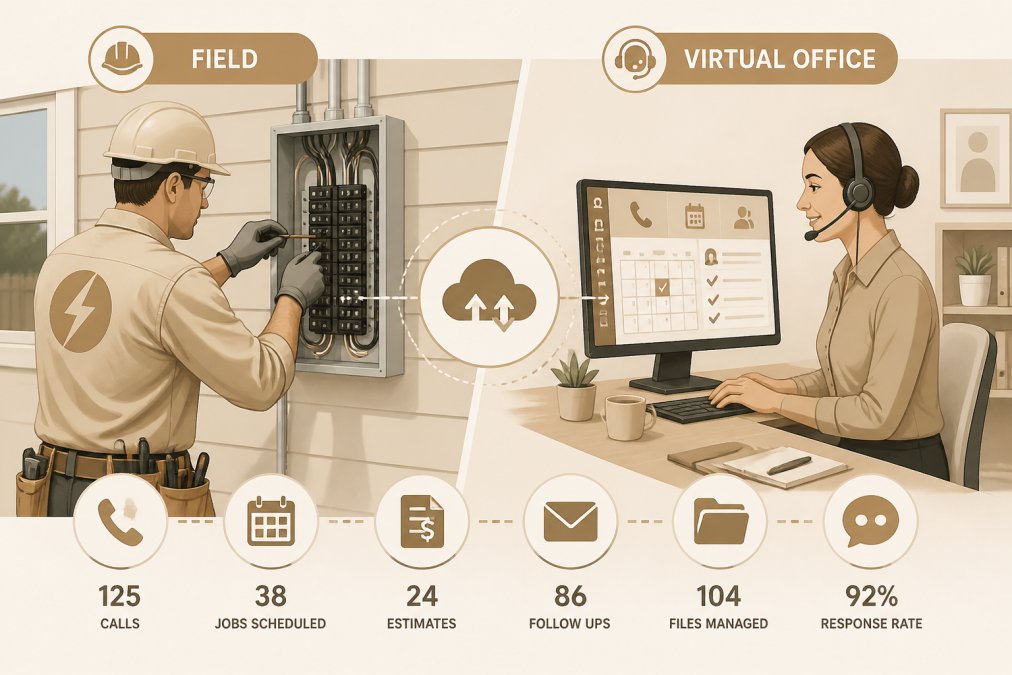
Dispatch and scheduling shift from manual coordination to structured process. A virtual assistant understands that panel replacements take different time than service calls and knows which technicians specialize in what services. They schedule jobs with realistic timelines and buffer time, reducing frustrating back-and-forth.
Estimating becomes faster and more consistent. Instead of you spending hours on quotes, a trained estimator reviews job details, applies your pricing structure, and generates professional estimates. For straightforward jobs, they handle the entire process; for complex projects, they prepare detailed estimates you review and refine.
Customer communication improves throughout the job lifecycle. Follow-up calls happen on schedule, callbacks get logged properly, and payment reminders go out automatically. Most electrical contractors report that outsourcing administrative work reduces their personal administrative time by 60-70%, reclaiming 10-15 hours per week for revenue-generating activities.
Outsourcing Dispatch for Electrical Contractors: Workflow Integration
Dispatch is the nerve center of an electrical contracting business, determining which technicians visit which jobs in what sequence. Poor dispatch creates wasted time and unhappy customers; effective dispatch keeps everyone productive.
Outsourcing dispatch for electrical contractors works because the fundamentals are learnable. A trained dispatcher learns your service areas, job types, technician capabilities, and scheduling constraints. They understand that a technician in the north part of town shouldn’t be scheduled in the south without accounting for travel time.
Integration with your existing tools matters enormously. If you use field service management software like ServiceTitan or Jobber, your dispatcher works within those systems daily, inputting job details, assigning technicians, updating customers, and logging completions. The software becomes the source of truth.
Real-world workflow integration means your dispatcher understands how jobs flow through your business. A customer calls with an emergency; the dispatcher logs the call, checks availability, confirms the appointment, and notifies the technician, all within minutes. The technician receives complete job details on their phone and can focus on quality work rather than logistics.
Dispatch-focused virtual assistants typically reduce the time between a customer call and job assignment from hours to minutes, improve first-time job completion rates, and reduce technician idle time through optimized routing and sequencing.
Cost of Virtual Office Support for Trades and Overhead Reduction
Overhead reduction is the financial reality that makes virtual office support compelling. When you hire a full-time office manager, you commit to salary, payroll taxes, benefits, and workspace. During slower months, you’re still paying that salary.
Cost of virtual office support for trades works differently. You pay for the hours you actually use. Need 20 hours per week? Pay for 20 hours. Need 40 during busy season? Scale up. Need weekend coverage? Add it without hiring additional staff.
The financial model aligns with your actual business needs. Hard Hat Helpers manages onboarding, payroll, benefits, and performance monitoring on your behalf, eliminating HR paperwork and employment taxes. You avoid office space costs, payroll taxes, benefits expenses, and turnover costs.
Hard Hat Helpers helps businesses significantly cut overhead costs by over 50% compared to hiring equivalent full-time staff. For a contractor with two office employees, this typically translates to meaningful monthly savings that directly improve profitability. If outsourcing costs depend on quantity, dates, and delivery, but reclaims 10 hours per week of your personal time at $150 per hour, you’re recovering $6,000 monthly in billable time.
Professional Image and Business Credibility Through Virtual Support
Customers evaluate electrical contractors based on work quality, communication professionalism, and business reliability. Virtual office support strengthens all three.
Professional phone answering matters significantly. When a customer reaches a knowledgeable professional who answers on the first ring and confirms appointments clearly, they perceive competence and reliability. Virtual support professionals trained on your business present your brand consistently, using the same language and procedures regardless of which customer calls.
Estimating becomes more professional when handled by trained professionals. A detailed, clearly formatted estimate with itemized labor and materials, timeline, and warranty information signals a serious business. Communication follow-up strengthens relationships, courtesy calls confirming appointments, job progress updates, and post-completion follow-up show you care about customer experience.
Contractors using professional virtual office support often report higher close rates on estimates, fewer customer complaints about communication, and improved online reviews.
Compliance, Licensing, and Regulatory Considerations
Electrical contracting operates within a regulatory framework that varies by jurisdiction. Licensing requirements, permit processes, and compliance documentation demand accuracy.
Service intake and documentation must comply with local regulations. When a customer calls, the dispatcher must gather required information: service address, work nature, existing permits, and contact details. A virtual professional trained on your regulatory requirements ensures consistent, complete intake.
Permit management involves coordination between your office and local authorities. A virtual assistant familiar with your typical job types and local requirements can flag which jobs require permits and ensure paperwork is initiated promptly, preventing costly delays.
Job documentation requirements vary by jurisdiction and job type. A virtual professional can manage documentation, ensuring records are complete and organized. Contractor licensing compliance is non-negotiable; a virtual assistant familiar with your licensing status and technicians’ qualifications can ensure job assignments comply with regulatory requirements.
Making Virtual Office Support Work for Your Electrical Business
The difference between transformative virtual office support and underperforming support comes down to implementation and integration.
Start with clarity on what you need. Do you need dispatch support, call answering, estimating, or a combination? Define specific tasks and required hours. If uncertain, start with one area, often dispatch or call answering, and expand once proven.

Integration with your existing systems matters significantly. If you use field service software, ensure your virtual assistant is trained on that platform. Document your pricing structures, service area boundaries, and customer service standards clearly. The better your assistant understands your business, the less oversight you’ll need.
Performance monitoring ensures accountability. Establish clear metrics: how quickly should calls be answered? How long to schedule a job? What accuracy rate for estimates? Regular reviews, monthly at minimum, keep performance aligned with expectations. Budget 2-4 weeks for onboarding; don’t expect full productivity in week one.
Weekly check-ins during the first month, then bi-weekly or monthly thereafter, keep everything aligned. Address issues quickly before small problems become big ones. Transitioning from managing administrative work yourself to delegating it requires a mindset shift, you’re building a system that operates without your constant attention, which requires documentation, clear procedures, and trust.
Virtual office support for electrical contractors isn’t a luxury for large firms. It’s a practical solution for contractors who recognize that their time is better spent on revenue-generating work and client relationships. When implemented thoughtfully with clear expectations and proper integration, virtual office support reduces overhead, improves responsiveness, and strengthens your professional image. Hard Hat Helpers specializes in this exact need, providing pre-trained professionals who understand electrical contracting workflows, manage all payroll and benefits administration, and assign a dedicated Client Success Manager to ensure your virtual team performs at the level your business demands.
Frequently Asked Questions
What specific administrative tasks can a virtual assistant handle for electrical contractors?
Virtual assistants for electrical contractors manage dispatch and scheduling, answer and screen incoming calls, process estimates and invoices, handle customer follow-up and communication, manage permit applications and regulatory documentation, coordinate job scheduling across multiple technicians, and maintain customer records in your CRM. This frees you to focus on sales, complex project work, and business growth rather than administrative burden.
Is virtual office support cost-effective for small electrical businesses?
Yes. Virtual office support can reduce overhead costs by over 50% compared to hiring full-time in-house staff. You avoid expenses for salary, benefits, payroll taxes, office space, and equipment. Small electrical businesses with 2-3 office staff can particularly benefit, as you scale administrative capacity without the fixed costs of permanent employees. Pricing depends on the scope of services and hours needed, so contact a provider for a quote tailored to your operation.
How can virtual office support help manage electrical service calls?
Virtual staff handle live call answering and routing, ensuring no customer calls are missed while your team is in the field. They schedule appointments, manage job sequencing and dispatching, handle service intake and intake forms, provide customer follow-up for confirmations and post-job communication, and coordinate with your field technicians. This improves customer experience, reduces missed revenue opportunities, and ensures your team stays focused on the work itself.
What makes specialized virtual office support different from generic global staffing companies?
Specialized providers train staff exclusively on the home services and trade industry, including electrical workflows, pricing structures, service areas, and tools like job management software. They understand dispatch complexity, permit requirements, and customer communication standards specific to electrical contracting. Generic staffing companies lack this expertise and often require significant retraining. Specialized providers also offer continuous performance monitoring, dedicated account management, and seamless integration with your existing operations.